How to Calculate Acceleration: The a = Δv/Δt Formula, Worked Out
a = Δv/Δt.That's the whole thing — acceleration is the change in velocity divided by the time it took to change. Every acceleration problem you'll meet in an introductory physics course comes back to this one ratio. The hard part isn't the division; it's knowing which number is Δv, keeping the signs straight, and getting the units into m/s² before you do anything else with the answer. This page takes the formula apart piece by piece, works two examples with real numbers, and shows you where it quietly breaks down.
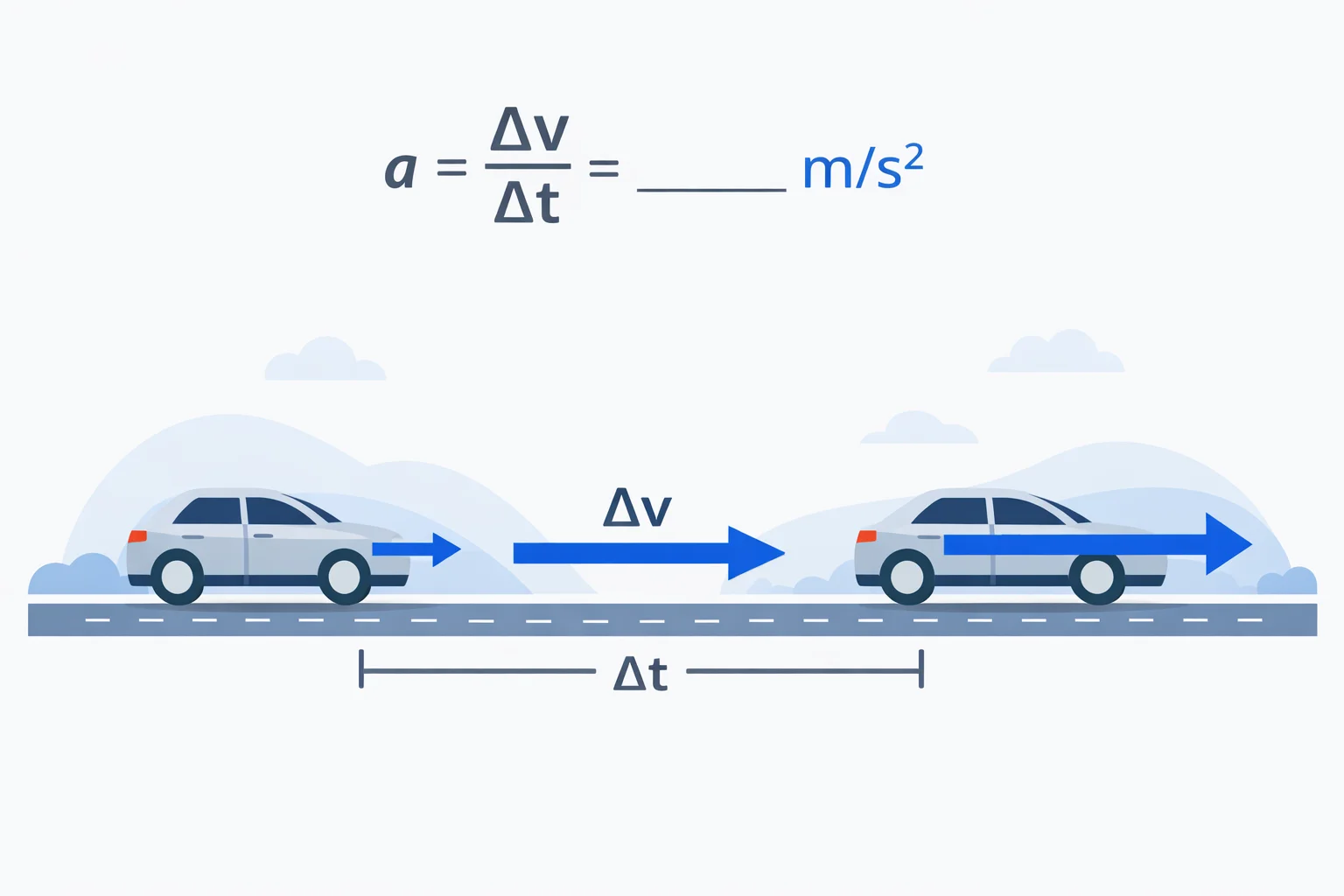
a = Δv/Δt: The Whole Formula in One Line
The Greek letter Δ (delta) means “change in,” so Δv is the final velocity minus the starting velocity, and Δt is the elapsed time. Written out in full, average acceleration is a = (v_f − vᵢ) / t. If a train pulls away from a platform and reaches 20 m/s in 40 seconds, its acceleration is (20 − 0) / 40 = 0.5 m/s². Notice that the starting velocity was zero, so Δv just equals the final velocity — that's the single most common setup, an object starting from rest. Rearrange the same ratio for time and you get t = Δv/a, which is how the time calculator clocks an acceleration. Flip it the other way and it becomes vf = vᵢ + at, the rule a final velocity calculator uses to find where the speed ends up. Both rearrangements are just two faces of the same kinematic equations that govern any motion at a steady rate.
Acceleration depends on a changein velocity, not on velocity itself. A jet cruising at a steady 250 m/s has zero acceleration, because nothing about its velocity is changing. A cyclist crawling at 2 m/s but speeding up has a real, non-zero acceleration. This is the idea students lose first: a fast object isn't necessarily accelerating, and a slow one can be. The velocity you start with is computed by the velocity calculator; acceleration is about how fast that number is moving.
Why the Units Are Meters per Second, Per Second
The unit m/s² looks strange the first time you see it, and the trick to understanding it is to read it as “meters per second, per second.” You're dividing a velocity (m/s) by a time (s), and the algebra of units does the rest: (m/s) ÷ s = m/s². An acceleration of 3 m/s² means the velocity grows by 3 m/s during every single second. After one second you're at 3 m/s, after two seconds 6 m/s, after three seconds 9 m/s — the velocity climbs in equal steps because the acceleration is constant.
That “per second, per second” structure is why time is so powerful in motion problems. Velocity stacks up linearly with time, but the displacement an object covers from rest grows with the square of time: d = ½at². Double the time and the distance quadruples. Hold that thought — it's the reason stopping distances balloon at highway speeds, and it's the part of kinematics that catches people off guard.
Worked Example: 0 to 100 km/h in a Sports Car
Car magazines love the “0 to 100 km/h” sprint. Say a hot hatch does it in 6.5 seconds. What's its average acceleration? The first move is non-negotiable: convert 100 km/h to m/s by dividing by 3.6, giving 27.8 m/s. Skip this and your answer comes out in the near-useless unit of km/h per second.
Now plug in. The car starts from rest, so vᵢ = 0 and Δv = 27.8 m/s. Then a = 27.8 / 6.5 = 4.27 m/s². To feel what that means, divide by 9.81: that's 0.44 g, so the seat pushes you back with a bit under half your body weight. The distance covered during the sprint is the average velocity times the time: (0 + 27.8)/2 × 6.5 ≈ 90 m, a little under the length of a soccer pitch. Every one of those figures — the acceleration, the g-force, the distance — appears in the calculator above the instant you type the speed and time.
Worked Example: Negative Acceleration on the Brakes
Now the same car brakes hard. It's travelling at 30 m/s (about 108 km/h) and comes to a complete stop in 3.5 seconds. Here vᵢ = 30 m/s and v_f = 0, so Δv = 0 − 30 = −30 m/s. The acceleration is −30 / 3.5 = −8.57 m/s². The minus sign isn't a mistake — it tells you the acceleration points backward, opposite to the motion, which is exactly what slows the car down.
That's 0.87 g of braking, near the limit of what ordinary tyres grip on dry tarmac. The stopping distance is (30 + 0)/2 × 3.5 ≈ 52.5 m — a figure you can reproduce in the distance calculator using d = v₀t + ½at². Compare that with braking from 15 m/s at the same deceleration: the stop takes half the time but only a quarter of the distance, because distance scales with the square of the speed. The force behind that deceleration comes straight from Newton's second law — feed the −8.57 m/s² into the force calculator with the car's mass to find the braking force the tyres must supply.
The Sign Trap: Speeding Up Can Be Negative
Here's the misconception that costs more marks than any other: students assume positive acceleration means speeding up and negative means slowing down. It doesn't. The sign of acceleration tells you its direction, nothing more. Whether an object speeds up or slows down depends on whether acceleration points the same way as the velocity or against it.
Picture a ball you throw straight up. On the way up it's slowing down, at the top it's momentarily still, and on the way down it speeds up. Yet gravity's acceleration is −9.8 m/s² the entire time, pointing down without pause. During the rise, that downward acceleration opposes the upward velocity, so the ball slows. During the fall, the same downward acceleration now agrees with the downward velocity, so the ball speeds up. One constant, unchanging acceleration produces both effects. The rule to memorise: an object speeds up when a and v share a sign, and slows down when they have opposite signs.
How Hard Things Accelerate, in m/s² and g
Numbers in m/s² are hard to picture until you anchor them to things you've felt. This table lists real accelerations, with the g-force (the value divided by 9.81) beside them so you can sense the push. Use it to sanity-check your own answers — if your calculation says a city bus accelerates at 30 m/s², something's wrong.
| Situation | Acceleration (m/s²) | In g |
|---|---|---|
| City bus pulling away | 1.1 | 0.11 |
| Free fall (no air resistance) | 9.81 | 1.0 |
| Sports car, 0–100 km/h sprint | 4.3 | 0.44 |
| Hard emergency braking | 8.5 | 0.87 |
| Formula 1 car braking | 49 | 5.0 |
| Fighter pilot blackout threshold | 88 | 9.0 |
The free-fall row is special: 9.81 m/s² is the acceleration every dropped object has near Earth's surface, regardless of mass. Drop a bowling ball and a tennis ball in a vacuum and they accelerate identically and land together. Mass changes the force needed (heavier things need more pull), but the acceleration from gravity stays put — a point worth checking against the net force on the object when more than one force is acting.
When a = Δv/Δt Stops Working
The formula gives you averageacceleration over an interval, and that's exactly right when the acceleration is constant. It quietly misleads you when the acceleration changes during the interval. A rocket burning fuel gets lighter every second, so its acceleration climbs throughout the launch; a car merging onto a motorway eases off the throttle as it reaches speed. In those cases, a = Δv/Δt still gives a true average, but it won't tell you the acceleration at any single instant.
For the instantaneous value you need the slope of a velocity-time graph at one point — the limit of Δv/Δt as the interval shrinks toward zero, which is the derivative of velocity. If you've got real lab data plotted as velocity versus time, reading that slope directly is often easier than the formula, and the slope of a graph calculator handles the rise-over-run for you. The other limit case: when v_f equals vᵢ, Δv is zero and so is the acceleration, no matter how much time passes — constant velocity means no acceleration at all.
Acceleration Mistakes That Lose Exam Marks
- Forgetting to convert to m/s. Plugging km/h or mph straight into a = Δv/Δt gives an acceleration in the wrong units. Worse, if you carry that number into F = ma the force is off by a factor of 3.6 or more. Convert first, every time.
- Treating a negative sign as “slowing down.” The sign is a direction, not a speed verdict. An object reversing and speeding up has negative velocity and negative acceleration. Decide your positive direction first, then let the signs follow.
- Using final velocity instead of the change in velocity. If a car goes from 12 m/s to 20 m/s, Δv is 8 m/s, not 20. Only when the object starts from rest does Δv equal the final velocity.
- Assuming acceleration and velocity point the same way. A ball thrown upward has upward velocity but downward acceleration. They're independent — always check the direction of each separately before you decide what the motion does next.