How to Calculate Velocity: Speed, Direction, and the v = d/t Formula
Picture a runner finishing one full lap of a standard 400 m track in 80 seconds. Ask for their average speed and the answer is easy: 400 m ÷ 80 s = 5 m/s. Ask for their average velocity and the honest answer is zero. That gap is the entire reason a velocity calculator exists, and it's the single idea that separates students who really understand kinematics from those just plugging numbers into v = d/t. Velocity is displacement over time, and displacement cares about where you ended up, not how far you traveled to get there.
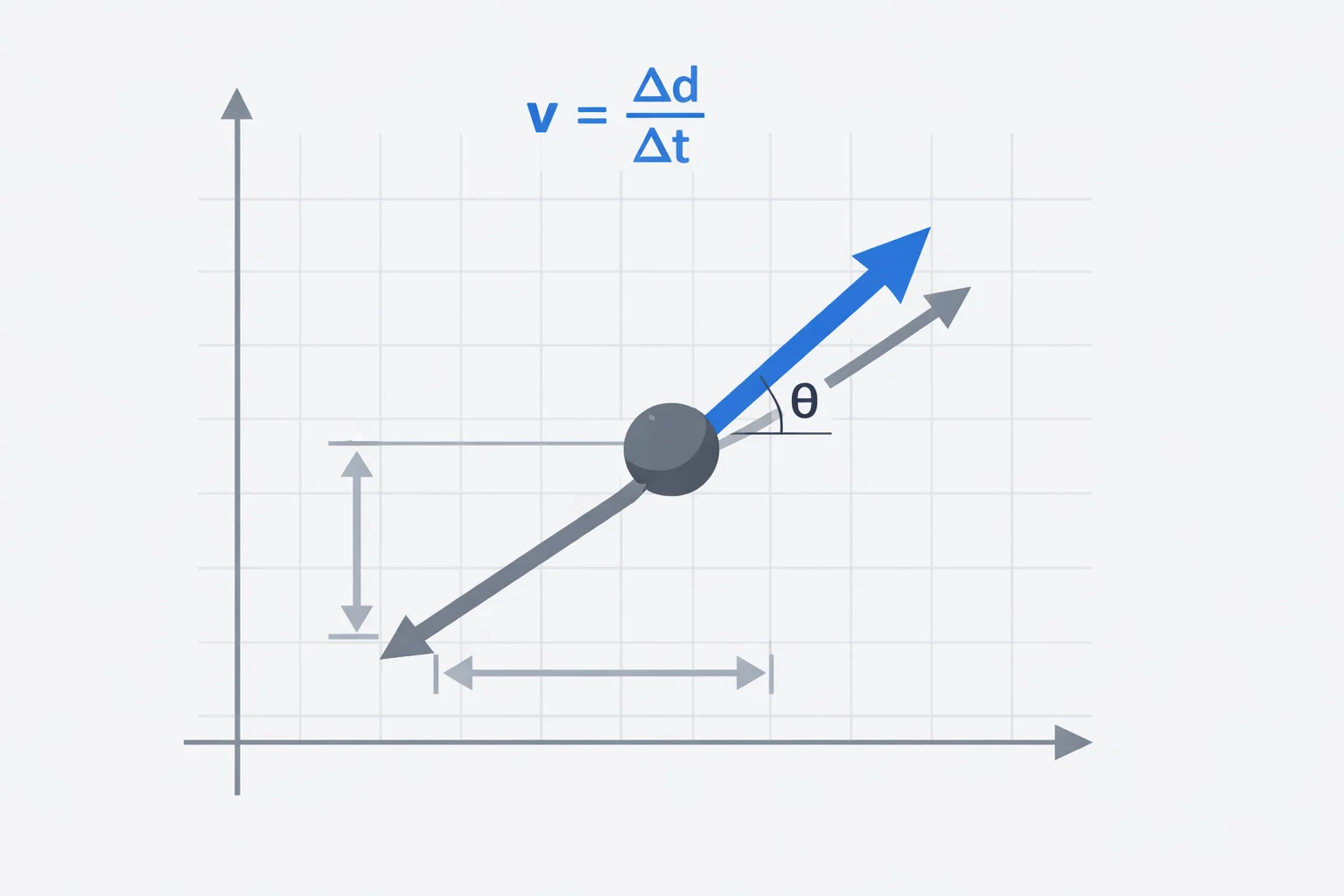
The 400 m Lap That Has Zero Velocity
Start the runner at the finish line and send them once around the oval. They cover 400 m of track, but a lap brings them right back to where they started — so the straight-line distance between start and end, the displacement, is 0 m. Average velocity is displacement ÷ time = 0 ÷ 80 = 0 m/s. Their average speed, which uses the full 400 m path, is a brisk 5 m/s. Same runner, same 80 seconds, two completely different answers.
This isn't a trick question — it's the definition doing exactly what it's supposed to. Now run only the back straight, 100 m in a dead-straight line in 12 seconds, and the two numbers snap back together: displacement and distance are both 100 m, so speed and velocity are both 8.33 m/s. Velocity and speed agree only when the motion is straight and one-way. The instant the path bends, they diverge, and velocity is always the smaller magnitude.
v = Δd/Δt: Why Direction Is Baked In
The working formula is short: average velocity equals the change in position divided by the change in time, v = Δd/Δt. The Δ (delta) means “change in,” so Δd is the final position minus the starting position and Δt is the elapsed time. Because Δd is a displacement, it carries a direction with it — and that's what makes velocity a vector rather than a plain number. Speed is the magnitude that's left when you throw the direction away.
Work a clean case. A cyclist rides from the 200 m marker to the 950 m marker on a straight bike path in 50 seconds. The displacement is Δd = 950 − 200 = 750 m, all in one direction, and Δt = 50 s. So v = 750 ÷ 50 = 15 m/s, which is 54 km/h or about 33.6 mph. Notice the units travel through the math intact: meters divided by seconds gives meters per second, the SI unit for velocity. If your displacement is in kilometers and your time in hours, you get km/h — which is why this calculator lets you mix units and converts the result for you.
Speed and Velocity Are Not the Same Number
Everyday language treats speed and velocity as synonyms, and physics exams punish that habit relentlessly. Speed is a scalar: it answers “how fast?” with a single positive number. Velocity is a vector: it answers “how fast, and which way?” The distinction matters the moment a path isn't straight, and the table below shows where the two part company.
| Feature | Speed | Velocity |
|---|---|---|
| Type of quantity | Scalar (size only) | Vector (size + direction) |
| Uses | Total distance traveled | Displacement (start → end) |
| Can it be negative? | No — always ≥ 0 | Yes — sign shows direction |
| Round trip value | Large (full path) | Zero (no displacement) |
| Which is bigger? | ≥ velocity magnitude, always | ≤ speed, equal only if straight |
Here's the rule worth memorizing: average speed is never smaller than the magnitude of average velocity. The path can only be longer than (or equal to) the straight-line displacement, so dividing both by the same time keeps that ordering. Velocity squared also drives the energy of motion — the same v you compute here goes straight into the kinetic energy calculator as KE = ½mv², where doubling the velocity quadruples the energy.
Velocity in Two Directions at Once
Real motion rarely stays on a single line. A boat crossing a river, a football thrown downfield, a plane in a crosswind — all move in two directions at the same time. When that happens, you break the displacement into perpendicular components, find each one's contribution, then recombine. If an object moves Δx east and Δy north, its displacement magnitude is √(Δx² + Δy²) by the Pythagorean theorem, and the velocity magnitude is that divided by time.
The direction comes from the angle θ = arctan(Δy/Δx), measured from the east axis. Take the cleanest possible case: 30 m east and 40 m north in 10 seconds. The displacement is √(30² + 40²) = √2500 = 50 m — the famous 3-4-5 triangle scaled up by ten. Velocity is 50 ÷ 10 = 5 m/s, pointing arctan(40/30) ≈ 53° north of east. The east and north velocity components are 3 m/s and 4 m/s, and they recombine to exactly 5 m/s. Switch the calculator to 2D mode and it does this decomposition for any numbers you throw at it. The same split into perpendicular components is what powers projectile motion, where a launch velocity becomes a constant horizontal piece and a gravity-driven vertical one.
Worked Example: A Drone in a Crosswind
A delivery drone is programmed to fly due east. Over a 20-second stretch its onboard log records that it actually ended up 240 m east and 70 m north of where it started, because a steady southerly wind nudged it off course. What was its average velocity — magnitude and direction?
First the displacement magnitude: √(240² + 70²) = √(57,600 + 4,900) = √62,500 = 250 m. Divide by the 20 seconds and the velocity magnitude is 250 ÷ 20 = 12.5 m/s, or 45 km/h. The direction is θ = arctan(70/240) ≈ 16.3° north of east — that small angle is the wind's fingerprint on the flight. Notice the trap: if you only looked at the eastward number, you'd report 240 ÷ 20 = 12 m/s and miss both the true speed and the drift entirely. The crosswind added half a meter per second to the ground velocity and tilted the whole path. This is exactly the kind of component bookkeeping that the slope of a position-time graph captures when you plot each axis separately.
Average vs Instantaneous: What the Speedometer Reads
Everything above computes averagevelocity — total displacement over total time, a single number for the whole trip. But a car's speedometer doesn't show that. It shows instantaneousspeed: how fast you're going at this exact moment. Mathematically, the instantaneous velocity is the limit of Δd/Δt as the time interval shrinks toward zero — it's the derivative of position with respect to time, and it's the slope of the tangent line on a position-time graph.
For constant-velocity motion the two are identical, which is why this calculator's average value is all you need for steady-speed problems. The difference bites on trips with stops and bursts. Drive 60 km in exactly one hour and your average velocity is 60 km/h — even if you hit 120 km/h on the highway and sat at 0 at three red lights. Average velocity smooths all of that into one figure; instantaneous velocity is the frame-by-frame story. When an object speeds up or slows down, that change in velocity over time is acceleration, and from there Newton's second law lets the force calculator turn it into the force responsible.
Everyday Speeds in m/s, km/h, and mph
Physics works in m/s, but human intuition runs on km/h and mph. Building a feel for the conversions saves you from answers that are off by a factor of 3.6. These are typical real-world values, handy for sanity- checking whether your computed velocity is even plausible.
| Motion | m/s | km/h | mph |
|---|---|---|---|
| Brisk walk | 1.4 | 5.0 | 3.1 |
| Usain Bolt, peak sprint | 12.4 | 44.6 | 27.7 |
| City driving | 13.9 | 50.0 | 31.1 |
| Highway driving | 27.8 | 100.0 | 62.1 |
| Commercial jet, cruise | 250 | 900 | 559 |
The quick conversion to keep in your head: multiply m/s by 3.6 to get km/h, and by about 2.24 to get mph. So a 10 m/s velocity is 36 km/h — right around a fast cyclist.
Velocity Mistakes That Cost Exam Marks
- Using distance when the question wants displacement. For any curved or back-and-forth path, plugging the total distance into v = d/t gives you speed, not velocity. On a round trip this turns a correct answer of 0 m/s into a confidently wrong positive number.
- Forgetting to convert km/h to m/s. Mixing units is the classic blunder. A velocity of 72 km/h is 20 m/s — divide by 3.6. Feed 72 straight into KE = ½mv² and your kinetic energy comes out about 13× too large.
- Dropping the direction.Velocity without a direction (or sign) is incomplete. “15 m/s” isn't a full velocity answer; “15 m/s east” is. On vector problems, leaving off the angle loses marks even when the magnitude is right.
- Adding 2D components like plain numbers.A velocity of 3 m/s east and 4 m/s north is 5 m/s, not 7. Components combine through the Pythagorean theorem, never by simple addition — that's the most common slip in two-dimensional motion.