Speed Calculator: How to Find Average and Instantaneous Speed in Physics
A police lidar gun parked on a highway shoulder pings a passing car and reads 118 km/h in less than a tenth of a second. That single number is a speed measurement — distance over time, squeezed into a sliver of an instant. Every speed you'll ever calculate, from that radar reading to a sprinter's 100 m time, comes from the same deceptively simple relationship: how far divided by how long. The trick is knowing whether you want the speed at one instant or averaged across a whole journey, because those two numbers are almost never the same.
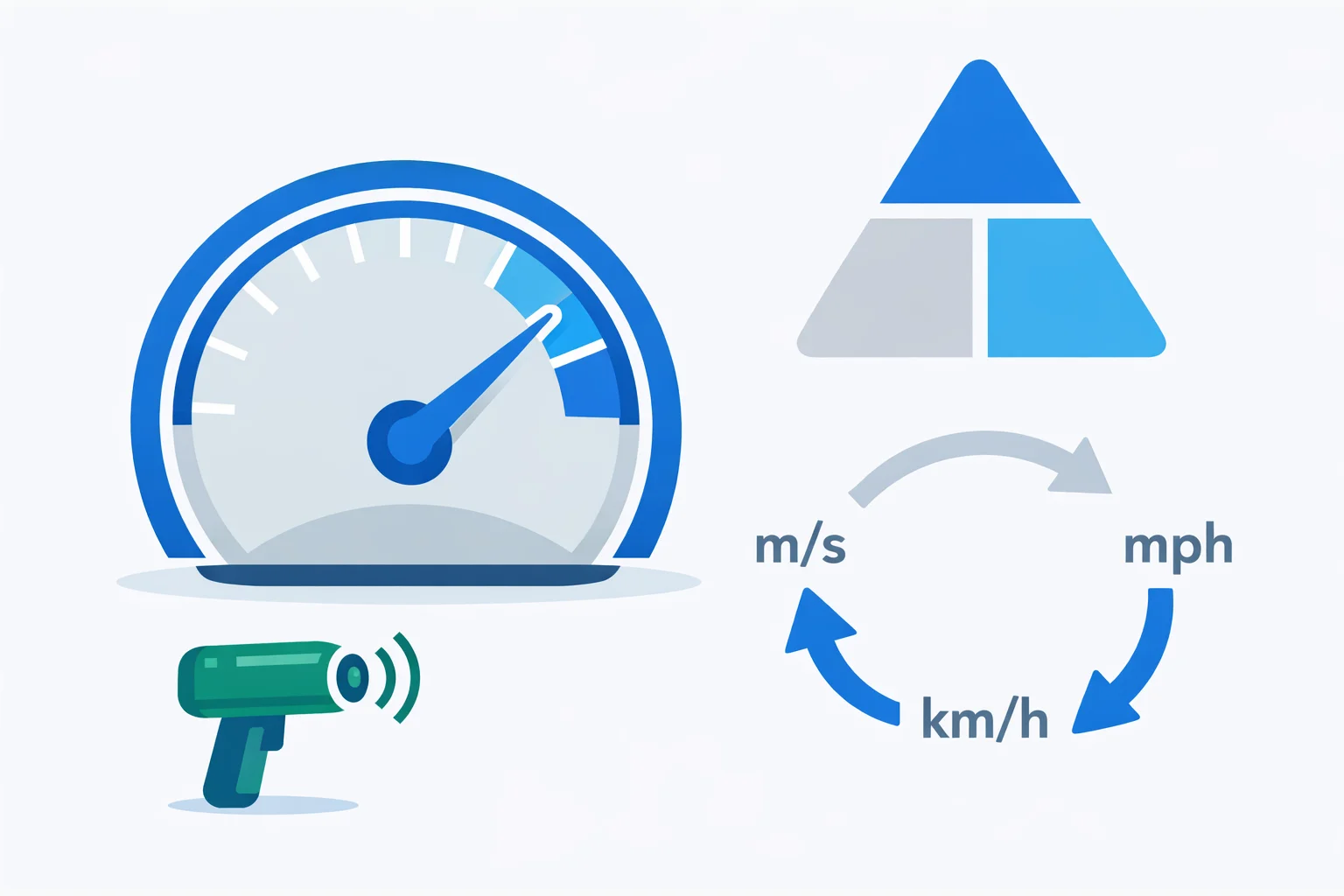
What a Radar Gun Actually Catches
That lidar gun doesn't time your car over a measured kilometer. It fires a pulse, catches the reflection, and measures how the signal's timing shifts to infer your speed at the moment of the ping — roughly a 0.05-second window. So it's reading instantaneousspeed, the value at a single instant. That's why a driver who brakes hard the second they spot the gun can sometimes duck under the limit: the device only sees that frozen moment, not the 130 km/h they were doing ten seconds earlier. The physics is identical to the speed = distance ÷ time you learned in class — the time interval is just astonishingly short.
s = d/t and Its Two Rearrangements
Speed is distance divided by time: s = d/t. If a marathon runner covers 42,195 m in 7,200 seconds (two hours flat), their average speed is 42,195 ÷ 7,200 = 5.86 m/s, or about 21.1 km/h. The same triangle relationship rearranges two ways, and this calculator handles all three. Solve for distance with d = s × t — a car at 25 m/s for 600 s travels 15,000 m, or 15 km. Solve for time with t = d/s — covering 400 m at 8 m/s takes 50 seconds. One formula, three questions, depending on which quantity you're missing. That t = d/s shortcut only holds at constant speed, though; once there's acceleration, the time calculator switches to t = (v − u)/a or a full quadratic.
The units carry the meaning. Meters divided by seconds gives meters per second; kilometers divided by hours gives km/h. That's why you can't blindly mix a distance in kilometers with a time in seconds and expect a sensible answer — the calculator converts everything to a common base (meters and seconds) before dividing, then converts the result back out. If you need the directional cousin of speed, the velocity calculator uses displacement instead of distance and reports an angle alongside the magnitude.
Average Speed vs the Number on Your Speedometer
Here's the distinction that separates a B from an A on a kinematics test. Average speed is the total distance divided by the total time — one figure summarizing an entire trip. Instantaneous speedis how fast you're going at a single moment, the number your speedometer shows and the value a radar gun captures. Mathematically, instantaneous speed is the average speed measured over a vanishingly small time interval — the slope of the tangent line on a distance-time graph.
Drive 60 km in exactly one hour and your average speed is 60 km/h, even if you hit 110 km/h on the open road and idled at 0 through four sets of traffic lights. The average flattens all of that into a single number; instantaneous speed is the frame-by-frame reality. The two match only when speed never changes — perfectly steady cruising. The moment the speed shifts, you've got acceleration, and average and instantaneous speed start to drift apart.
Worked Example: A Bullet Train's Real Average
China's Beijing–Shanghai high-speed line runs 1,318 km, and the fastest scheduled service covers it in 4 hours and 18 minutes. What's the train's average speed? First convert the time: 4 h 18 min = 4.3 hours = 15,480 seconds. The distance is 1,318,000 m. So s = 1,318,000 ÷ 15,480 = 85.1 m/s. Multiply by 3.6 and that's 306.5 km/h, or about 190 mph — sustained, for over four hours.
Now the subtlety. That same train hits a top speed of 350 km/h on the fastest stretches. So why is the average only 306 km/h? Because the train spends minutes accelerating out of Beijing, decelerating into a couple of intermediate stops, and braking into Shanghai — all time spent below cruising speed. The 44 km/h gap between top speed and average speed is entirely the cost of starting and stopping. It's the same reason your car's trip-average always lands well under the highway limit, just scaled up to a 1,300 km journey.
Why Averaging Two Speeds Gives the Wrong Answer
Suppose you drive to a town 60 km away at 30 km/h, then drive the same 60 km home at 60 km/h. What's your average speed for the round trip? The tempting answer is (30 + 60) ÷ 2 = 45 km/h. It's wrong. Average speed is total distance over total time, never the average of the speed numbers. The outbound leg takes 60 ÷ 30 = 2 hours; the return takes 60 ÷ 60 = 1 hour. That's 120 km in 3 hours, so the true average is 40 km/h.
Why is it pulled toward the slower speed? Because you spend twice as long crawling along at 30 km/h as you do zipping back at 60, so the slow leg dominates the time total. Equal distances at different speeds always produce an average closer to the slower one — a result that surprises most students the first time they meet it. The simple (v₁ + v₂) ÷ 2 average is only correct when you spend equal time at each speed, not equal distance. When the speed varies leg by leg, lean on the distance traveled and total time rather than averaging the speeds directly. For a trip with several legs and stops, the average speed calculator sums each one's distance and time for you and flags the wrong simple average automatically.
How Fast Things Move, in m/s, km/h, and mph
Physics runs on m/s, but intuition runs on km/h and mph. Building a feel for the conversions helps you sanity-check a result — if your calculation says a thrown ball travels at 200 m/s, you've made an error, because that's faster than most aircraft. These are real measured values, not rounded guesses.
| Mover | m/s | km/h | mph |
|---|---|---|---|
| Olympic 100 m sprint (avg) | 10.4 | 37.6 | 23.4 |
| Cheetah, top sprint | 29 | 104 | 65 |
| Fastest tennis serve | 73 | 263 | 163 |
| Peregrine falcon, dive | 90 | 324 | 201 |
| Speed of sound (air, 20°C) | 343 | 1,235 | 767 |
| ISS orbital speed | 7,660 | 27,600 | 17,100 |
Notice the jump from a falcon's 90 m/s to the ISS at 7,660 m/s — about 85 times faster. Orbital speed isn't about a powerful engine; it's the speed needed to fall around the Earth without hitting it, set by the balance between gravity and the station's sideways motion.
Converting Between m/s, km/h, mph, and Knots
Speed problems live or die on unit conversions, so it's worth keeping the key factors handy. The most useful one to memorize is ×3.6 to turn m/s into km/h. Knots show up in aviation and sailing — one knot is one nautical mile per hour, or 0.5144 m/s.
| To convert | Multiply by | Example |
|---|---|---|
| m/s → km/h | 3.6 | 20 m/s = 72 km/h |
| m/s → mph | 2.237 | 20 m/s = 44.7 mph |
| km/h → m/s | ÷ 3.6 | 90 km/h = 25 m/s |
| mph → km/h | 1.609 | 60 mph = 96.6 km/h |
| knots → m/s | 0.5144 | 10 kn = 5.14 m/s |
Speed Mistakes That Cost Exam Marks
- Averaging speeds instead of using total distance over total time. For two equal-distance legs at 30 and 60 km/h, the answer is 40 km/h, not 45. Always go back to total distance ÷ total time.
- Leaving speed in km/h before squaring it. Kinetic energy uses KE = ½mv² in m/s. Plug in 72 instead of 20 (its m/s value) and your energy is off by 3.6², about 13 times too large. Feed your speed into the kinetic energy calculator only after converting to m/s.
- Confusing instantaneous and average speed.A speedometer reading is instantaneous; a trip's distance-over-time is an average. Questions that mention “at that moment” want the instantaneous value, which you can't get from total distance alone.
- Reporting a negative speed.Speed is never negative — if you wrote down −15 m/s, you've computed a velocity component. Take the magnitude and the speed is 15 m/s.