How to Calculate Displacement (and Why It Isn't the Same as Distance)
Ask two students to find the displacement of a runner who jogs once around a 400 m track, and you'll often get two different answers: 400 m and 0 m. Only one is right — the displacement is zero. That single example is why a displacement calculator is worth more than a tape measure: displacement isn't how far you went, it's how far apart your start and end points are, with a direction attached. Distance and displacement get used interchangeably in everyday speech, but in physics they're genuinely different quantities, and confusing them is the fastest way to lose marks on a kinematics question.
The One Question That Separates Displacement from Distance
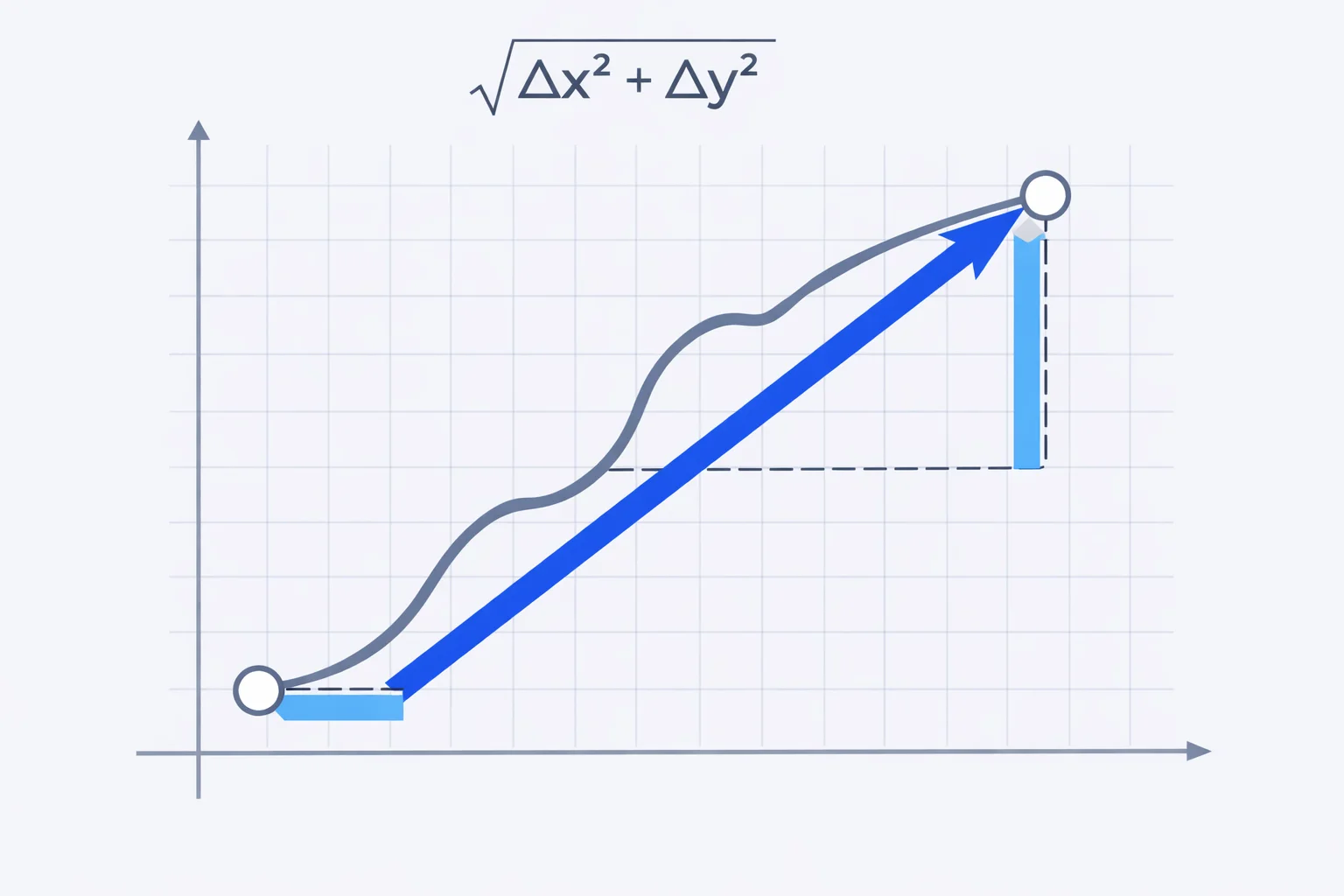
Here's the test that settles every displacement-versus-distance confusion: do you care about the route, or just the endpoints? Distance cares about the route — every twist, every backtrack, every extra step adds up. Displacement ignores the route entirely and looks only at where you started and where you finished. Draw a straight arrow from the start to the end, and its length is the displacement; its direction is part of the answer too.
Picture walking 3 m east, then 4 m back west. Your distance is 3 + 4 = 7 m — you really did move that much, and a distance calculator would add both legs together. But your displacement is just 1 m west, because you ended up 1 m from where you began. The 4 m you walked back didn't add to the displacement; it subtracted from it. This is the behavior that makes displacement a vector and distance a scalar, and it's baked into every formula on this page.
Displacement Is a Vector: Δx = x_f − x_i
In one dimension the definition is almost embarrassingly simple: displacement equals the final position minus the initial position, Δx = x_f − x_i. The Δ (delta) means “change in.” If you start at the 12 m mark on a number line and end at the 30 m mark, your displacement is 30 − 12 = 18 m in the positive direction. Start at 30 m and end at 12 m, and it's 12 − 30 = −18 m — same size, opposite direction. The order matters: always final minus initial, never the other way round.
Because displacement keeps its sign (or, in two dimensions, its angle), it slots directly into the rest of kinematics. Divide a displacement by the time it took and you get average velocity, which is why velocity is also a vector. Distance, by contrast, can only give you average speed — a number with no direction. That's the quiet reason physics insists on the distinction: half the equations downstream depend on the direction that displacement carries and distance throws away.
Worked Example: 8 km Hiked, 5.8 km Displaced
A hiker leaves the trailhead and walks 5 km due north to a lake, then turns and walks 3 km due east to a lookout, where the trail ends. Her fitness watch reads 8 km — that's the distance, the full length of the path. But the ranger station wants to know how far the lookout is from the trailhead in a straight line, in case of a helicopter pickup. That's the displacement.
The two legs are perpendicular, so the displacement is the hypotenuse of a right triangle with Δy = 5 km north and Δx = 3 km east: √(3² + 5²) = √(9 + 25) = √34 ≈ 5.83 km, pointing arctan(5/3) ≈ 59° north of east. The helicopter flies 5.83 km; the hiker walked 8 km. Now suppose she'd carried on and looped 2 km back toward the lake before stopping — her distance climbs to 10 km, but her displacement shrinks, because she's now closer to a point she already passed. Distance only ever grows; displacement can go either way.
Displacement and Distance, Side by Side
When two quantities are this easy to mix up, a direct comparison helps more than any definition. Here's exactly where they agree and where they split.
| Feature | Distance | Displacement |
|---|---|---|
| Type of quantity | Scalar (size only) | Vector (size + direction) |
| What it measures | Total length of the path | Straight line, start → end |
| Can it be negative? | No — always ≥ 0 | Yes — sign or angle shows direction |
| Round-trip value | Large (full path) | Zero (back to start) |
| SI unit | meter (m) | meter (m) |
| Which is bigger? | ≥ |displacement|, always | ≤ distance, equal only if straight |
Combining Displacements in Two Dimensions
Real trips rarely stay on one line. The moment motion has both an east-west part and a north-south part, you find each component separately and recombine them with the Pythagorean theorem. If Δx is the eastward displacement and Δy the northward one, the total displacement magnitude is √(Δx² + Δy²), and its direction is θ = arctan(Δy/Δx) measured from east.
Take the cleanest example there is: 30 m east and 40 m north. The displacement is √(30² + 40²) = √(900 + 1600) = √2500 = 50 m — the famous 3-4-5 triangle scaled by ten — pointing arctan(40/30) ≈ 53° north of east. Add the components as plain numbers and you'd get 70 m, which is wrong by 40%. The calculator's Two Points mode does this decomposition for any coordinates, and it's the same component bookkeeping you'd read off the slope of a position-time graph if you plotted each axis on its own.
Finding Displacement from Velocity and Time
You won't always be handed start and end coordinates. Often you know how something was moving — its initial velocity, its acceleration, and the time — and you need the displacement that resulted. That's where the kinematic equations come in. The workhorse is s = ut + ½at², where u is the initial velocity, a is the acceleration, and t is the time.
Say a car starts from rest (u = 0) and accelerates at 3 m/s² for 5 seconds. Its displacement is s = (0)(5) + ½(3)(5²) = ½ × 3 × 25 = 37.5 m. If you instead know the initial and final velocities, use s = ½(u + v)t; if you know the velocities and the acceleration but not the time, use s = (v² − u²)/2a. All three live in the calculator's From Motion mode. Notice the ½at² term squares the time — that's why displacement from rest quadruples when you double the time, and it's the same relationship the acceleration calculator works in reverse. When acceleration isn't constant, none of these three apply, and you'd find displacement as the area under a velocity-time graph instead.
Why a Negative Displacement Isn't a Mistake
Students see a minus sign pop out of a displacement calculation and assume they've made an error. They usually haven't. In one dimension, the sign of the displacement is the direction. If you call east positive and an object ends up west of where it started, its displacement is negative — say, −18 m. The size (18 m) is how far apart the points are; the minus is which way.
This is exactly why distance and displacement need different rules. Distance can't be negative — you can't walk a negative number of meters. Displacement must be able to, or it couldn't encode direction on a single axis. When a projectile is thrown up and comes back down past its launch point, its displacement is negative even though its distance is large and positive. Keep the sign; it's carrying real physical information that the next equation will need.
Distance vs Displacement for Common Paths
Building intuition for how far the two quantities can drift apart is worth more than memorizing the definitions. These are exact values for paths you'll meet again and again in problems.
| Path | Distance | Displacement |
|---|---|---|
| Straight 100 m sprint | 100 m | 100 m |
| 50 m out and 50 m back | 100 m | 0 m |
| 30 m east, then 40 m north | 70 m | 50 m |
| One lap, 400 m track | 400 m | 0 m |
| Half lap, 400 m track | 200 m | ≈ 127 m (diameter) |
| Quarter circle, r = 10 m | ≈ 15.7 m | ≈ 14.1 m |
Notice the half-lap row: the displacement is the track's diameter (about 127 m for a standard 400 m oval), not half the distance. Curved paths never let displacement equal distance — the straight line always cuts the corner.
Displacement Mistakes That Lose Exam Marks
- Reporting distance when the question asks for displacement. On any path that curves or doubles back, the total distance is the wrong answer. A round trip has zero displacement no matter how far you walked — write 0 m, not the path length.
- Dropping the direction.“50 m” is an incomplete displacement; “50 m at 53° north of east” or “−18 m” is complete. Vector answers need a direction or a sign, and leaving it off costs marks even when the number is right.
- Adding 2D components straight up. 30 m east and 40 m north is 50 m, not 70 m. Perpendicular components combine through the Pythagorean theorem — never by simple addition.
- Forgetting the time is squared in s = ut + ½at². Plugging the time in without squaring it in the ½at² term is a classic slip. From rest, displacement scales with t², so a small error in time becomes a large error in displacement.