From Rocket Engines to Bicycle Brakes: How F = ma Governs Every Force You Feel
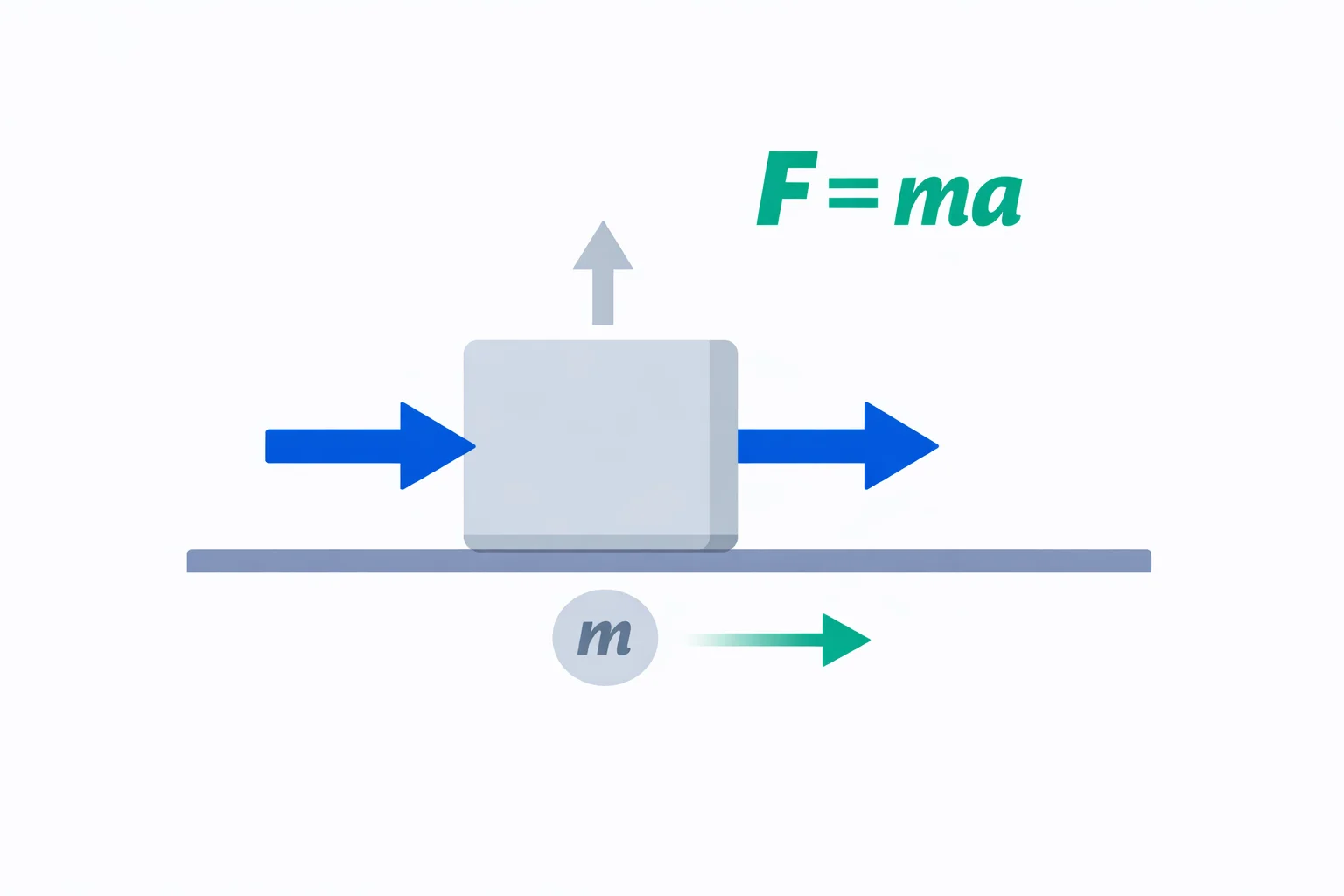
A force calculator built on F = ma is the most direct way to answer one of physics' oldest questions: how much push or pull does it take to change an object's motion? A SpaceX Falcon 9 produces about 7,607 kN of thrust at liftoff to accelerate a 549,054 kg stack at roughly 1.24 g. A tennis player's racket applies around 406 N during the 4 milliseconds of contact to send a 58-gram ball across the court at 200 km/h. Both situations are the same equation. The numbers just change.
Your Phone Weighs About 1 Newton — Start There
Pick up your smartphone. If it's around 200 grams, gravity pulls it down with about 1.96 N. That's your tactile benchmark for what a Newton feels like. A medium apple? Roughly 1 N. A gallon of milk? About 37 N. Building physical intuition for force units matters more than memorizing conversion factors, because you'll instantly spot when a homework answer gives 0.003 N for a car's engine force or 5,000 N for a thrown baseball.
The Newton is defined as the force required to accelerate exactly 1 kilogram at 1 m/s². That's the beauty of SI units: F = ma produces Newtons directly when you feed in kilograms and meters per second squared. No conversion needed. The imperial system isn't so clean — pound-force (lbf), slugs, and ft/s² trip up even experienced engineers during unit conversions, which is exactly why a certain spacecraft crashed into Mars.
Three Variables, One Equation: Solving for Any Unknown
Newton's Second Law is really three equations wearing one coat. Need force? F = ma. Need mass? m = F/a. Need acceleration? a = F/m. The algebra is trivial, but applying it correctly requires knowing which values you actually have and what they mean physically. Acceleration isn't always a separate measurement — sometimes you calculate it from velocity change divided by time, or from kinematic equations when you know distance and initial speed.
Here's a pattern that catches students: when a problem says “an object moves at constant velocity,” the acceleration is zero, which means the net force is zero. That doesn't mean no forces act on it — it means they balance. A 2,000 kg car cruising at 110 km/h on a level highway has zero net force despite the engine producing roughly 400 N to overcome air drag. Confusing “net force” with “applied force” is the single most common error on AP Physics 1 free-response questions.
Worked Example: Stopping a Car from 100 km/h
A 1,400 kg sedan travels at 100 km/h (27.78 m/s) and brakes to a stop over 52 meters. What's the average braking force?
First, find the deceleration using kinematics: v² = v₀² + 2aΔx. Since the final velocity is 0:
0 = (27.78)² + 2a(52)
a = −(771.73) / 104 = −7.42 m/s²
Now apply F = ma:
F = 1,400 × (−7.42) = −10,389 N
The negative sign tells you the force opposes the direction of motion — exactly what brakes do. That's 10.4 kN, or about 2,336 lbf, distributed across four brake calipers. Each caliper handles roughly 2,600 N. For comparison, the same car at 50 km/h needs only about 2,597 N to stop over the same distance — braking force scales with the square of the speed because kinetic energy does. Double the speed, quadruple the force needed for the same stopping distance. This is why speed limits in school zones aren't just about reaction time.
Forces You Encounter Every Day (With Real Numbers)
Textbooks tend to use “a box on a frictionless surface,” but real forces are everywhere. Here's what they actually look like:
| Scenario | Mass | Acceleration | Force |
|---|---|---|---|
| Typing on a keyboard (per keystroke) | ~0.01 kg (finger) | ~5 m/s² | 0.05 N |
| Throwing a baseball | 0.145 kg | ~1,200 m/s² | 174 N |
| Pushing a loaded wheelbarrow | 80 kg | 0.5 m/s² | 40 N |
| Bicycle braking (gentle) | 85 kg (rider + bike) | −2 m/s² | −170 N |
| Elevator starting upward | 1,200 kg | 1.2 m/s² | 1,440 N (net) |
| Falcon 9 at liftoff | 549,054 kg | ~12.2 m/s² | ~6,698,000 N |
| Mosquito landing on your arm | ~0.0000025 kg | ~10 m/s² | 0.000025 N |
Notice the range: from 0.000025 N (a mosquito touchdown) to nearly 7 million N (a rocket). F = ma handles all of it. The equation doesn't care about scale — it works the same way for particle physics and aerospace engineering. When you need to combine multiple forces at angles, the net force calculator handles vector addition so each individual F = ma result feeds into the bigger picture.
When Units Go Wrong: The Mars Climate Orbiter Lesson
On September 23, 1999, NASA's Mars Climate Orbiter disintegrated in the Martian atmosphere because one engineering team used pound-force-seconds for impulse while another expected Newton-seconds. The spacecraft received 4.45 times too much thrust correction. A $327.6 million mission lost to a unit mismatch in F = ma's inputs.
The lesson is stark: 1 lbf = 4.44822 N. If your acceleration is in ft/s² but your mass is in kilograms, you won't get Newtons — you'll get a nonsense number that looks reasonable. Always check that your units reduce to kg·m/s² before trusting the output. Better yet, stick to SI and convert at the end. The doomed thrust figure was an impulse (force × time), which is exactly why its pound-force-second versus newton-second mixup slipped through.
Force vs. Weight: Same Formula, Different Meanings
Weight is just F = ma with a specific acceleration: gravity. On Earth, W = mg = m × 9.81 m/s². A 70 kg person weighs 686.7 N on Earth, 114.5 N on the Moon (g = 1.635 m/s²), and 264.6 N on Mars (g = 3.78 m/s²). Their mass stays 70 kg everywhere — mass is intrinsic, weight is situational.
This distinction shows up in practical ways. When you step on a bathroom scale in an accelerating elevator, the scale reads your apparent weight: m(g + a). If the elevator accelerates upward at 2 m/s², the scale reads 70 × 11.81 = 826.7 N, or about 84.3 kg-equivalent. You feel heavier. During free-fall (a = −g), the scale reads zero. You feel weightless. Neither situation changes your mass by a single gram. The tension calculator uses this same principle for elevator cable problems.
Beyond Constant Acceleration: Where F = ma Gets Complicated
F = ma assumes constant mass and gives instantaneous force at a single moment. Real systems are rarely that clean. A rocket burns fuel, so its mass decreases over time — the thrust equation becomes F = v_exhaust × (dm/dt), and acceleration increases even at constant thrust because the rocket is getting lighter. Tsiolkovsky's equation handles this, but F = ma gives you the force at any single instant. The same caveat applies to direction: for an object moving in a circle the acceleration points inward, so F = ma becomes the centripetal force F = mv²/r — still Newton's second law, just aimed at the center.
Forces that change with position cause the same headache. A spring pulls harder the further you stretch it — the spring force calculator captures that with F = kx — so the acceleration isn't constant for a single instant either. Feed the spring's force into F = ma and you get the acceleration at that one position, which is exactly how spring-mass oscillation is built up moment by moment.
Another complication: forces that depend on velocity. Air drag is roughly F_drag = ½ρAv²C_d, so the net force changes as the object speeds up. A skydiver accelerating at 9.81 m/s² right after jumping eventually reaches terminal velocity where drag equals weight and the net force drops to zero. You can't solve the full trajectory with a single F = ma calculation — you need to apply it at many small time steps. That's what numerical simulation does, and it's also where the kinetic energy calculator becomes useful: instead of tracking force over time, you can sometimes use energy conservation to jump straight to the final speed.
The Free-Body Diagram Shortcut That Saves Exam Time
On the AP Physics 1 exam, roughly 30% of the free-response points involve drawing or interpreting free-body diagrams. Here's the fastest approach: draw the object as a dot, then add exactly one arrow for each force. Don't split gravity into components yet — draw it straight down first. Don't forget normal force (always perpendicular to the surface, not “upward”). Then pick coordinate axes that make one direction align with acceleration, so you only need to resolve forces in the other direction.
The most efficient axis choice for an incline: tilt your x-axis along the surface. Then gravity has components mg sinθ (along the incline) and mg cosθ (into the surface). Normal force cancels mg cosθ. You're left with one equation: F_net = mg sinθ − friction = ma. Students who don't tilt their axes end up with two equations and two unknowns for a problem that's really just one equation. On a timed exam, that's the difference between finishing early and running out of time.