Solving Tension Problems: From a Hanging Lamp to an Elevator Cable
A tension calculator answers the single most common question in first-year mechanics: "What force is the rope actually carrying?" The answer is almost never just the weight of the object. Acceleration, angles, friction, and pulleys all change the tension — sometimes dramatically. A 1,000 kg elevator hanging still puts 9,810 N on its cable, but the moment it accelerates upward at 3 m/s², that jumps to 12,810 N. Miss that distinction on an exam and you lose the whole problem.
The Elevator Cable Problem: A Step-by-Step Solve
Here's a real scenario. A hospital elevator carries a 1,400 kg car plus 600 kg of passengers — total system mass 2,000 kg. The elevator accelerates upward from rest at 1.5 m/s² for the first 3 seconds, then cruises at constant velocity, then decelerates at 1.5 m/s² before stopping. What's the cable tension in each phase?
Phase 1 (accelerating up):Apply Newton's second law to the elevator (if you need a refresher on F = ma, the force calculator breaks it down). The net upward force is T − mg. Set that equal to ma:
T − mg = ma → T = m(g + a) = 2,000 × (9.81 + 1.5) = 2,000 × 11.31 = 22,620 N
Phase 2 (constant velocity):Acceleration is zero, so T = mg = 2,000 × 9.81 = 19,620 N. The cable carries exactly the system's weight.
Phase 3 (decelerating):The elevator is still moving up, but slowing down — acceleration is −1.5 m/s²:
T = m(g + a) = 2,000 × (9.81 − 1.5) = 2,000 × 8.31 = 16,620 N
That 6,000 N swing between phases is why elevator cables use a safety factor of 8–12. A cable rated for 200,000 N handles a 20,000 N load — with room for acceleration, passenger weight variation, and decades of wear.
Tension Is Not Weight — Here's Why That Matters
Students default to T = mg because most textbook diagrams show a mass hanging motionless from a string. That's the special case, not the rule. Tension equals weight only when acceleration is zero and the rope hangs straight down. Change either condition and the formula changes:
- Vertical acceleration:T = m(g + a). An upward acceleration of 2 m/s² on a 5 kg mass gives T = 5 × 11.81 = 59.05 N instead of 49.05 N.
- Rope at an angle:Hang a 10 kg picture from two wires at 45° each and each wire carries T = mg / (2 sin 45°) = 98.1 / 1.414 = 69.4 N —more than the total weight.
- On an incline:A rope pulling 8 kg up a 30° frictionless ramp needs only T = mg sin 30° = 8 × 9.81 × 0.5 = 39.24 N, about 40% of the full weight.
The key insight: tension adjusts to whatever force balance the situation demands. It's a constraint force, not a fixed property of the object. The work calculator shows this from the energy side — the work done by tension depends on both the force magnitude and the distance moved.
Inclined Planes: Three Forces Fighting Over One Rope
Pulling a crate up a ramp is the classic inclined-plane problem. The rope must overcome three things simultaneously: the gravity component along the slope (mg sin θ), kinetic friction (μ mg cos θ), and any desired acceleration (ma). The total tension is their sum:
T = mg sin θ + μmg cos θ + ma
Suppose you're hauling a 50 kg crate up a 25° loading ramp (μ = 0.35) at constant speed (a = 0):
Gravity along slope: 50 × 9.81 × sin 25° = 50 × 9.81 × 0.4226 = 207.3 N
Normal force: 50 × 9.81 × cos 25° = 50 × 9.81 × 0.9063 = 444.6 N
Friction: 0.35 × 444.6 = 155.6 N
Total tension: 207.3 + 155.6 = 362.9 N
The normal force calculator handles that mg cosθ step for any incline angle and also covers the elevator and banked-curve cases where N diverges from the object's weight. Without friction, you'd only need 207.3 N. Friction adds 75% more tension. That's why movers use roller conveyor ramps — cutting μ from 0.35 to 0.05 drops the required pull by 130 N. When multiple ropes pull at different angles on the same crate, you need to add them as vectors — the net force calculator handles that component-by-component addition.
The Atwood Machine Trick That Saves Exam Time
An Atwood machine — two masses connected by a string over a frictionless pulley — appears on nearly every AP Physics 1 exam. The derived formulas are elegant:
Acceleration: a = (m&sub1; − m&sub2;)g / (m&sub1; + m&sub2;)
Tension: T = 2m&sub1;m&sub2;g / (m&sub1; + m&sub2;)
The time-saving trick: the tension formula is the harmonic mean of the two weights times g. For m&sub1; = 12 kg and m&sub2; = 4 kg:
T = 2 × 12 × 4 × 9.81 / (12 + 4) = 941.76 / 16 = 58.86 N
Compare this to the individual weights: 117.7 N and 39.24 N. The tension always sits between the two weights. If the masses are equal, acceleration is zero and the tension equals each weight exactly — a useful sanity check. Use the kinetic energy calculator to find how fast each mass is moving after the system travels a given distance.
Real Rope Breaking Strengths: When Does It Snap?
Physics problems assume ideal, unbreakable ropes. Real ropes have limits, and engineers size cables using these numbers plus a safety factor (typically 5:1 for lifting applications, 10:1 for human-rated climbing gear).
| Material | Diameter | Breaking Strength | Safe Working Load (5:1) |
|---|---|---|---|
| Manila hemp rope | 12 mm | 10.7 kN | 2.1 kN (214 kg) |
| Nylon (3-strand) | 12 mm | 21.4 kN | 4.3 kN (438 kg) |
| Polyester (double braid) | 12 mm | 25.8 kN | 5.2 kN (530 kg) |
| Steel wire rope (6×19) | 12 mm | 92 kN | 18.4 kN (1,876 kg) |
| Dyneema/Spectra (HMPE) | 12 mm | 140 kN | 28 kN (2,854 kg) |
| Kevlar (aramid) | 12 mm | 155 kN | 31 kN (3,160 kg) |
A 12 mm climbing rope (dynamic nylon) is rated around 22–28 kN — more than enough for a 80 kg climber whose fall generates roughly 8–12 kN of peak force. But the same rope under static tension (no elongation) would break at that same 22 kN. That matters for rigging, where you need a potential energy calculator to estimate fall forces before choosing cable thickness.
Pulley Systems: Trade Force for Distance
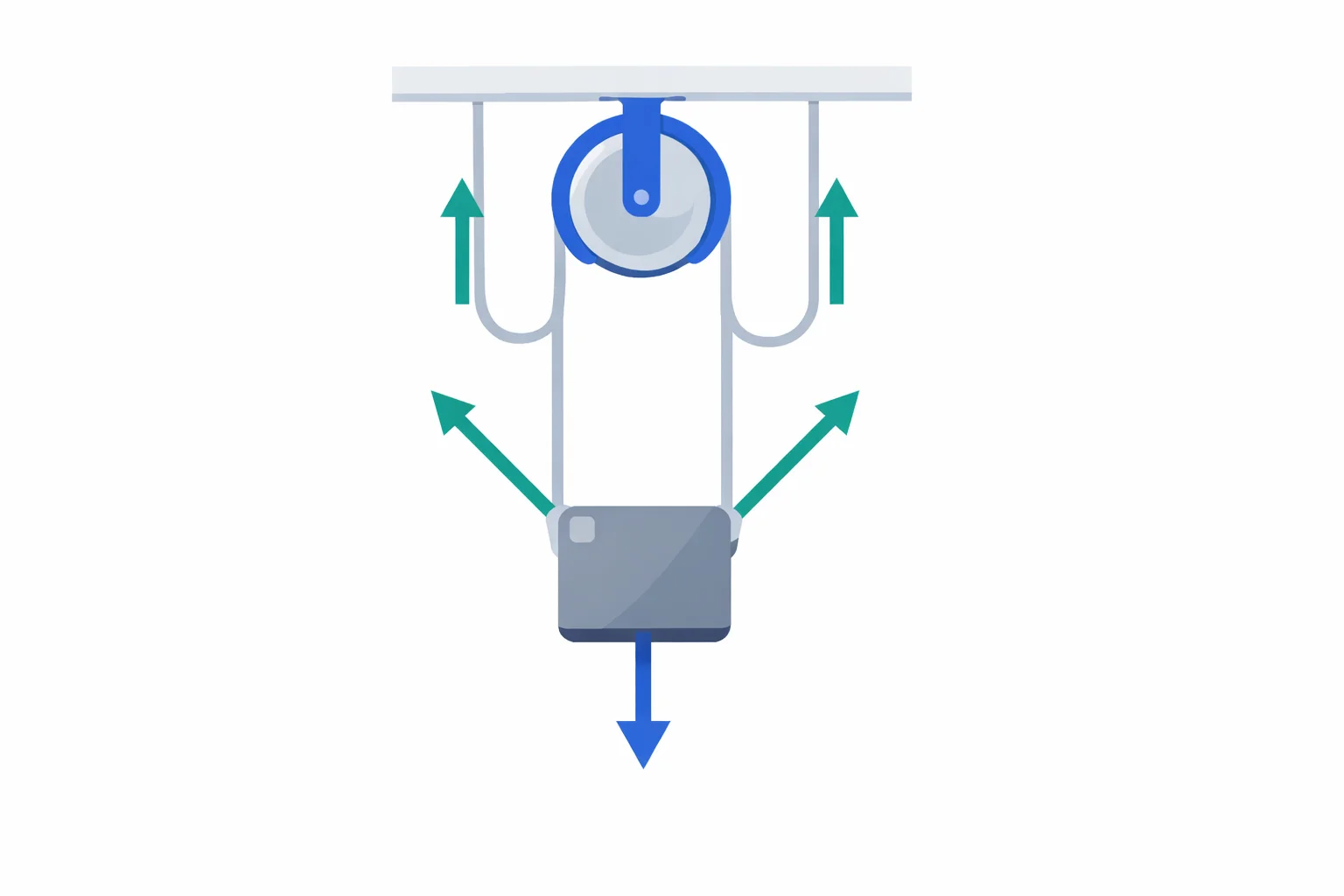
A single fixed pulley changes the direction of the pull but not the tension — you still pull with mg. The magic starts with movable pulleys. Each movable pulley adds a rope segment supporting the load, dividing the tension:
- 1 fixed pulley: T = mg (no advantage, direction change only)
- 1 movable + 1 fixed: T = mg/2, but pull 2× the rope
- Block and tackle (4 segments): T = mg/4, pull 4× the rope
- Block and tackle (6 segments): T = mg/6, pull 6× the rope
Energy conservation forbids free lunches: reducing force by a factor of n means pulling n times more rope. Lifting a 200 kg engine 1 meter with a 4:1 block and tackle requires pulling 4 meters of rope at 490.5 N instead of 1 meter at 1,962 N. Same mechanical advantage trade-off you see in levers and gear trains.
Two Ropes at Angles — The Setup That Stumps Everyone
A 25 kg traffic light hangs from two cables making 35° and 55° with the horizontal. What's the tension in each cable? This is where students panic, but the method is mechanical:
Step 1: The vertical components must support the weight.
T&sub1; sin 35° + T&sub2; sin 55° = 25 × 9.81 = 245.25 N
Step 2: The horizontal components must cancel.
T&sub1; cos 35° = T&sub2; cos 55°
From step 2: T&sub1; = T&sub2; × cos 55° / cos 35° = T&sub2; × 0.5736 / 0.8192 = 0.7002 T&sub2;
Substitute into step 1: 0.7002 T&sub2; × 0.5736 + T&sub2; × 0.8192 = 245.25
0.4016 T&sub2; + 0.8192 T&sub2; = 245.25
1.2208 T&sub2; = 245.25
T&sub2; = 200.9 N, and T&sub1; = 0.7002 × 200.9 = 140.7 N
The steeper cable (55° from horizontal, closer to vertical) carries more load. That makes intuitive sense — a more vertical rope bears more of the downward weight. A perfectly vertical single rope would carry the full 245.25 N.
When T = mg Stops Working
The simple tension formulas assume massless, inextensible ropes. Here's where those assumptions break and what to use instead:
- Heavy ropes:A 50-meter steel cable with mass 30 kg supporting a 100 kg load doesn't have uniform tension. The top must support (100 + 30) × 9.81 = 1,275.3 N while the bottom carries only 100 × 9.81 = 981 N. Tension varies linearly along the length.
- Elastic ropes:Bungee cords and dynamic climbing ropes stretch under load. The tension follows Hooke's law during the elastic phase: T = kΔx. A cord with spring constant k = 80 N/m stretched 5 meters produces 400 N of tension — unrelated to the static weight formula.
- Circular motion:A ball on a string swung in a vertical circle has tension that changes continuously. At the top: T = mv²/r − mg. At the bottom: T = mv²/r + mg. If v is too low at the top, T goes to zero and the string goes slack.
- Friction on a capstan: When rope wraps around a post or bollard, friction causes tension to differ on each side. The capstan equation T&sub2; = T&sub1;eμθmeans three full wraps (θ = 6π) with μ = 0.3 gives a tension ratio of e5.65≈ 285. One person pulling 50 N on one side can hold 14,250 N on the other.
These aren't rare edge cases. Elevator cables are heavy, climbing ropes stretch, and mooring lines wrap around bollards every day. Recognizing when the simple model fails is what separates a correct answer from a dangerously wrong one.