Normal Force vs Weight: Why the Scale Reading Changes Even When Your Mass Doesn’t
Ask ten physics students whether the normal force on a box equals its weight, and nine will say yes. They're right about one-third of the time. The normal force is the push a surface gives back to anything resting on it — and it only equals the weight in the specific case of a flat, horizontal, non-accelerating surface with no other vertical forces in play. Tilt the surface, accelerate the frame, or push at an angle, and the two quantities diverge. That divergence is where most incline and elevator problems on AP Physics live.
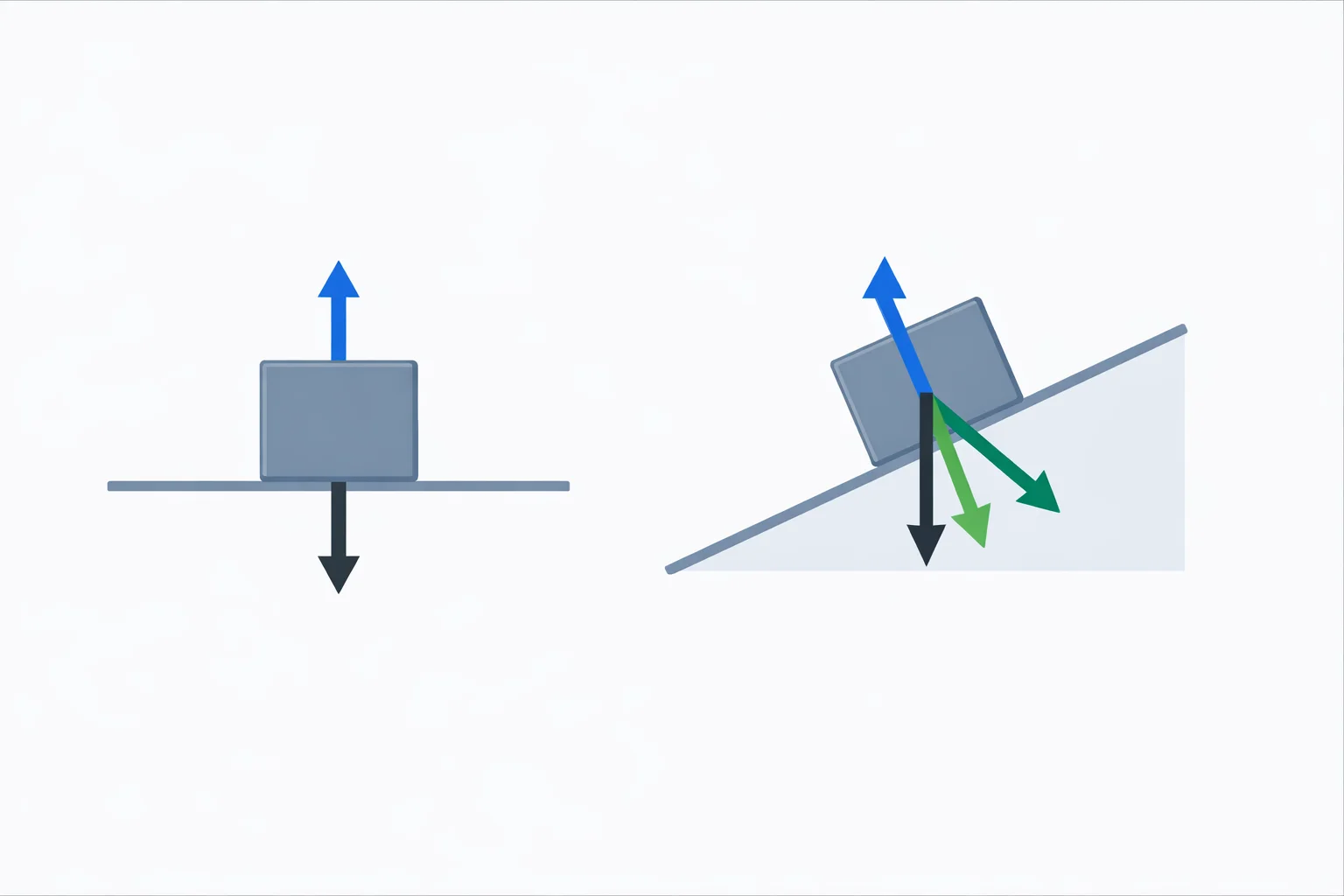
The Scale-Reading Test: Why Weight and Normal Force Aren't the Same
Step on a bathroom scale in your bedroom: 70 kg, say. The scale shows 686 N — that's your weight. Now carry that same scale into an elevator and press the button for floor 20. The instant the elevator accelerates upward at 2 m/s², the scale jumps to roughly 826 N. You didn't eat anything. Your body still contains 70 kg of mass. But the number changed.
That's because a bathroom scale doesn't measure mass or weight — it measures the normal force you push down on it with. At rest, that normal force happens to equal your weight (N = mg = 686 N). Accelerating up, it equals m(g + a) = 70 × 11.81 = 826.7 N. The scale honestly reports what it's feeling. The rest is physics the instrument can't see.
This single experiment is the cleanest way to understand the difference between the two quantities. Weight is how hard Earth pulls on you. Normal force is how hard the surface pushes back. They're equal only when nothing else is pulling you away from or pushing you into that surface.
Weight vs Normal Force: Formal Definitions and Units
Weight (W or Fg) is the gravitational force Earth exerts on an object: W = mg, where m is mass in kilograms and g is 9.81 m/s² at sea level. Weight points straight down toward Earth's center, always. Units: newtons (N). A 1 kg textbook has a weight of 9.81 N anywhere on Earth's surface.
Normal force (N or FN) is the contact force a surface exerts on an object, directed perpendicular to the surface. Units: also newtons. The word “normal” here doesn't mean “ordinary” — it's the geometric term for perpendicular. On a flat floor, the normal force points straight up. On a 30° ramp, it points up-and-away from the ramp surface at 60° from horizontal.
Solving for N on any free body diagram comes from Newton's second law applied perpendicular to the surface. If the object isn't accelerating into or out ofthe surface, the forces perpendicular to the surface sum to zero, and that equation gives you N. For a deeper look at how Newton's second law drives every free body diagram, the force calculator walks through F = ma with worked examples.
Side-by-Side: When Weight = N and When It Doesn't
Here's a 10 kg block (weight = 98.1 N) placed in five different scenarios. Watch how the normal force changes while the weight stays fixed:
| Scenario | Weight (N) | Normal Force (N) | Why It Differs |
|---|---|---|---|
| Flat floor, at rest | 98.1 | 98.1 | Perfect balance |
| On a 30° incline | 98.1 | 85.0 | N = mg cos 30° |
| On a 60° incline | 98.1 | 49.05 | N = mg cos 60° |
| Elevator up at 3 m/s² | 98.1 | 128.1 | N = m(g + a) |
| Free-falling elevator | 98.1 | 0 | a = −g, full cancellation |
Every row has the same object and the same Earth. What changed is the geometry and the acceleration — and N tracks those changes while weight doesn't care.
On an Incline: Why N Shrinks as the Slope Steepens
Tilt a surface by angle θ and gravity still pulls the block straight down with force mg. But only part of that weight pressesinto the ramp. The other part pulls the block alongthe ramp. Decomposing mg into those two perpendicular directions gives you two components: mg cosθ pressing into the surface, and mg sinθ pulling the block down the slope.
Since the block isn't burrowing into the ramp or floating off it, the surface responds with a normal force equal and opposite to that perpendicular component: N = mg cosθ. Increase the angle and cosθ shrinks, so N shrinks too. At 90° (a vertical wall) cosθ = 0 and the normal force vanishes — the block has nothing to rest on.
The ripple effect matters far beyond textbook problems. Static friction is fs = μsN, so when N drops on a steeper slope, the maximum friction also drops. The friction force calculator uses this same mg cosθ geometry to decide whether an object slides or holds on a ramp. That's why a box starts sliding on a ramp once the angle passes a critical value: mg sinθ (pulling it down) finally exceeds μsmg cosθ (holding it up). Canceling mg gives the clean result tanθslip = μs. For a rubber-on-asphalt coefficient of 0.8, that threshold is about 38.7°. For ice (μs\u2248 0.03), just 1.7°. Run that logic in reverse and the slip angle becomes a measuring tool — the coefficient of friction calculator turns a measured tilt angle straight into μ.
The Elevator Problem: Your Apparent Weight in Motion
Here's a clean exam-style scenario. A 65 kg passenger stands on a bathroom scale inside an elevator. The elevator accelerates upward at 2.5 m/s² for 4 seconds, cruises at constant velocity for 10 seconds, then decelerates at 2.5 m/s² until it stops. What does the scale read during each phase?
Apply Newton's second law in the vertical direction. The forces on the passenger are the normal force N (up, from the scale) and the weight mg (down). Net force equals ma:
Phase 1 (accelerating up, a = +2.5):N − mg = ma → N = m(g + a) = 65 × 12.31 = 800.2 N. Scale reads 81.6 kg. Feels about 26% heavier.
Phase 2 (constant velocity, a = 0):N = mg = 65 × 9.81 = 637.7 N. Scale reads 65 kg. Feels normal because N exactly balances weight.
Phase 3 (decelerating up, a = −2.5):N = m(g + a) = 65 × 7.31 = 475.2 N. Scale reads 48.4 kg. Feels 25% lighter — that stomach-dropping moment.
Two subtle points students miss. First, the acceleration sign is about direction, not whether the elevator is speeding up. An elevator going down but slowing down has positive upward acceleration. Second, the scale reading at constant velocity is the same whether the elevator is rising at 3 m/s, falling at 3 m/s, or parked — only acceleration changes N.
Reference: Typical Normal Force Values You'll Encounter
Having a feel for real-world numbers catches arithmetic errors fast. If your answer for a car on pavement comes out to 500 N, you know you've dropped a factor of 10 somewhere.
| Object / Scenario | Mass | Normal Force |
|---|---|---|
| Smartphone on a desk | 0.2 kg | 1.96 N |
| Laptop on a desk | 2.2 kg | 21.6 N |
| Adult on a bathroom scale | 75 kg | 735.8 N |
| Sedan on pavement (each tire) | ~375 kg | ~3,679 N |
| Sedan on a 5° banked ramp | 1,500 kg | 14,771 N (total) |
| Astronaut on ISS floor | 80 kg | ~0 N (free fall) |
| Truck (18-wheeler) on highway | 36,000 kg | 353,160 N |
Notice the jump from a person (735 N) to a sedan (14,700 N) to a truck (353,000 N) — roughly 20× each step. That's why bridge engineers rate load capacity in tonnes, not newtons. Normal force from friction is the companion quantity. The net force calculator helps when multiple forces (normal force, friction, applied push) need to be summed as vectors.
Common Mistakes (and What They Actually Cost You)
Three errors show up constantly in graded work:
- Using N = mg on an incline.A 12 kg box on a 40° ramp has N = 12 × 9.81 × cos 40° = 90.2 N, not 117.7 N. Friction = μN inherits the same mistake, so a friction calculation can be off by 23% with a single wrong cosine.
- Sign-flipping acceleration in elevator problems.“Going down” isn't the same as “accelerating down.” A descending elevator that's slowing has upward acceleration. Always draw the velocity and acceleration arrows before writing the equation.
- Treating N and mg as a Newton's third law pair.They're not. Third-law pairs act on different bodies. N acts on the block (from the table); the reaction is the block pushing down on the table. mg acts on the block (from Earth); its reaction is the block pulling up on Earth. Four different forces, not two.
When the Simple N = mg cosθ Formula Breaks Down
The tidy formulas in this article assume rigid surfaces, point contacts, and Newtonian mechanics. They break down in three ways worth knowing about.
On soft or deforming surfaces, the contact area spreads, pressure distribution varies, and “the” normal force becomes an integral of stress over the contact patch. A car tire has roughly 140–200 kPa of contact pressure over 150 cm² — the total normal force is still m g cosθ, but you can no longer treat it as a single arrow.
When the object is accelerating along the normal direction— a roller-coaster cresting a hill, or a car hitting a dip — the formula becomes N = m(g ± a) or, for a curved surface of radius r, N = m(g − v²/r) at the top of the crest. At high enough speed, v²/r exceeds g and the normal force would need to go negative: the car leaves the road.
At relativistic or quantum scales, the whole concept dissolves. “Normal force” at the atomic level is electron cloud repulsion — quantum mechanical, not a classical push. That's why you feel a floor at all, but it's not the framework to reach for when solving an inclined plane problem. For those, the tension calculator is the natural companion — normal force and tension are the two contact forces that appear in almost every introductory free-body diagram.