From Tug-of-War to Car Crashes: How Net Force Decides What Moves and What Doesn’t
How to calculate net force in physics comes down to one deceptively simple idea: add up every push and pull on an object as vectors, and whatever's left over is what actually accelerates it. That single leftover vector is the net force — written F_net or just “Fnet” in most textbooks and on the AP equation sheet. Simple in principle \u2014 but a 1,200 kg car slamming into a barrier at 56 km/h (35 mph) generates a net force around 90,000 N during the 0.15-second crumple, enough to crush a steel frame like a soda can. That single number \u2014 the resultant of all contact forces, friction, and deformation resistance acting at once \u2014 determines whether the occupant walks away or doesn't. Every force problem you'll ever solve, from a textbook free body diagram to an actual crash reconstruction, is just a more careful version of the same vector sum.
A 35 mph Crash and 90,000 Newtons of Net Force
Here's how crash engineers use net force in practice. A 1,200 kg test vehicle hits a rigid barrier at 15.6 m/s (56 km/h). High-speed cameras show the front crumple zone collapses over about 0.6 meters in roughly 0.15 seconds. Using the impulse-momentum theorem:
F_net \u00D7 \u0394t = m \u00D7 \u0394v
F_net = m \u00D7 \u0394v / \u0394t = 1,200 \u00D7 15.6 / 0.15 = 124,800 N
That's the average net force. Real crash pulses peak higher \u2014 National Highway Traffic Safety Administration (NHTSA) data shows peak forces around 150,000\u2013200,000 N for a 35 mph frontal crash. The crumple zone's entire job is stretching \u0394t from 0.01 seconds (hitting a concrete wall) to 0.10\u20130.15 seconds, which cuts F_net by a factor of 10\u201315. The vector sum of all the internal deformation forces, friction between crumpling panels, and seatbelt restraint forces yields that net force on the occupant. Every newton of that sum translates directly into acceleration via F_net = ma, and the human body can tolerate roughly 60 g (\u224835,000 N for a 60 kg person) before serious injury becomes likely.
The Component Method \u2014 Why You Can't Just Add Magnitudes
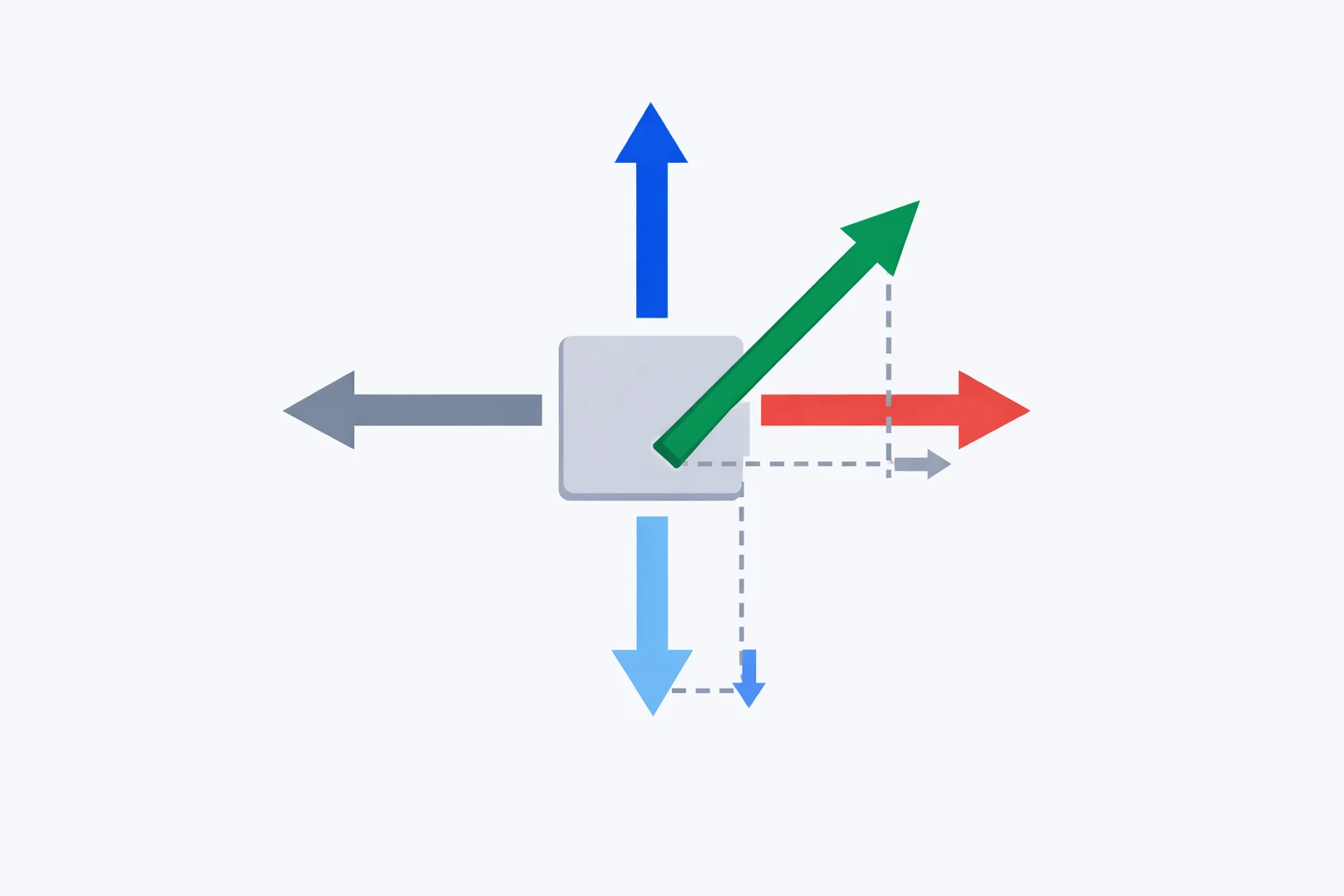
The net force formula requires vector addition, not arithmetic. For any set of forces, the procedure is always the same: decompose each force into x and y components, sum all x-components, sum all y-components, then recombine.
F_x = F cos\u03B8 F_y = F sin\u03B8
F_net = \u221A(\u03A3F_x\u00B2 + \u03A3F_y\u00B2)
\u03B8_net = arctan(\u03A3F_y / \u03A3F_x)
Consider two forces: 50 N at 0\u00B0 and 30 N at 90\u00B0. Adding magnitudes gives 80 N, which is wrong. The component method gives:
\u03A3F_x = 50 cos(0\u00B0) + 30 cos(90\u00B0) = 50 + 0 = 50 N
\u03A3F_y = 50 sin(0\u00B0) + 30 sin(90\u00B0) = 0 + 30 = 30 N
F_net = \u221A(50\u00B2 + 30\u00B2) = \u221A(3400) = 58.31 N
\u03B8 = arctan(30/50) = 30.96\u00B0
The resultant is 58.31 N, not 80 N \u2014 a 27% overestimate if you skip vector addition. In a tension problem with angled ropes, that error compounds through every step of the solution.
Three Ropes, Three Angles: A Worked Example
A 25 kg crate sits on a factory floor. Three workers pull it with ropes: Worker A applies 80 N at 20\u00B0, Worker B applies 65 N at 140\u00B0, and Worker C applies 50 N at 260\u00B0. What's the net force and the crate's acceleration?
Worker A (80 N, 20\u00B0):
F_Ax = 80 cos(20\u00B0) = 75.18 N
F_Ay = 80 sin(20\u00B0) = 27.36 N
Worker B (65 N, 140\u00B0):
F_Bx = 65 cos(140\u00B0) = \u221249.79 N
F_By = 65 sin(140\u00B0) = 41.78 N
Worker C (50 N, 260\u00B0):
F_Cx = 50 cos(260\u00B0) = \u22128.68 N
F_Cy = 50 sin(260\u00B0) = \u221249.24 N
Totals:
\u03A3F_x = 75.18 + (\u221249.79) + (\u22128.68) = 16.71 N
\u03A3F_y = 27.36 + 41.78 + (\u221249.24) = 19.90 N
F_net = \u221A(16.71\u00B2 + 19.90\u00B2) = 25.99 N
\u03B8 = arctan(19.90 / 16.71) = 49.97\u00B0
a = F_net / m = 25.99 / 25 = 1.04 m/s\u00B2
Three workers pulling with a combined 195 N of effort only produce 26 N of net force \u2014 an 87% loss from opposing directions. The crate crawls at just over 1 m/s\u00B2. If all three pulled at the same angle, they'd get 195 N net and 7.8 m/s\u00B2 of acceleration. This is exactly why coordinated pulling matters in rescue operations and rigging. One force we left out for clarity is friction with the floor, which would oppose the 26 N resultant and could keep the crate stationary entirely — the friction force calculator shows how much push it takes to break a resting object loose.
Collinear vs. Angled Forces \u2014 A Comparison That Matters
| Scenario | Forces Applied | Angle Between | Net Force | Efficiency |
|---|---|---|---|---|
| Both pulling same direction | 60 N + 60 N | 0\u00B0 | 120.0 N | 100% |
| Pulling at 30\u00B0 apart | 60 N + 60 N | 30\u00B0 | 115.9 N | 96.6% |
| Pulling at 60\u00B0 apart | 60 N + 60 N | 60\u00B0 | 103.9 N | 86.6% |
| Pulling at 90\u00B0 apart | 60 N + 60 N | 90\u00B0 | 84.9 N | 70.7% |
| Pulling at 120\u00B0 apart | 60 N + 60 N | 120\u00B0 | 60.0 N | 50.0% |
| Pulling opposite directions | 60 N + 60 N | 180\u00B0 | 0.0 N | 0% |
The efficiency column is the ratio of the net force to the arithmetic sum. For two equal forces, it follows the formula: efficiency = cos(\u03B1/2), where \u03B1 is the angle between them. At 90\u00B0 you've already lost 29.3% of the total effort to opposing components. This is why sled dogs are harnessed in a narrow fan, not a wide V \u2014 spreading the angle from 20\u00B0 to 60\u00B0 between the outermost dogs drops the forward pull by over 13%.
Net Forces You Encounter Every Day
| Situation | Approximate Net Force | What's Happening |
|---|---|---|
| Book on a table | 0 N | Gravity and normal force cancel exactly |
| Walking (per step) | 50\u2013100 N | Friction pushes you forward; briefly unbalanced |
| Braking a car (normal stop) | 4,000\u20138,000 N | Tire friction opposes forward momentum |
| Sprinter accelerating (100 m start) | 600\u2013800 N | Ground reaction exceeds body weight |
| Elevator acceleration (up) | 1,500\u20133,000 N | Cable tension exceeds cabin weight |
| 35 mph car crash (peak) | 150,000\u2013200,000 N | All deformation forces act on the vehicle |
| Falcon 9 rocket at liftoff | ~2,800,000 N | Thrust minus weight of fueled rocket |
Notice the enormous range. A book at rest and a launching rocket both follow ΣF = ma. The book's net force is zero because the 20 N normal force from the table exactly cancels the 20 N weight pulling down \u2014 the normal force calculator shows how N adjusts when that balance breaks (on inclines, in elevators, or under an applied push). The Falcon 9's 2.8 million N of net force accelerates its 549,000 kg mass at roughly 5.1 m/s² (≈0.52 g) right off the pad. Use the force calculator to solve for any single variable in F = ma once you know the net force magnitude. If you want to see how that net force converts into energy, the work calculator connects F_net to work done over a distance.
When \u03A3F = ma Stops Being Enough
Newton's second law assumes constant mass and non-relativistic speeds. It breaks down in a few specific situations:
- Variable mass systems: A rocket burns fuel continuously, so m decreases over time. You need the Tsiolkovsky rocket equation instead of plain F = ma. A Falcon 9 that starts at 549,000 kg ends first-stage burn at roughly 75,000 kg \u2014 the same net thrust produces wildly different accelerations at the start and end of the burn.
- Relativistic speeds: Above about 0.1c (30,000 km/s), relativistic momentum p = \u03B3mv replaces classical p = mv. At CERN, protons circulating at 0.999999991c have an effective inertial mass about 7,454 times their rest mass.
- Non-inertial reference frames:If your coordinate system is accelerating (you're on a merry-go-round, inside a turning car, or on Earth's rotating surface), fictitious forces like the Coriolis effect appear. These aren't real forces \u2014 they're artifacts of the rotating frame \u2014 but you have to include them in \u03A3F to make predictions that match observation.
- Deformable bodies:\u03A3F = ma treats objects as point particles. A real car in a crash doesn't accelerate uniformly \u2014 the front crumples while the rear is still moving at impact speed. You need finite element analysis, not a single net force equation, to model what each part of the structure experiences.
Three Net Force Mistakes That Cost Exam Points
After grading hundreds of AP Physics free-response answers, these three errors come up over and over:
- Adding magnitudes instead of components. Two 40 N forces at 60\u00B0 to each other produce 69.3 N, not 80 N. The magnitude error is 15.4% \u2014 enough to lose full marks on a multi-step problem because every subsequent calculation inherits the wrong number. Always decompose into x and y first, even if it feels like extra work.
- Forgetting that cos(90\u00B0) = 0, not 1. A surprisingly common calculator mistake. If a force acts purely vertically (90\u00B0 from the x-axis), its x-component is F cos(90\u00B0) = 0, not F. Students who rush through trig substitutions often write down the magnitude instead of the component. On a kinetic energy problem where you need acceleration from net force, this error makes the calculated KE wrong by a factor that depends on the angle.
- Using the wrong sign convention and not catching it. If you define rightward as positive but forget to make a leftward force negative, you add 30 N instead of subtracting it. The net force comes out 60 N too high. Draw the free body diagram, label your positive direction, and double-check that every force's sign matches its direction before summing.