Coulomb’s Law Explained: The Force That Holds Atoms Together and Rips Them Apart
Here's a number that should bother you: the electrostatic repulsion between two protons sitting one femtometer apart is roughly 230 newtons — enough to lift a small adult off the ground. That's from particles so small you can't see them with any microscope. Coulomb's Law, the equation behind this Coulomb's Law calculator, describes the force between any two charged objects and it's arguably the most important formula in all of electrostatics. Without it, we can't explain why atoms hold together, why lightning strikes, or why your socks cling to your pants out of the dryer.
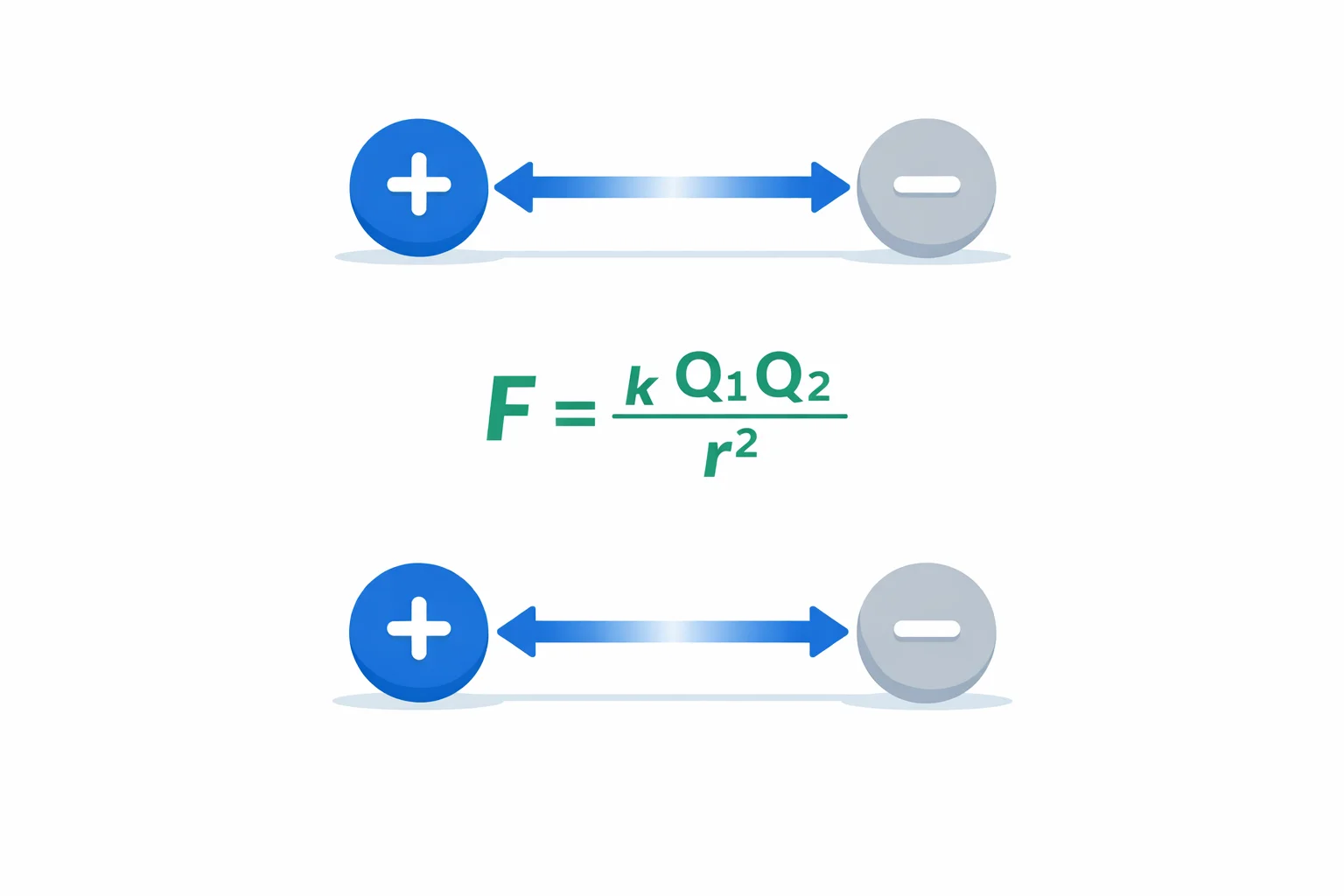
The Formula and What Each Variable Means
Coulomb's Law is written as F = kQ₁Q₂/r², where:
- F — the magnitude of the electrostatic force in newtons (N)
- k — Coulomb's constant, 8.9876 × 10⁹ N·m²/C² (sometimes written as 1/4πε₀)
- Q₁ and Q₂ — the charges in coulombs (C)
- r — the center-to-center distance between the charges in meters
The sign convention is straightforward. Plug in the actual charge values — positive or negative — and if the result is positive, the force is repulsive (like charges). Negative result? Attractive (opposite charges). For magnitude calculations, just use absolute values.
One subtlety students miss: the coulomb is a hugeunit of charge. A single coulomb is about 6.24 × 10¹⁸ elementary charges. In practice, you'll almost always work with microcoulombs (μC = 10⁻⁶ C) or nanocoulombs (nC = 10⁻⁹ C) unless you're calculating forces at the subatomic scale, where charges are multiples of 1.602 × 10⁻¹⁹ C.
Worked Example: Two Charged Spheres in a Lab
Imagine a classic AP Physics lab setup. You've got two small conducting spheres on insulating stands. Sphere A carries +3.0 μC and sphere B carries −1.5 μC. They're 0.20 m apart, center to center. What's the force between them?
Step 1: Convert to SI units. Q₁ = 3.0 × 10⁻⁶ C, Q₂ = 1.5 × 10⁻⁶ C (using magnitudes for the force calculation).
Step 2: Plug into the formula.
F = (8.99 × 10⁹)(3.0 × 10⁻⁶)(1.5 × 10⁻⁶) / (0.20)²
F = (8.99 × 10⁹)(4.5 × 10⁻¹²) / (0.04)
F = 4.046 × 10⁻² / 0.04 = 1.01 N
That's roughly the weight of a small apple, produced by charges you can barely measure on a household scale. And since the charges are opposite in sign, this is an attractive force — the spheres pull toward each other. Try adjusting the distance in the calculator above to see how quickly this force ramps up if you move them closer.
Why the Inverse-Square Law Matters So Much
The r² in the denominator isn't arbitrary — it's a geometric consequence of living in three-dimensional space. Picture the electric field radiating outward from a charge in all directions. At distance r, that field spreads over a sphere with surface area 4πr². Double the distance and the same "amount" of field covers four times the area, so the intensity at any point drops to one quarter.
This has practical consequences that catch students off guard. Moving two charges from 10 cm to 5 cm apart doesn't double the force — it quadruplesit. Move from 10 cm to 1 cm and the force jumps by a factor of 100. That extreme sensitivity to distance is why static electricity effects seem to "suddenly" appear when objects get close. The force was always there; it was just too weak to notice until the gap shrank enough.
Coulomb's Law vs. Newton's Gravitational Law
The resemblance between F = kQ₁Q₂/r² and F = Gm₁m₂/r² is striking, and it's not a coincidence. Both are inverse-square force laws describing how a property of matter (charge or mass) creates a field that affects other objects carrying that same property. But the differences are just as important:
| Property | Coulomb's Law | Newton's Gravity |
|---|---|---|
| Source | Electric charge | Mass |
| Constant | k = 8.99 × 10⁹ | G = 6.674 × 10⁻¹¹ |
| Direction | Attractive or repulsive | Always attractive |
| Relative strength | ~10³⁶ times stronger | Extremely weak |
| Dominant at | Atomic / molecular scale | Planetary / cosmic scale |
Gravity dominates at large scales only because matter is electrically neutral overall — the positive and negative charges cancel out, leaving gravity as the only long-range force that accumulates. If you could somehow give the Earth a net charge of just 1 coulomb per kilogram of mass, the electrostatic force would overwhelm gravity entirely.
Superposition: When More Than Two Charges Are Involved
Real problems rarely involve just two charges. The superposition principle says the net force on any charge is the vector sum of the individual Coulomb forces from every other charge. "Vector sum" is the key phrase — you can't just add the magnitudes. You have to account for direction.
Consider three charges in a line: Q₁ = +2 μC at x = 0, Q₂ = −3 μC at x = 0.3 m, and Q₃ = +1 μC at x = 0.5 m. To find the net force on Q₂, calculate the Coulomb force from Q₁ on Q₂ (attractive, pulling left) and from Q₃ on Q₂ (attractive, pulling right), then subtract since they're in opposite directions. Our electric field calculator handles the superposition of two fields at any test point if you need to visualize this.
Mistakes Students Make With Coulomb's Law
After grading hundreds of physics exams, certain errors show up like clockwork:
- Forgetting to square the distance. The most common mistake, period. Students write kQ₁Q₂/r instead of kQ₁Q₂/r². This gives an answer that's off by a factor of r, which can be enormous.
- Using centimeters instead of meters. If r = 30 cm, you must convert to 0.30 m before plugging in. Using 30 makes the denominator 900 instead of 0.09 — your answer will be 10,000 times too small.
- Confusing force with field. Force (F = kQ₁Q₂/r²) requires two charges. Electric field (E = kQ/r²) uses only the source charge. Mixing these up gives the wrong units and the wrong answer.
- Ignoring signs during superposition. When adding forces from multiple charges, you need to track direction. Two forces of 5 N and 3 N can give a net force anywhere from 2 N to 8 N depending on the angle between them.
- Treating Coulomb's Law as exact for all situations. It's only exact for point charges or spherically symmetric distributions. Two irregularly shaped conductors close together? The charge redistributes and the point-charge formula breaks down.
Where Coulomb's Law Breaks Down
Coulomb's Law is a static law — it assumes the charges aren't moving (or are moving slowly enough that magnetic effects are negligible). Once charges start moving at appreciable speeds, you need the full Lorentz force law, which adds a magnetic force term: F = qE + qv × B. Our magnetic force calculatorhandles that second term, computing F = qvB sin(θ) for moving charges and F = BIL sin(θ) for current-carrying wires. At relativistic speeds, even the Lorentz force law isn't enough, and you need the machinery of special relativity.
The law also assumes vacuum or a simple dielectric medium. Inside a conductor, free charges rearrange to cancel internal fields — Coulomb's Law still holds for individual charge pairs, but the net effect is screened. In plasmas, a similar screening effect (Debye shielding) limits the range of the Coulomb interaction.
At quantum scales, Coulomb's Law gets replaced by quantum electrodynamics (QED), where photons mediate the electromagnetic force. The classical formula remains an excellent approximation for everyday and even most atomic-scale calculations, though.
From Xerox Machines to DNA: Real Applications
Coulomb's Law isn't confined to physics textbooks. Laser printers and photocopiers use electrostatic attraction to transfer toner particles onto paper — the charged drum attracts toner with a force governed directly by Coulomb's Law. Electrostatic precipitators in power plants use the same principle to remove soot and ash from exhaust gases, charging the particles and then collecting them on oppositely charged plates.
In biochemistry, the stability of DNA's double helix depends heavily on electrostatic interactions between the negatively charged phosphate backbone and positively charged histone proteins. Drug designers use Coulomb's Law calculations to predict how well a drug molecule will bind to its target protein based on the charge distributions of both. The capacitance calculatorshows a related application — parallel plate capacitors store energy by exploiting the same electrostatic forces between separated charges.
Even touchscreens rely on Coulomb's Law. Capacitive touch screens detect your finger because your body carries enough charge to alter the electric field at the screen surface, changing the capacitance at that point. Every tap is a Coulomb's Law calculation in miniature.
When to Use This Coulomb's Law Calculator
Use this calculator whenever you need to find the electrostatic force between point charges, whether for homework, AP exam prep, or quick lab estimates. The three solve-for modes let you work backwards from any known quantity. If your problem involves electric fields rather than forces, switch to our electric field calculator, which handles point charges, superposition, and parallel plate configurations.
For circuit problems where current is flowing and you need voltage, current, or resistance relationships, the Ohm's Law calculator is the right tool. And if your problem asks about voltage at a point rather than force, our electric potential calculator handles V = kQ/r and superposition of multiple charges. If you need to calculate the work done when a Coulomb force moves a charge through a distance, the work calculatorapplies the general W = Fd cos(θ) formula with step-by-step breakdowns. Coulomb's Law covers the static force between charges; Ohm's Law covers what happens when those charges start moving through a wire.