How to Find Electric Field Strength: Point Charges, Superposition, and Parallel Plates
A 1 µC charge sitting on a lab bench creates an electric field of nearly 36,000 N/C at just 50 cm away. That's strong enough to deflect a stream of water from a faucet, and your electric field calculator above can show you exactly how that number comes from E = kQ/r². But the formula is deceptively simple — the real challenge is knowing when to use it, when to use superposition instead, and when neither applies because you're dealing with parallel plates.
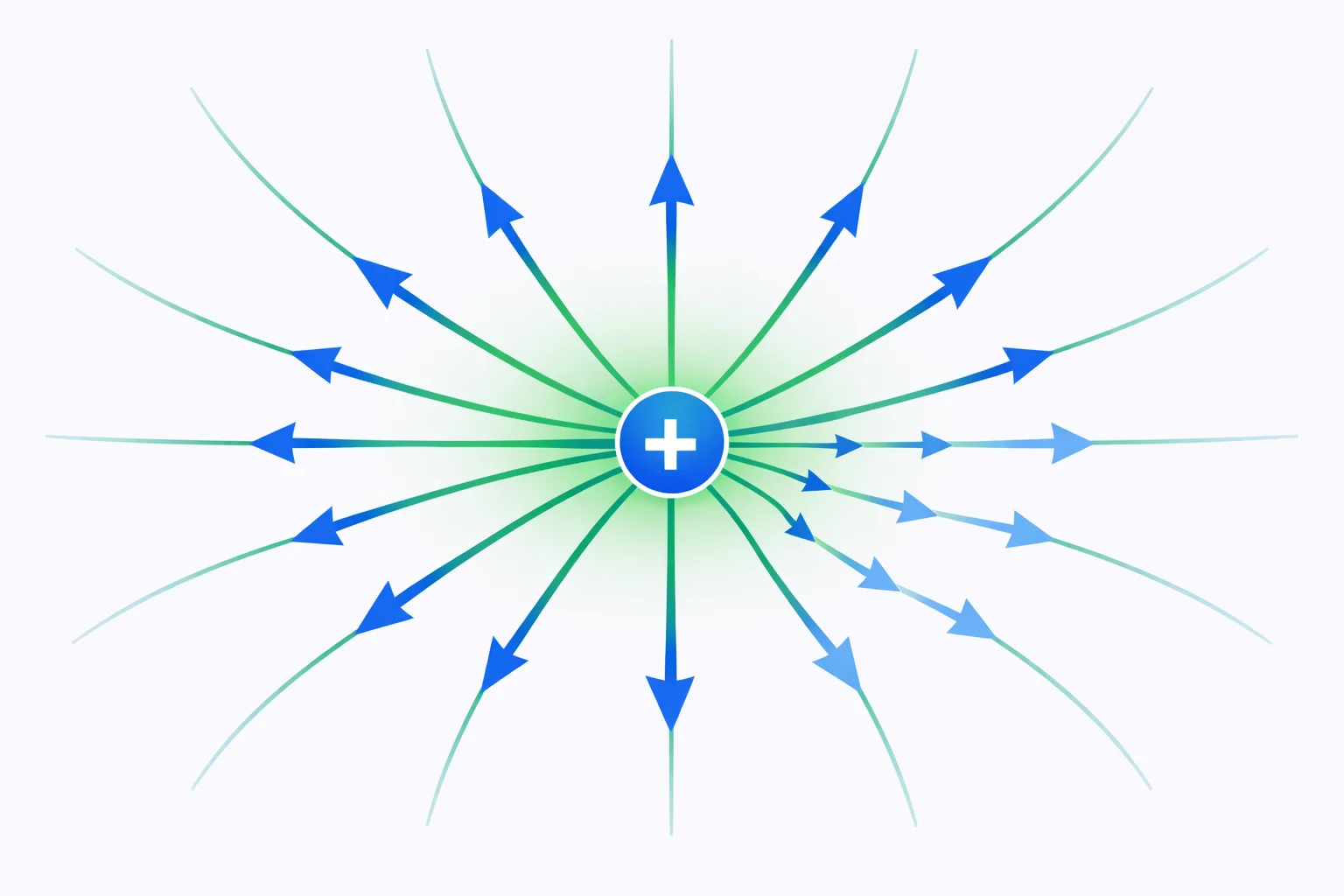
Coulomb's Law and the Electric Field Formula
The electric field at a distance r from a point charge Q is:
E = k|Q| / r²
where k = 8.99 × 10&sup9; N·m²/C² (Coulomb's constant). The bars around Q mean we use the absolute value for magnitude — the sign of Q only tells you the direction: outward for positive charges, inward for negative ones. This formula is derived directly from Coulomb's Law (F = kQ₁Q₂/r²) by dividing both sides by the test charge — our Coulomb's Law calculatorlets you work with the force equation directly if that's what your problem requires.
Notice the r² in the denominator. This inverse-square relationship is identical to gravity, and it has the same dramatic consequence: move twice as far from a charge, and the field drops to one quarter. Move ten times farther and the field falls to 1/100th. Physicists call this an "inverse-square law," and it shows up everywhere from electrostatics to light intensity to sound.
Worked Example: The Static Charge on Your Phone Screen
Your phone screen picks up a static charge of about 0.5 µC (5 × 10⁻&sup7; C) on a dry winter day. What's the electric field 3 cm from the screen surface?
- Convert units: r = 3 cm = 0.03 m, Q = 5 × 10⁻&sup7; C
- Plug into the formula: E = (8.99 × 10&sup9;)(5 × 10⁻&sup7;) / (0.03)²
- Numerator: 8.99 × 10&sup9; × 5 × 10⁻&sup7; = 4,495 N·m²/C
- Denominator: (0.03)² = 9 × 10⁻&sup4; m²
- E = 4,495 / 9 × 10⁻&sup4; = 4,994,444 N/C ≈ 5 × 10&sup6; N/C
That's close to the breakdown voltage of air (3 × 10&sup6; V/m), which explains why you sometimes feel a small shock touching your phone after shuffling across carpet. The field is genuinely enormous at close range — it just drops off fast because of that r².
Superposition — Why Fields Add as Vectors
What happens when two charges are near each other? Each one creates its own field independently, and the total field at any point is the vector sum of all individual fields. This is the principle of superposition, and it's one of the most powerful ideas in electrostatics.
Here's where students trip up: electric fields are vectors, not scalars. You can't just add magnitudes. If a +2 µC charge creates a 1,000 N/C field pointing right at some point, and a −3 µC charge creates a 600 N/C field also pointing right at that same point, the net field is 1,600 N/C to the right. But if the second field pointed left, you'd get 400 N/C to the right instead. Direction matters.
The superposition mode in the calculator above handles this for you — slide the test point between two charges and watch the individual contributions and net field update in real time. For problems involving charges not on a single line, you'd need to break each field into x and y components, but the principle is identical.
The Uniform Field Between Parallel Plates
Point charges create fields that weaken with distance. Parallel plates do something different: they create a uniform field between them. The formula is remarkably simple:
E = V / d
where V is the voltage across the plates and d is the separation. A 200 V potential across plates 5 mm apart gives E = 200 / 0.005 = 40,000 V/m, uniform everywhere between the plates (except near the edges, where fringe effects bend the field lines outward).
This uniformity is why parallel plates are used in so many devices — cathode ray tubes, mass spectrometers, ink-jet printers, and Millikan's famous oil drop experiment all depend on the fact that a charged particle experiences a constant force between the plates, making its motion predictable and calculable. If you need to figure out the capacitance of that parallel plate setup, the relationship C = εA/d ties directly back to the same geometry.
Field Lines: What They Actually Tell You
Field lines aren't real physical objects — they're a visualization tool that Michael Faraday invented in the 1830s. But they encode two critical pieces of information at a glance:
- Direction: the tangent to a field line at any point gives the electric field direction there. Lines point away from positive charges and toward negative charges.
- Strength: where field lines are packed close together, the field is strong. Where they spread apart, the field is weak. The density of lines through a surface is proportional to field magnitude.
Two equal positive charges side by side? Their field lines push away from each other in the middle, creating a dead zone (E = 0) at the exact midpoint. A positive and negative charge? Their lines connect, running from the positive charge directly to the negative one — and the field between them is the strongest part of the diagram.
Where Students Lose Points on Exams
After grading hundreds of AP Physics exams, these are the mistakes that come up over and over:
- Forgetting to square the distance. E = kQ/r, not kQ/r²? That gives you electric potential (V), not electric field. This single error is probably the most common on the AP Physics C: E&M exam.
- Adding field magnitudes instead of vectors. Two charges creating 500 N/C each don't necessarily give you 1,000 N/C total. If the fields point in opposite directions, the net field could be anywhere from 0 to 1,000 N/C depending on the geometry.
- Using the wrong sign convention. The magnitude of E is always positive — it's the direction that carries the sign information. When problems ask for "the electric field," they usually want both magnitude and direction specified separately.
- Confusing E and F. The field E exists at a point in space regardless of whether a test charge is there. The force F = qE only appears when you actually place a charge q in that field. An Ohm's Law approach might help here: just as V = IR relates voltage to current, E = F/q relates field to force.
Electric Field vs. Gravitational Field
Both the electric field and the gravitational field follow inverse-square laws, and the math looks strikingly similar. But there are crucial differences that exam questions love to test:
| Property | Electric Field | Gravitational Field |
|---|---|---|
| Formula | E = kQ/r² | g = GM/r² |
| Source | Electric charge | Mass |
| Can be repulsive? | Yes (like charges) | No (always attractive) |
| Relative strength | ∼10³&sup6; × stronger | Weakest fundamental force |
| Shieldable? | Yes (Faraday cage) | No |
| Unit | N/C or V/m | N/kg or m/s² |
The fact that electric force is roughly 10³&sup6; times stronger than gravity between two protons is mind-boggling. The only reason gravity dominates at planetary scales is that matter is overwhelmingly neutral — positive and negative charges cancel, leaving gravity as the only game in town. There's also a third player: the magnetic force, which acts only on movingcharges and always pushes perpendicular to the velocity — a fundamentally different behavior from either electric or gravitational fields.
Real-World Applications of Electric Fields
Electric fields aren't just textbook abstractions. They drive real technology you interact with daily:
- Touchscreen displays: capacitive touchscreens use a uniform electric field across the glass. Your finger (a conductor) distorts that field locally, and the controller chip triangulates where you touched by measuring which corners of the screen see the biggest change in current flow.
- Laser printers and photocopiers: a corona wire creates a strong electric field (~5 × 10&sup6; V/m) that charges a photosensitive drum. Light from the laser discharges specific spots, and toner particles — attracted to the remaining charged areas — transfer the image to paper. The entire process is driven by carefully controlled electric fields.
- Lightning rods: a pointed conductor concentrates the electric field at its tip (sharp points have higher field strength due to smaller radius of curvature). When the atmospheric field exceeds air's breakdown threshold of ~3 × 10&sup6; V/m, the rod provides a controlled discharge path rather than letting lightning strike randomly.
- Electrostatic precipitators: coal power plants use fields of 30,000–60,000 V/m to charge and collect fly ash particles from exhaust, removing up to 99% of particulate matter before it reaches the atmosphere.
In every one of these cases, the same E = kQ/r² or E = V/d formula governs what happens — scaled up from textbook numbers to engineering reality.