How to Calculate Distance: Speed × Time, Acceleration, and Whole Trips
You leave home, drive 100 km/h on the motorway for an hour and a half, then crawl through 60 km/h roadworks for another half hour, and finally sit dead still at a closed level crossing for fifteen minutes. How far have you actually driven? This is the question a distance calculator in physics is built to answer, and the honest reply involves more than one multiplication. Distance is the total length of the path you cover — and the moment your speed changes, you can't just multiply one number by another and call it done.
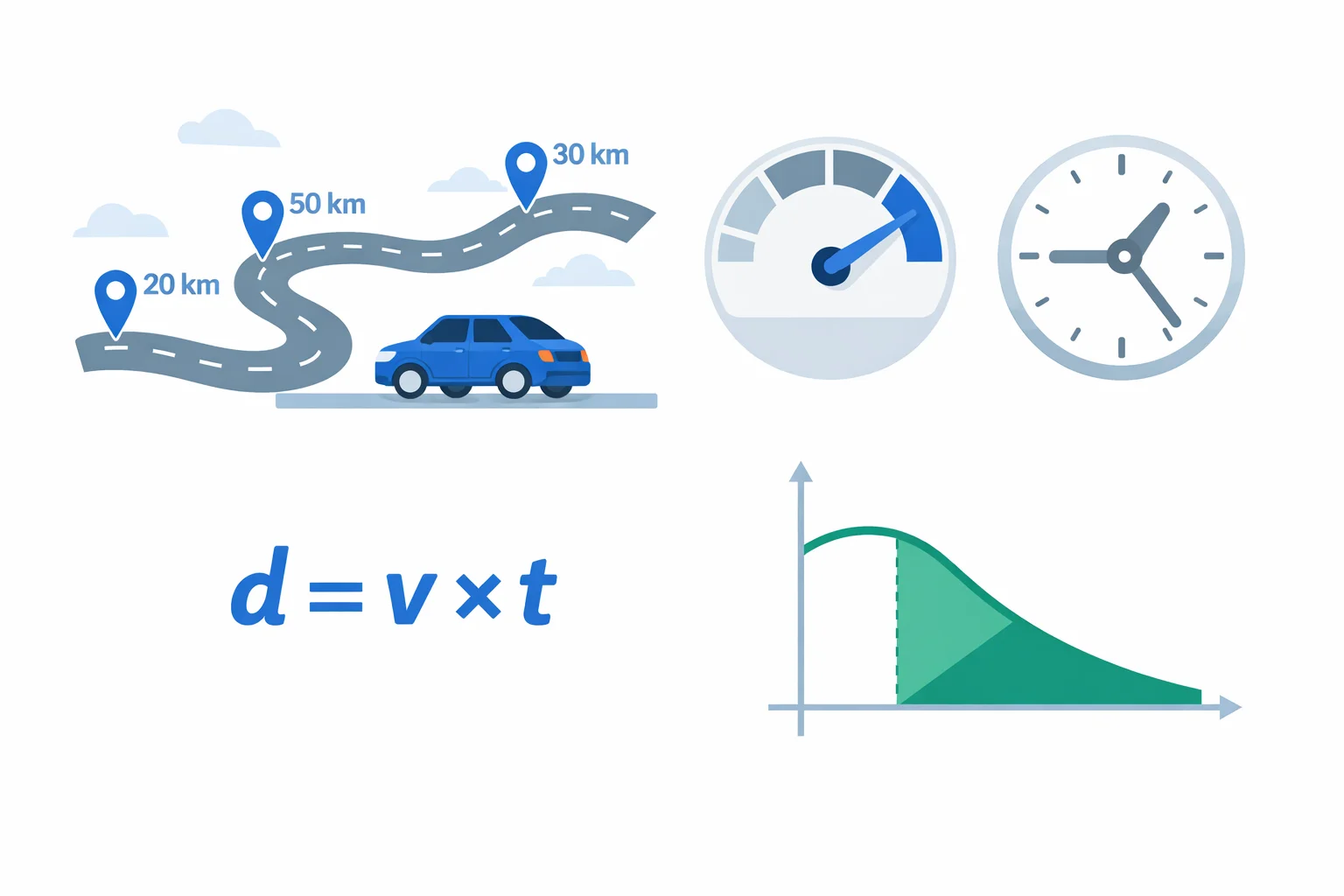
A Two-Speed Road Trip, Solved Live
Take that opening trip and pin down what's known. Leg one: 100 km/h for 1.5 hours. Leg two: 60 km/h for 0.5 hours. Leg three: 0 km/h (stopped) for 0.25 hours. The unknown is the total distance. The trick is to treat each leg on its own, because within each leg the speed holds steady, and a steady speed is the one case where distance is just speed times time.
Leg one covers 100 × 1.5 = 150 km. Leg two covers 60 × 0.5 = 30 km. Leg three covers 0 × 0.25 = 0 km — sitting still adds time but no distance. Add them up: 150 + 30 + 0 = 180 km total. Here's the part that catches people out: your average speed for the whole trip is 180 km ÷ 2.25 hours = 80 km/h, which is slower than either driving leg, because that fifteen-minute stop still counts against your time. To work that last figure directly from each leg, the average speed calculator totals the distances and times and divides for you. Plug those same three legs into the multi-leg mode above and you'll watch the total and the average speed update as you change them.
d = v × t and the Three Things It Quietly Assumes
The core formula is the one everybody knows: distance equals speed multiplied by time, d = v × t. Rearranged, it gives you v = d/t for speed or t = d/v for time, so a single relationship answers three different questions. But that clean little equation only works when three conditions hold, and exam questions love to break them.
First, the speed has to be constant — if it changes, you need a different approach (coming up next). Second, the units must match: speed in meters per second pairs with time in seconds to give meters, while km/h pairs with hours to give kilometers. Mix km/h with seconds and your answer is off by a factor of 3600. Third, d = v × t gives you distance along the path, which equals the straight-line displacement only when the motion stays in one direction. A car driving a steady 25 m/s for 8 seconds covers 25 × 8 = 200 m — but only if it never turns around.
Distance When the Speed Keeps Changing
Constant speed is the easy world. Real objects speed up and slow down. When an object accelerates at a steady rate, the distance it covers is d = v₀t + ½at², where v₀ is the starting velocity, a is the acceleration, and t is the time. That second term, ½at², is where the magic hides — because time is squared, distance piles up fast once an object gets moving.
Work a concrete case. A sprinter explodes out of the blocks from rest (v₀ = 0) and accelerates at 3.2 m/s² for the first 3 seconds. The distance is d = 0 × 3 + ½ × 3.2 × 3² = ½ × 3.2 × 9 = 14.4 m. Now double the time to 6 seconds and the distance becomes ½ × 3.2 × 36 = 57.6 m — four times as far, not twice, because the time got squared. That squaring is exactly why stopping distances balloon at highway speed and why a small increase in launch time sends a projectile dramatically farther.
Reading Distance Off a Speed-Time Graph
There's a second way to find distance that needs no formula at all: the area under a speed-time graph equals the distance traveled. Plot speed on the vertical axis and time on the horizontal, and the region trapped between the line and the time axis is your distance — units of (speed × time) work out to a length, which is why the area means what it means.
For constant speed, that area is a rectangle: 25 m/s held for 8 seconds traces a rectangle of area 25 × 8 = 200 m, the same answer d = v × t gives. For steady acceleration from rest, the graph is a sloping line and the area is a triangle: ½ × base × height = ½ × time × final speed. A car reaching 18 m/s over 6 seconds covers ½ × 6 × 18 = 54 m. When the speed wanders unpredictably — real lab data, a stop-and-go commute — you fall back on the area under the curve to total up the distance numerically.
Distance Is the Whole Path, Not the Shortcut
Distance and displacement get treated as the same word in conversation, but they split apart whenever the path bends or doubles back. Distance is a scalar — the full length you traveled, always zero or positive. Displacement is a vector — the straight-line gap from start to finish, with a direction. The calculator's accelerating mode makes this visible: throw a ball straight up at 15 m/s and let gravity decelerate it at 9.8 m/s². After 3 seconds the ball has gone up, stopped, and fallen partway back. Its path distance (up plus down) is larger than its net displacement, and the tool reports both, flagging the moment the object reverses.
| Question | Distance | Displacement |
|---|---|---|
| What it measures | Total path length | Start-to-end straight line |
| Scalar or vector? | Scalar (size only) | Vector (size + direction) |
| Can it be negative? | Never — always ≥ 0 | Yes — sign shows direction |
| One lap of a 400 m track | 400 m | 0 m (back to start) |
How Far You Travel Before You Even React
Here's a use of d = v × t that has nothing to do with homework and everything to do with staying alive. Before a driver hits the brakes, there's a reaction time — typically around 1.5 seconds from seeing a hazard to pressing the pedal. During that gap the car keeps moving at full speed, and the distance it covers is pure speed times time. These numbers are sobering once you see them laid out.
| Speed | Speed (m/s) | Reaction distance (1.5 s) |
|---|---|---|
| 30 km/h (city) | 8.3 | 12.5 m |
| 50 km/h (suburban) | 13.9 | 20.8 m |
| 100 km/h (motorway) | 27.8 | 41.7 m |
| 120 km/h (fast lane) | 33.3 | 50.0 m |
At 100 km/h you roll forward almost 42 meters — close to ten car lengths — before the brakes do a thing, and that's before the actual braking distance even starts. The reaction distance scales straight up with speed, so doubling your speed doubles this slice of the gap. It turns an abstract formula into a reason to leave a bigger following distance.
Practice Problems (With Answers)
Try these by hand, then check yourself against the calculator above.
- 1. A train travels at a constant 45 m/s for 4 minutes. How far does it go? Answer: convert 4 min to 240 s, then d = 45 × 240 = 10,800 m, or 10.8 km.
- 2. A cyclist starts from rest and accelerates at 1.5 m/s² for 8 seconds. Distance? Answer: d = ½ × 1.5 × 8² = ½ × 1.5 × 64 = 48 m.
- 3. A delivery van drives 80 km/h for 45 minutes, then 50 km/h for 30 minutes. Total distance? Answer: 80 × 0.75 + 50 × 0.5 = 60 + 25 = 85 km.
Distance Mistakes That Lose Exam Marks
- Forgetting to convert minutes or hours to seconds. A speed in m/s needs a time in seconds. If the problem gives minutes, multiply by 60 first — a 5-minute trip is 300 seconds, and skipping that step undercounts your distance by a factor of 60.
- Multiplying by average speed when speed isn't constant. For an accelerating object, d = v × t with the starting speed is wrong. Use d = v₀t + ½at², or in special cases the average of the start and end speeds times the time.
- Reporting a negative distance.Distance is a path length — it can't be negative. A minus sign means you've actually found a displacement or a velocity component. Take the absolute value if the question asks for distance.
- Counting the stops as zero time. In a multi-leg trip, a stop adds time without distance. Leave it out of the total time and your average speed comes out too high — which is the most common error on journey-graph questions.