Time Calculator: How to Solve for Time in Physics Kinematic Equations
Reach for the wrong time formula and you can be off by a factor of two without realizing it. A student calculating how long a car takes to cover 80 m while accelerating will often divide 80 by the final speed — and land on a time that's roughly half the real value. A physics time calculator only helps if you feed it the right equation, and which equation gives you time depends entirely on what you don't know. Sometimes finding time is a one-step division. Sometimes it means solving a quadratic with two valid answers. This page walks through every case and shows you which is which.
Time Is Hiding in Every Kinematic Equation
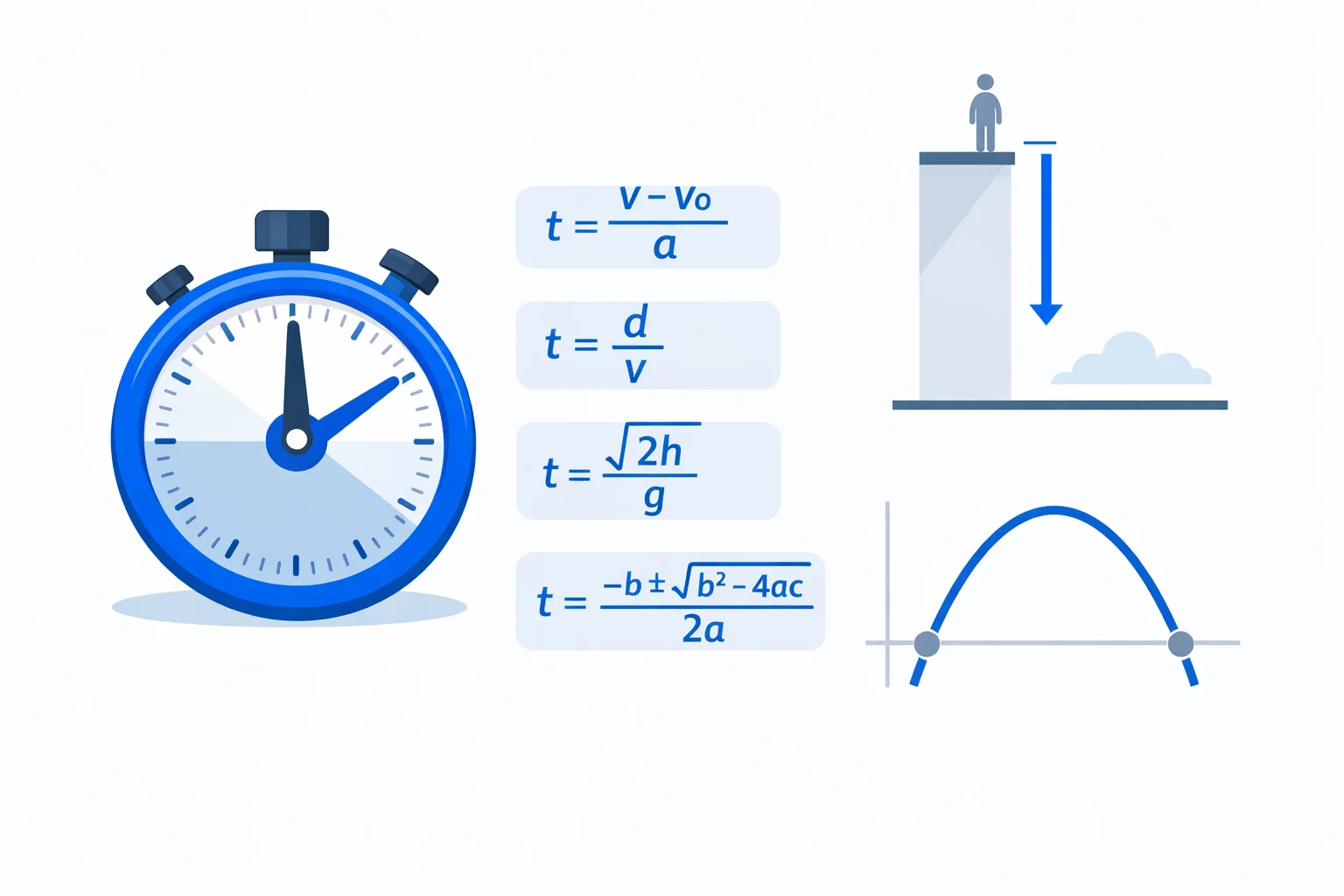
Time is the one variable that shows up in almost every equation of motion, which is exactly why it's easy to mis-handle. Speed is distance over time. Acceleration is a change in velocity over time. The displacement equation d = ut + ½at² has time squared in it. So when a problem asks "how long?", the first move isn't to grab a formula — it's to list what you already have. Distance and a steady speed? That's a division. A velocity change and an acceleration? Different formula. A displacement, a launch speed, and gravity pulling back? Now you're in quadratic territory. Get the inventory right and the formula picks itself.
The Easy Case: t = d/v When Speed Holds Steady
When nothing accelerates, time is just distance divided by speed: t = d/v. A train crossing a 1,200 m bridge at a steady 30 m/s takes 1,200 ÷ 30 = 40 seconds. A sprinter holding 10 m/s covers 100 m in exactly 10 s. This is the same relationship the speed calculator rearranges, and it's the only time formula most people ever meet. The catch is the word steady. The instant the speed changes, this clean division stops telling the truth, and you have to bring acceleration into the picture.
Timing an Acceleration with t = (v − u)/a
If you know how much the velocity changed and how hard the object was accelerating, time falls straight out of the definition of acceleration. Rearrange a = (v − u)/t into t = (v − u)/a. A car pulling away from a light at 4 m/s² and reaching 27.8 m/s (100 km/h) takes (27.8 − 0)/4 = 6.95 seconds — which lines up nicely with the 0-to-100 figures carmakers quote. Braking is the same formula with a negative sign: a motorcycle decelerating at −8 m/s² from 24 m/s stops in (0 − 24)/(−8) = 3 seconds. You can find that acceleration value first if it isn't given, then plug it in here.
When Solving for Time Means the Quadratic Formula
Here's where most "time calculators" quietly give up. If you know the displacement, the starting velocity, and the acceleration — but not the final velocity — the equation you need is d = ut + ½at². That t² makes it a quadratic, and you have to solve it like one. Rearranged into standard form it becomes ½at² + ut − d = 0, and the quadratic formula gives:
t = [ −u ± √(u² + 2ad) ] / a
Take a ball dropped from rest (u = 0) under gravity, falling 20 m. Plug in: t = √(2 × 9.8 × 20)/9.8 = √392/9.8 = 19.8/9.8 ≈ 2.02 s. With u = 0 the formula collapses to the handy free-fall shortcut t = √(2d/g). But leave a starting velocity in there and the full quadratic earns its keep — and it can hand you two answers instead of one.
Two Answers for Time, and Why Both Are Real
A quadratic has two roots, and in kinematics both can be genuine. Throw a ball straight up at 20 m/s and ask when it's at a height of 15 m. Set d = 15, u = 20, a = −9.8 in d = ut + ½at². Solving gives t ≈ 0.99 s and t ≈ 3.09 s. Both are correct: the ball passes 15 m on the way up at about 0.99 s, keeps rising, then passes the same height coming back down at 3.09 s. The gap between the two times is how long it spent above that height. This is the part the simple t = d/v can never capture — it has no concept of an object reversing direction.
Two rules sort the roots out. A negative root means "before you started the stopwatch," so you discard it for a one-way drop. And if the bit under the square root — the discriminant u² + 2ad — comes out negative, there's no real solution at all: the object never reaches that displacement. Throw the ball up at 20 m/s and ask when it hits 25 m, and the math refuses, because it only climbs to about 20.4 m before falling back. The calculator above flags that case instead of inventing a number.
Worked Example: How Long Was the Ball Above the Window?
A second-floor window sits 4 m above the ground. You toss a ball straight up from ground level at 12 m/s. For how long is the ball higher than the window? This is a two-root problem in disguise. Using d = ut + ½at² with d = 4, u = 12, a = −9.8: rearrange to 4.9t² − 12t + 4 = 0. The quadratic formula gives t = [12 ± √(144 − 78.4)]/9.8 = [12 ± 8.1]/9.8, so t ≈ 0.40 s and t ≈ 2.05 s.
The ball crosses the window's height at 0.40 s going up and at 2.05 s coming down, so it spends 2.05 − 0.40 = 1.65 seconds above the window. Notice you never needed the ball's speed at the top or the maximum height — the two time roots handed you the answer directly. If you wanted the velocity at either crossing, you'd take those times into the final velocity calculator with vf = u + at.
Free-Fall Times From Common Drop Heights
Free fall is the most common place students need to solve for time, so it's worth seeing the pattern in real numbers. These use t = √(2h/g) with g = 9.8 m/s², ignoring air resistance. Watch the square-root relationship: quadrupling the height only doubles the time.
| Drop height | Fall time (s) | Impact speed (m/s) | Everyday reference |
|---|---|---|---|
| 1 m | 0.45 | 4.4 | Phone off a table |
| 5 m | 1.01 | 9.9 | First-floor window |
| 20 m | 2.02 | 19.8 | Six-story rooftop |
| 45 m | 3.03 | 29.7 | High-diving cliff |
| 100 m | 4.52 | 44.3 | Top of a 30-story tower |
From 1 m to 100 m the height grows 100-fold, but the fall time only grows about 10-fold — exactly √100. That square-root scaling is why a fall from twice the height feels far less than twice as long, and why the distance covered in the final second of a long fall is always the biggest.
When the Constant-Acceleration Clock Stops Working
Every equation above assumes one thing: the acceleration stays constant. Break that assumption and the times come out wrong. A real skydiver doesn't fall for t = √(2h/g) seconds, because air resistance grows until they hit terminal velocity around 53 m/s — after that they fall at a steady speed, and time becomes plain distance over speed again. A car's braking isn't a clean constant deceleration either; tires grip harder at lower speed. Use these formulas when the acceleration is genuinely uniform — free fall over short distances, a puck on smooth ice, a cart down a ramp. For changing acceleration, you need calculus or a numerical step-by-step model, not a single quadratic.
Time Mistakes That Cost Exam Marks
- Using t = d/v when there's acceleration. Dividing distance by the final speed of an accelerating object roughly halves the time. If the speed changed, you need t = (v − u)/a or the quadratic — not a single division.
- Throwing away the second root by habit.For up-and-down motion, both quadratic roots are real and meaningful. Only discard a root if it's negative or the question clearly wants one specific crossing.
- Forgetting the sign on a deceleration.Braking and upward throws need a negative acceleration. Plug in +9.8 for a ball thrown upward and you'll get nonsense; gravity points down, so it's −9.8.
- Ignoring a negative discriminant.If u² + 2ad is negative, there's no real time — the object never reaches that displacement. That's a physical answer ("it can't get there"), not a calculator error.