Free Fall Calculator: How Gravity Determines Drop Time, Distance, and Velocity
Stand at the edge of an old stone well, drop a pebble, and count until you hear the splash. That single number — the fall time — is enough to measure a depth you can't see, and it's exactly the kind of problem a free fall calculator solves in reverse. Free fall is the motion of an object when gravity is the only force acting on it: no engine, no rope, no air worth mentioning. Drop it, throw it down, even toss it up — as long as nothing but gravity is pulling, it's in free fall, accelerating at a steady 9.8 m/s² near Earth's surface. The math that governs it is some of the cleanest in all of physics, because one constant does all the work.
Reverse-Engineering a Well's Depth From a Falling Stone
Say the pebble takes 2.5 seconds to splash. Since it starts from rest, the drop height comes straight from h = ½gt² = ½ × 9.8 × 2.5² = 30.6 meters. That's a deep well — roughly a ten-story building. The pebble hits the water at v = gt = 9.8 × 2.5 = 24.5 m/s, about 88 km/h. Plug 2.5 s into the calculator's "Fall time" mode and you'll get those same numbers, plus a per-second table showing the stone covers just 4.9 m in the first second but a full 22 m in the third.
Here's the part most explanations skip: that 30.6 m is slightly too deep. The 2.5 seconds you counted includes the time for the soundof the splash to climb back up the shaft. Sound travels at roughly 343 m/s, so a 30 m return trip adds about 0.09 s. Subtract that and the true fall time is closer to 2.41 s, giving a depth near 28.5 m. For a shallow well the correction is invisible, but past about 20 m it's the difference between a rough guess and a real measurement — a detail surveyors and cavers genuinely account for.
What Counts as Free Fall (and What Doesn't)
The defining condition is simple: gravity is the onlyforce. That rules out a parachutist after the canopy opens (air drag is now huge) and a ball rolling down a ramp (the ramp pushes on it). But it includes some surprising cases. A ball thrown straight up is in free fall the entire time it's in the air, even while rising — it's decelerating at 9.8 m/s², coasting through the top, then speeding back up. Astronauts orbiting Earth are in free fall too; they feel weightless not because gravity vanished but because nothing is supporting them as they fall around the planet. "Weightless" really means "unsupported."
The most famous demonstration came in 1971, when Apollo 15 astronaut David Scott dropped a hammer and a falcon feather on the airless Moon. They hit the lunar surface at the same instant. On Earth, air resistance makes the feather drift, but strip the air away and Galileo's claim holds perfectly: every object falls at the same rate regardless of mass. That's why none of the equations below contain a mass term — the falling part of projectile motion works identically whether you drop a marble or a cannonball.
The Three Free-Fall Equations You Actually Need
Free fall is just constant-acceleration motion with a = g, so it inherits the standard kinematic equations. Three of them cover almost every problem. For an object released from rest, distance fallen is h = ½gt², the speed gained is v = gt, and if you know the height but not the time, v = √(2gh) gives the impact speed directly. That third one is handy because it skips time entirely.
Work a concrete case: a window washer's phone slips from a 60 m balcony. How fast is it going when it reaches the ground? Using v = √(2gh) = √(2 × 9.8 × 60) = √1176 = 34.3 m/s, which is about 123 km/h. The fall takes t = √(2h/g) = √(120/9.8) = 3.5 seconds. If the phone weighs 0.2 kg, it arrives carrying ½ × 0.2 × 34.3² ≈ 118 joules of kinetic energy — roughly the energy of a brick dropped on your foot from waist height, which is why nothing survives that fall. To chase the impact speed through a different route, the final velocity calculator lets you solve from acceleration and distance instead, and the time calculator handles the t = √(2h/g) step on its own.
Galileo's Odd-Number Rule: Why Each Second Falls Farther
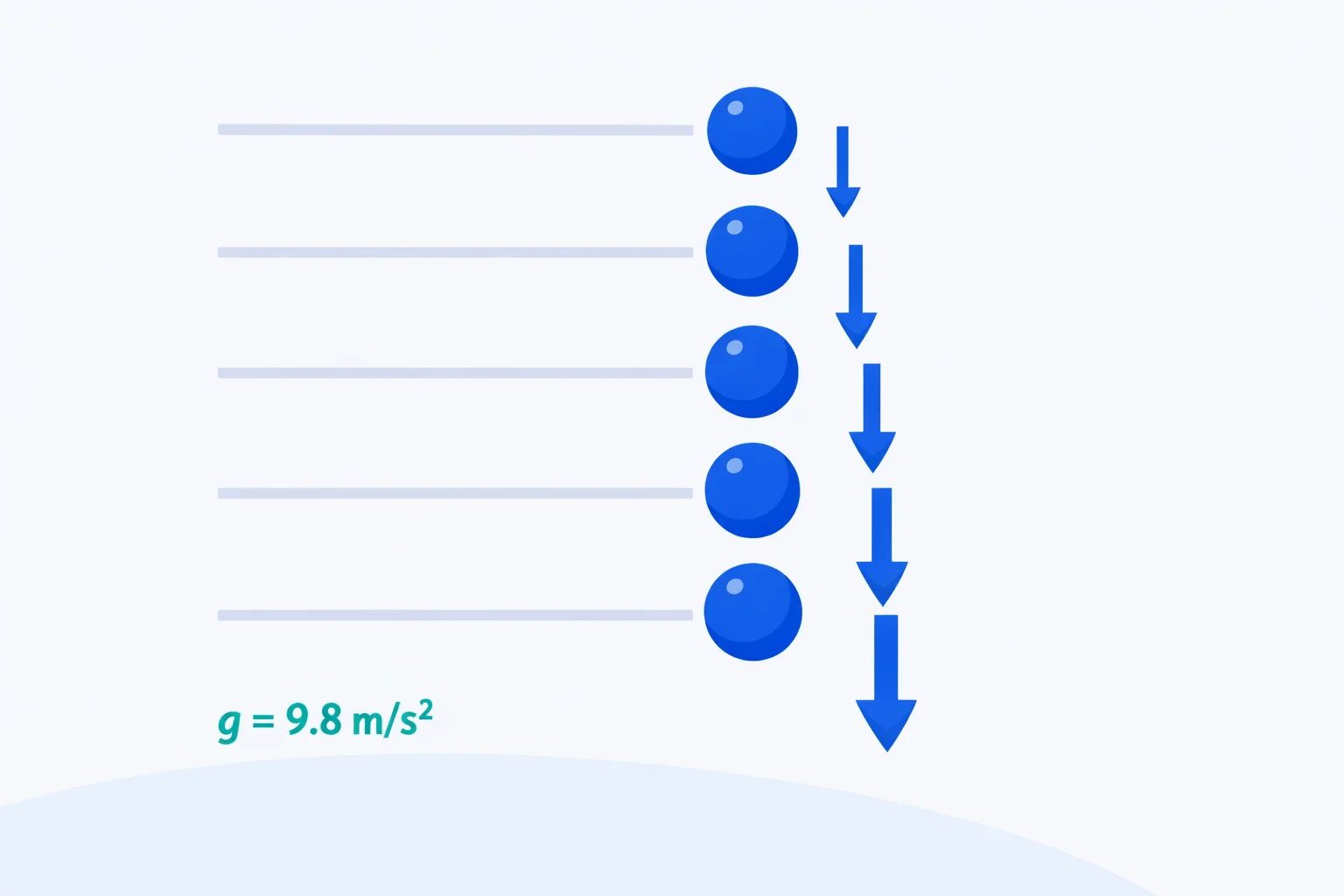
Watch the per-second table in the calculator and a striking pattern appears. In each successive second, a dropped object covers more ground than the last — and the extra distances follow the odd numbers. In the first second it falls 4.9 m. In the second second it falls 14.7 m (3 × 4.9). In the third, 24.5 m (5 × 4.9). The ratio is 1 : 3 : 5 : 7, a relationship Galileo discovered around 1604 by rolling balls down inclined planes, long before stopwatches existed.
| Second | Distance that second (m) | Total fallen (m) | Speed at end (m/s) |
|---|---|---|---|
| 1st | 4.9 | 4.9 | 9.8 |
| 2nd | 14.7 | 19.6 | 19.6 |
| 3rd | 24.5 | 44.1 | 29.4 |
| 4th | 34.3 | 78.4 | 39.2 |
The total-fallen column is the giveaway that distance grows with the square of time: 4.9, 19.6, 44.1, 78.4 are 1×, 4×, 9×, 16× the first value. This is the single most important feel to develop — an object falling for 4 seconds has dropped 16 times as far as one falling for 1 second, not 4 times. It's why a fall that looks "twice as long" is far more dangerous than it sounds.
Free Fall on the Moon, Mars, and Jupiter
Swap g and the whole picture changes, because every result scales with the local gravity. A 10 m drop that takes 1.43 s on Earth stretches to 3.51 s on the Moon, where g is only 1.62 m/s². Those surface-gravity values aren't magic numbers — a gravitational acceleration calculator builds each one from the planet's mass and radius with g = GM/r². The calculator's gravity presets let you re-run any scenario on another world instantly. Here's how the same 10 m drop plays out across the solar system, using real surface-gravity values:
| Body | Gravity g (m/s²) | Time to fall 10 m (s) | Impact speed (m/s) |
|---|---|---|---|
| Moon | 1.62 | 3.51 | 5.69 |
| Mars | 3.72 | 2.32 | 8.63 |
| Earth | 9.81 | 1.43 | 14.0 |
| Jupiter | 24.79 | 0.90 | 22.3 |
Notice the times don't scale linearly with gravity. Jupiter's g is about 15 times the Moon's, but the fall is only about 3.9 times faster, because time depends on √(1/g), not 1/g. That square-root relationship is the same reason the well-depth trick is so forgiving of small timing errors — a tenth of a second off on a long count barely moves the answer.
When Free Fall Stops Being Free: Terminal Velocity
Every equation here assumes a vacuum, and for short drops of dense objects that's an excellent approximation. But once an object is moving fast, air resistance grows until it balances gravity, and the object stops accelerating altogether — it has reached terminal velocity. From that point on, v = gt is flat wrong; the speed simply holds steady. A belly-down skydiver tops out near 55 m/s (about 200 km/h), which they hit after roughly 12 seconds and 450 m of fall.
| Object | Terminal velocity (m/s) | Vacuum math holds until… |
|---|---|---|
| Skydiver (belly-down) | ~55 | ~2–3 s, then drag takes over |
| Baseball | ~33 | first ~2 s of a long fall |
| Raindrop (large) | ~9 | almost never — drag dominates instantly |
| Steel ball bearing | ~75+ | most realistic drops — treat as ideal |
The rule of thumb: if the drop is under a few meters, or the object is dense and compact (a wrench, a coin, a ball bearing), the idealized free-fall numbers are accurate to within a percent or two. If it's light, large, or falling for more than a couple of seconds — a leaf, a sheet of paper, a parachutist — you need a drag model, and the simple equations will overshoot the real speed badly.
The Mistake That Wrecks Most Free-Fall Problems
The error that costs students the most marks is confusing the speed gainedwith the distance fallen. After 3 seconds, a dropped object is moving at v = 9.8 × 3 = 29.4 m/s — but it has not fallen 29.4 m. It has fallen h = ½ × 9.8 × 3² = 44.1 m. Speed grows linearly with time (v = gt), while distance grows with time squared (h = ½gt²). Mix the two formulas up and a homework answer can be off by 50% or more.
The second classic slip is forgetting that throwing an object downward changes the fall but not the acceleration. If you hurl a ball down at 5 m/s from a 20 m roof, gravity still adds 9.8 m/s every second on top of that head start — the ball isn't falling at constant 5 m/s. Set the initial speed to 5 in the calculator and the fall time drops from 2.02 s to about 1.59 s, with impact speed climbing from 19.8 m/s to 20.6 m/s. The gravitational pull behind that constant 9.8 m/s² is the same acceleration whether the object starts at rest or with a shove, and getting that straight is what separates a right answer from a near miss.