Gravitational Acceleration Calculator: How g = GM/r² Sets the Pull on Every Planet
g = GM/r². That one compact equation is the entire engine behind any gravitational acceleration calculator — feed it a planet's mass and its radius and it hands back the surface gravity, the 9.81 m/s² you memorized for Earth and the wildly different numbers waiting on every other world. What's easy to miss is that the famous 9.81 isn't a fundamental constant of the universe. It's an output. Change Earth's mass or squeeze its radius and that number moves. The calculator above makes the dependence visible: pick a body, watch g appear, then swap in your own mass and radius and see exactly how the answer responds.
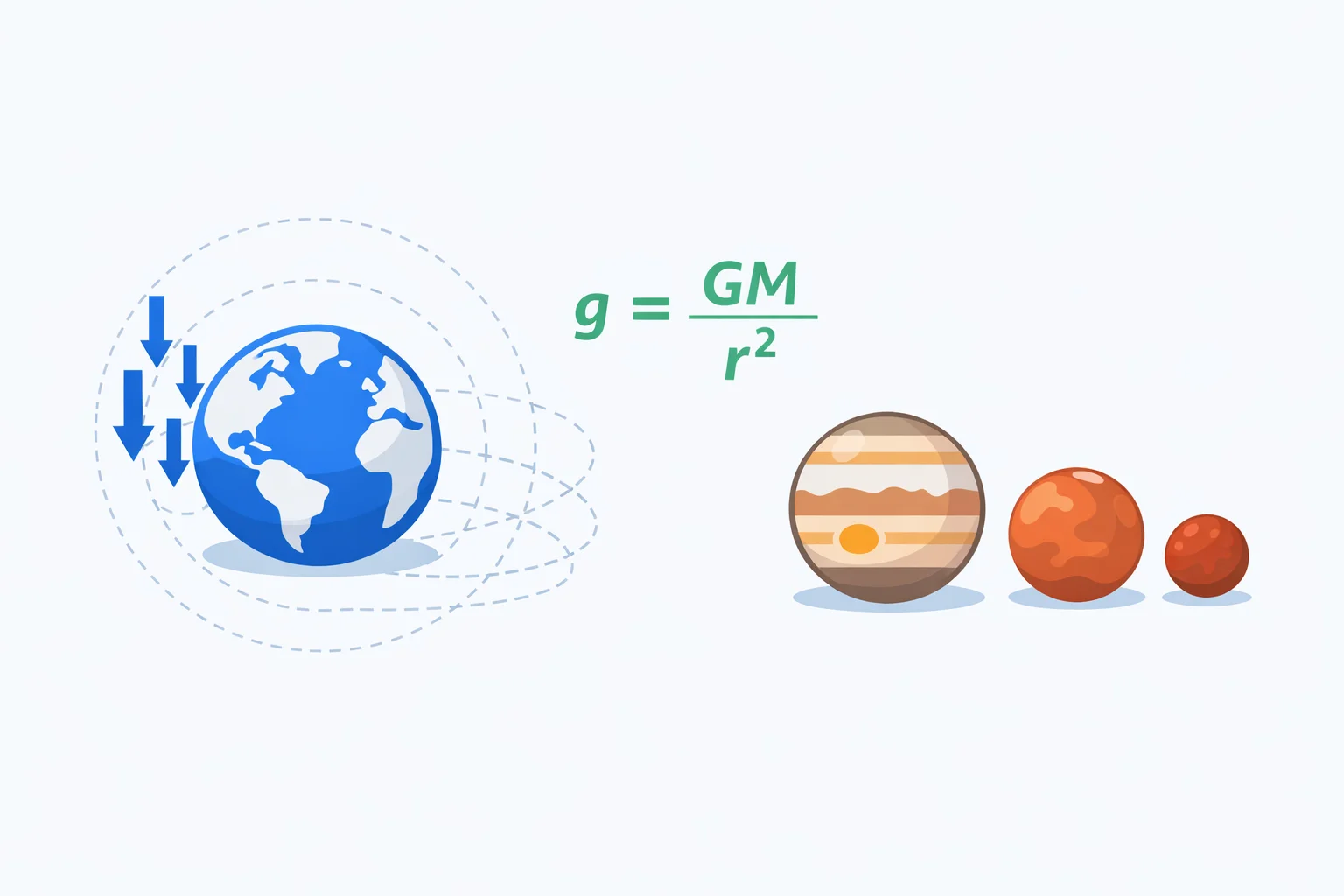
Where g = GM/r² Actually Comes From
The formula isn't handed down on its own — it's two equations glued together. Newton's law of gravitation says the force between a planet of mass M and an object of mass m is F = GMm/r². Newton's second law says that same force produces an acceleration through F = ma. Set the object's acceleration to g and the two expressions for force must agree: mg = GMm/r². The object's mass m sits on both sides, so it cancels — and you're left with g = GM/r², with no trace of the falling object in it.
That cancellation is the whole reason a hammer and a feather hit the ground together in a vacuum. The acceleration depends on the planet (M and r) and nothing about the thing being dropped. The constant G ties the units together at 6.674×10⁻¹¹ N·m²/kg², a famously tiny number — which is why it takes something the size of a planet to produce a gravity you can actually feel. This is the field a single mass creates; for the mutual tug between two comparable bodies you'd return to the full gravitational force calculator and keep both masses in play.
Two Numbers Set a Planet's Gravity: Mass and Radius
Look at where M and r sit in g = GM/r² and you can predict gravity in your head. Mass is on top and enters linearly: double a planet's mass and you double its surface gravity, clean and proportional. Radius is on the bottom and squared, so it fights back twice as hard — double the radius and g drops to a quarter, triple it and g falls to a ninth. The squared radius is the dominant lever, and it's the part students most often underestimate.
A quick numerical feel: if you could somehow keep Earth's mass but inflate it to twice its current radius, surface gravity would slide from 9.81 m/s² to about 2.45 — you'd weigh roughly what you would on a body between Mercury and the Moon. Compress Earth to half its radius instead and g would rocket to about 39 m/s², four times stronger. The mass never changed in either thought experiment; only how close the surface sits to the center did.
Worked Example: Building Mars's Gravity From Scratch
Let's compute Mars's surface gravity from raw numbers rather than looking it up. Mars has a mass of 6.417×10²³ kg and an equatorial radius of 3,396 km, which is 3.396×10⁶ m. Plug straight into g = GM/r²:
g = (6.674×10⁻¹¹ × 6.417×10²³) / (3.396×10⁶)² = (4.283×10¹³) / (1.153×10¹³) ≈ 3.71 m/s².
That's about 0.38 of Earth's gravity — a 100 kg astronaut would tip a Martian scale at the equivalent of 38 kg back home. Notice how the exponents do the heavy lifting: 10⁻¹¹ times 10²³ gives 10¹², and dividing by a radius squared (10¹³) brings it back down to single digits. Keeping the powers of ten lined up is the entire trick to not botching these by a factor of a thousand. Once you have that 3.71, you can pour it straight into a free fall calculator to find how long a dropped wrench takes to hit the Martian dirt.
Why Mercury and Mars Have Almost the Same Gravity
Here's the result that surprises almost everyone. Mercury and Mars feel nearly identical underfoot — 3.70 versus 3.71 m/s² — yet Mars has more than double Mercury's mass. How does the lighter planet pull just as hard? Density and radius. Mercury is small and made of heavy iron, so its surface sits close to a dense core. Mars is bigger but far less dense, so its surface sits farther out where the inverse square has thinned the pull. The two effects cancel almost perfectly. This is exactly the kind of thing the calculator's density readout exposes — switch between the two and watch mass, radius, and density all shift while g barely budges.
| Body | Mass (kg) | Radius (km) | Density (kg/m³) | g (m/s²) |
|---|---|---|---|---|
| Mercury | 3.30×10²³ | 2,440 | 5,427 | 3.70 |
| Mars | 6.42×10²³ | 3,396 | 3,911 | 3.71 |
| Earth | 5.97×10²⁴ | 6,378 | 5,495 | 9.80 |
| Saturn | 5.68×10²⁶ | 60,268 | 687 | 10.44 |
| Jupiter | 1.90×10²⁷ | 71,492 | 1,326 | 24.79 |
Saturn drives the point home from the other direction. It packs 95 Earth masses, but its density is a measly 687 kg/m³ — less than water — so its mass is smeared across a radius nearly ten times Earth's. The result is a surface gravity of just 10.44 m/s², barely 6% above Earth's. Mass alone never tells you the gravity. Density and radius decide whether a giant flattens you or feels almost like home.
Climbing the Well: How g Fades With Altitude
The r in g = GM/r² is the distance from the planet's center, not from the ground — so the moment you gain altitude, r grows and g weakens. The drop is gentler than people expect, because near the surface you're already so far from the center that a few hundred kilometers is a small fractional change. At the International Space Station's 420 km, r climbs from 6,378 to about 6,798 km, only a 7% increase, so g = GM/r² gives roughly 8.7 m/s² — still about 89% of surface gravity.
That single fact dismantles the most common space misconception. Astronauts don't float because they've escaped gravity; up there gravity is nearly as strong as on the ground. They float because the station is in permanent free fall, curving around Earth so fast that it keeps missing. Push the altitude much higher and the inverse square finally bites: at the GPS satellites' 20,200 km, g has fallen to about 0.57 m/s², and at the Moon's distance it's a whisper. Type any of these altitudes into the calculator and the "drop vs surface" figure tracks the inverse-square curve for you.
Gravitational Acceleration vs Field Strength
Search results love to split "gravitational acceleration" and "gravitational field strength" into separate topics, but they are the same quantity. Acceleration is measured in m/s² and answers "how fast does a dropped object speed up?" Field strength is measured in N/kg and answers "how much force does each kilogram feel?" Run the units: a newton is a kg·m/s², so N/kg reduces to m/s² exactly. Earth's 9.81 m/s² and 9.81 N/kg are one number with two interpretations, which is why the calculator prints both side by side.
The N/kg framing is the more useful one when you turn gravity into weight. A field strength of 9.81 N/kg means every kilogram of mass is pulled with 9.81 newtons of force — multiply by your mass and you have your weight on the dot. That's the bridge to the weight calculator, which takes the g you compute here and runs W = mg to tell you what any object actually weighs on that world.
Where g = GM/r² Quietly Stops Being Exact
The formula assumes a perfect sphere of evenly spread mass, and real planets break all three assumptions. Earth bulges at the equator and spins, so the ground-level g you actually measure ranges from about 9.78 m/s² at the equator to 9.83 at the poles — the bare g = GM/r² with a single radius can't see that 0.5% spread. Local geology adds its own wrinkles: a dense ore body or a deep ocean trench shifts g by tens of parts per million, the very signal that gravimeters use to map what's underground. If you measure g yourself from a pendulum's period, that timing error carries its own measurement uncertainty — though the square root in the pendulum formula mercifully halves it.
The assumption fails hardest when you go below the surface. The formula treats all of a planet's mass as if it's pulling from the center, which is only true when you're outside the body. Drill downward and the shells of rock now above you pull outward, partly canceling the inward pull, so g actually decreases as you descend and reaches exactly zero at the center — not the infinity that plugging r = 0 into GM/r² would wrongly suggest. Use g = GM/r² for anything on or above a surface; once you're burrowing inward or dealing with a lopsided, fast-spinning body, it becomes a first approximation rather than the final word.