Mass Calculator: How to Find Mass Using Force, Weight, and Density in Physics
Step into an elevator, stand on a bathroom scale, and watch the number jump the instant the elevator starts climbing. You didn't gain a pound — so what changed? This is the trap at the heart of one of the most common confusions in physics, and it's exactly why a mass calculator matters: the scale measures weight, a force, while mass is the unchanging amount of matter you're made of. Get those two mixed up and your physics answers go sideways. The fix is knowing which formula to reach for — m = F/a, m = W/g, or m = ρV — and that's what the tool above sorts out in one step.
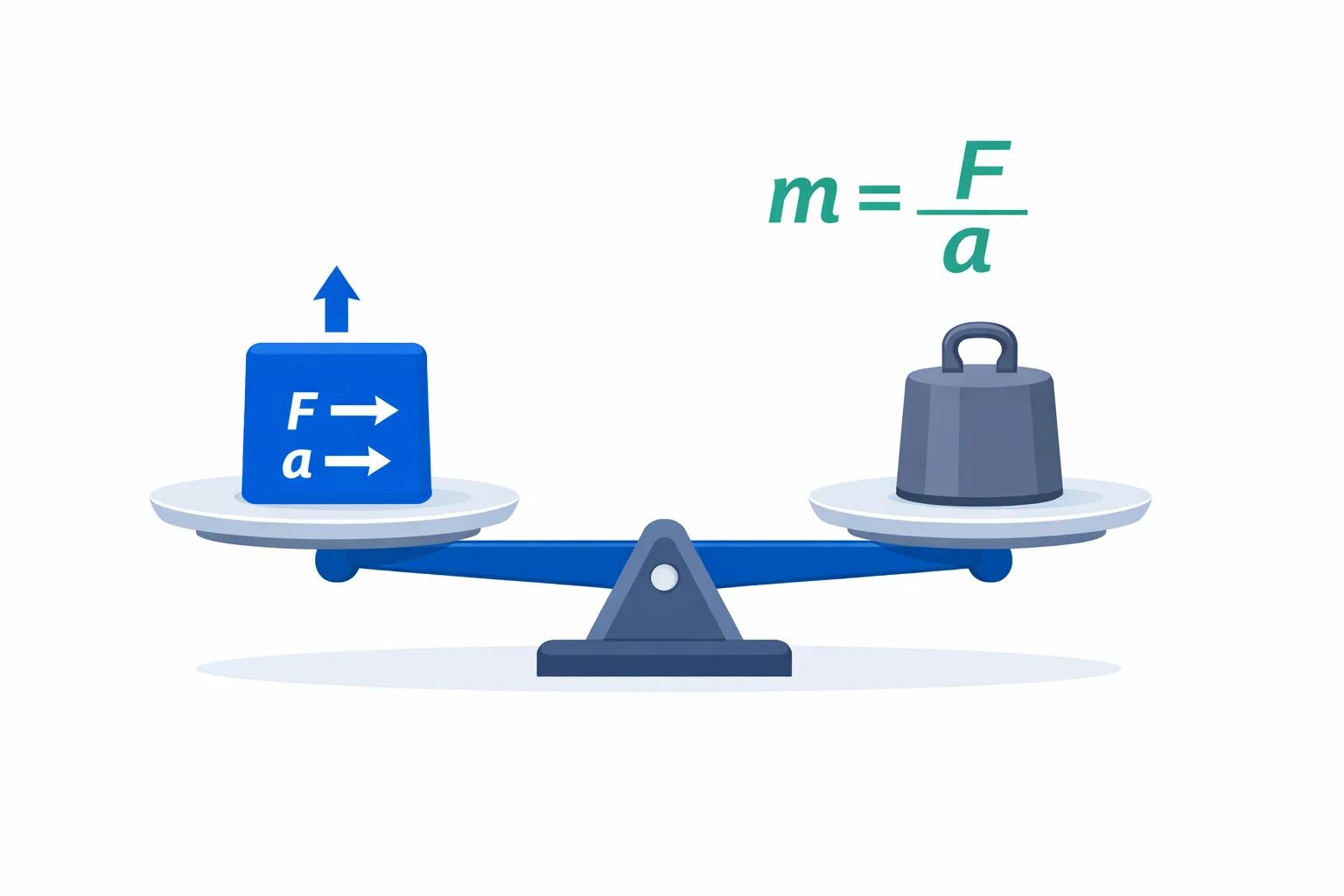
Why Your Bathroom Scale Is Lying About Your Mass
A digital bathroom scale never measures mass directly. It measures the force your feet press down with — your weight — and then quietly divides by 9.81 to print a mass-looking number. That shortcut works fine when you're standing still on Earth. It falls apart the moment gravity or motion changes. In an elevator accelerating upward at 2 m/s², the floor pushes up harder, the scale reads about 20% heavier, and yet not a single atom has been added to you. Your mass held perfectly steady at, say, 70 kg while your apparent weight climbed from 687 N to 827 N.
That gap is the whole reason mass and weight need separate treatment. Mass (measured in kilograms) is a property of the object itself — count the protons, neutrons, and electrons and you've fixed it forever. Weight (measured in newtons) is the pull of gravity on that mass, and it shifts with location. The mass calculator above lets you work in either direction: feed it a weight and a value for gravity and it backs out the true mass with m = W/g. Going the opposite way, from a known mass to the force gravity exerts, is what the weight calculator handles with W = mg.
Three Ways to Calculate Mass (and When Each Wins)
There isn't one mass formula — there are three common ones, and which you use depends entirely on what you already know. Each gives the same kilograms; they just start from different measurements.
- m = F/a — when you know a net force and the acceleration it produces. Push a shopping cart with 30 N of net force and watch it speed up at 2 m/s², and its mass is 30 ÷ 2 = 15 kg. This is the route for dynamics problems.
- m = W/g— when you have a weight reading and the local gravity. A suitcase that registers 196 N at an airport check-in has a mass of 196 ÷ 9.81 = 20.0 kg. This is the route for anything you've put on a scale.
- m = ρV— when you know what a thing is made of and how big it is, but can't lift it onto a scale. A granite boulder of volume 0.8 m³ (density ≈ 2700 kg/m³) has a mass near 2160 kg. This is the route for engineering estimates.
A subtle point worth flagging: in m = F/a the acceleration is whatever the object happens to be doing, but in m = W/g it's locked to gravity. Weight is really just the special case of Newton's second law where the force is gravity and the acceleration is g. If you want to go the other direction and find that force, the force calculator solves F = ma once the mass is known.
Mass vs Weight: The Side-by-Side That Settles It
Most students can recite "mass is matter, weight is force" and still mix them up under exam pressure. Lining the two up directly makes the distinction stick:
| Property | Mass | Weight |
|---|---|---|
| What it is | Amount of matter in an object | Gravitational force on that matter |
| Unit | Kilogram (kg) | Newton (N) |
| Changes with location? | No — same everywhere | Yes — scales with local g |
| Measured with | Balance scale (vs known masses) | Spring or digital scale |
| Can it be zero? | Only for a massless particle (e.g. a photon) | Yes — in free fall or deep space |
| Formula | m = F/a, W/g, or ρV | W = mg |
The "can it be zero" row is the one that surprises people. An astronaut in orbit weighs nothing on a scale — they're in continuous free fall — but their mass is exactly what it was on the launchpad. That's why spacecraft are designed around mass budgets in kilograms, never weight: the weight would be a meaningless, ever-changing number once the rocket leaves the ground.
Where m = F/a Comes From: Newton's Second Law, Rearranged
The m = F/a formula isn't a separate law — it's Newton's second law, F = ma, solved for mass. Divide both sides by acceleration and the mass pops out. What makes this version useful is that it gives mass an operational meaning: it's a measure of how hard something is to accelerate. A large mass barely budges under a given force; a small mass leaps. That resistance to acceleration is called inertia, and m = F/a is how you put a number on it.
Work a real case. A pit crew pushes a 1.5 m/s² acceleration out of a race car using a measured net force of 1080 N. What's the car's mass? Straight from m = F/a, that's 1080 ÷ 1.5 = 720 kg — light, as race cars go, which is the point. Here's the catch the formula hides: F must be the netforce, the sum of every push and drag combined. If the engine delivers 1080 N but friction and air resistance claw back 280 N, the real net force is 800 N and the mass you'd calculate from the engine figure alone would be badly wrong. Sort out the competing forces with the net force calculator first, then divide by the acceleration to get an honest mass.
Finding Mass You Can't Weigh: The Density Route
Some masses never touch a scale — the concrete in a bridge pier, the fuel in a tank, a meteorite still embedded in rock. For these, m = ρV is the only practical option: multiply the material's density by its volume. The power of this method is that density is a fixed, well-tabulated property. Once you know what something is made of, you know its mass per cubic meter, and the rest is multiplication. To run the formula the other way and calculate density from a measured mass and volume, just divide instead: ρ = m/V. And once you have the mass of each part of a system, feed them into the center of gravity calculator to find the single point where the whole thing balances.
This is where the same volume can hide wildly different masses. A one-liter bottle (0.001 m³) filled with different materials shows just how much density drives the result:
| Material | Density (kg/m³) | Mass of 1 liter (kg) |
|---|---|---|
| Air (sea level) | 1.225 | 0.001 |
| Ice | 917 | 0.917 |
| Water | 1000 | 1.000 |
| Aluminum | 2700 | 2.70 |
| Iron | 7870 | 7.87 |
| Gold | 19300 | 19.3 |
A liter of gold masses 19.3 kg — heavier than a liter of iron by more than two to one, and nearly 16,000 times heavier than the same volume of air. The notorious movie scene where a thief casually pockets a fist-sized gold bar is pure fiction: a 1-liter ingot would mass close to 19 kg, about the same as carrying two full bowling balls in one hand. The density presets in the calculator load these exact reference figures so you don't have to memorize them.
One Mass, Six Weights: A Trip Across the Solar System
Take a 75 kg astronaut and send them touring the planets. Their mass never moves off 75 kg — but the scale tells a completely different story on each world, because weight is W = mg and g varies enormously. The calculator's bottom table runs this automatically for whatever mass you compute, using the surface-gravity figures from NASA's planetary fact sheet; here it is for our traveler:
| Location | Gravity g (m/s²) | Weight of 75 kg (N) | Scale reads (kg-equivalent) |
|---|---|---|---|
| Moon | 1.62 | 122 | 12.4 |
| Mars | 3.72 | 279 | 28.4 |
| Earth | 9.81 | 736 | 75.0 |
| Jupiter | 24.79 | 1859 | 189.5 |
On the Moon that astronaut would feel as light as a 12 kg child does on Earth; near Jupiter's cloud tops they'd be crushed under the equivalent of 189 kg. The weight itself is a gravitational force, the same quantity the gravitational force calculator computes from masses and distance. Mass is the constant thread running through all of it — which is precisely why physicists insist on it as the fundamental quantity.
When These Mass Formulas Stop Working
The three formulas are reliable for everyday objects, but each has a boundary worth knowing. m = F/a assumes the mass is constant during the motion — it breaks for a rocket, which loses mass as it burns fuel, so its acceleration climbs even at constant thrust. m = W/g assumes the object is in equilibrium and the scale is in an inertial frame; use it in an accelerating elevator and you'll back out a mass that's 10–20% off, because the apparent weight isn't the true gravitational weight.
There's also a deeper limit. At speeds approaching the speed of light, an object's effective inertia grows and the simple m = F/a no longer holds — you need special relativity. For anything you'll meet outside a particle accelerator, though, the everyday formulas are accurate to far more decimal places than your measurements. The density method has its own quiet assumption: it treats the material as uniform, so a porous or hollow object (foam, a chocolate Easter egg) will mass far less than ρV predicts because the tabulated density assumes solid material throughout.
The Weight-as-Mass Slip That Wrecks Exam Answers
The single most expensive mistake on mechanics problems is plugging a weight in newtons into a formula that wants mass in kilograms. Say a problem states "a box weighing 200 N slides across a floor" and asks for its acceleration under a 50 N push. Drop 200 straight into a = F/m and you get 0.25 m/s² — wrong by a factor of almost ten. The mass is 200 ÷ 9.81 = 20.4 kg, so the real acceleration is 50 ÷ 20.4 = 2.45 m/s². That tenfold error is the difference between a box that barely creeps and one that shoots across the room.
The tell is always the unit. If a value is given in newtons, pounds-force, or kilograms-force, it's a weight and needs converting before it enters any F = ma or KE = ½mv² calculation. Whenever a question hands you a weight, divide by g first — and the mass you recover is the number that carries through every later step, from kinetic energy to momentum. Treat mass as the anchor it is, and the rest of the mechanics falls into place.