Newton's Law of Universal Gravitation: From a Falling Apple to the Orbit of Jupiter
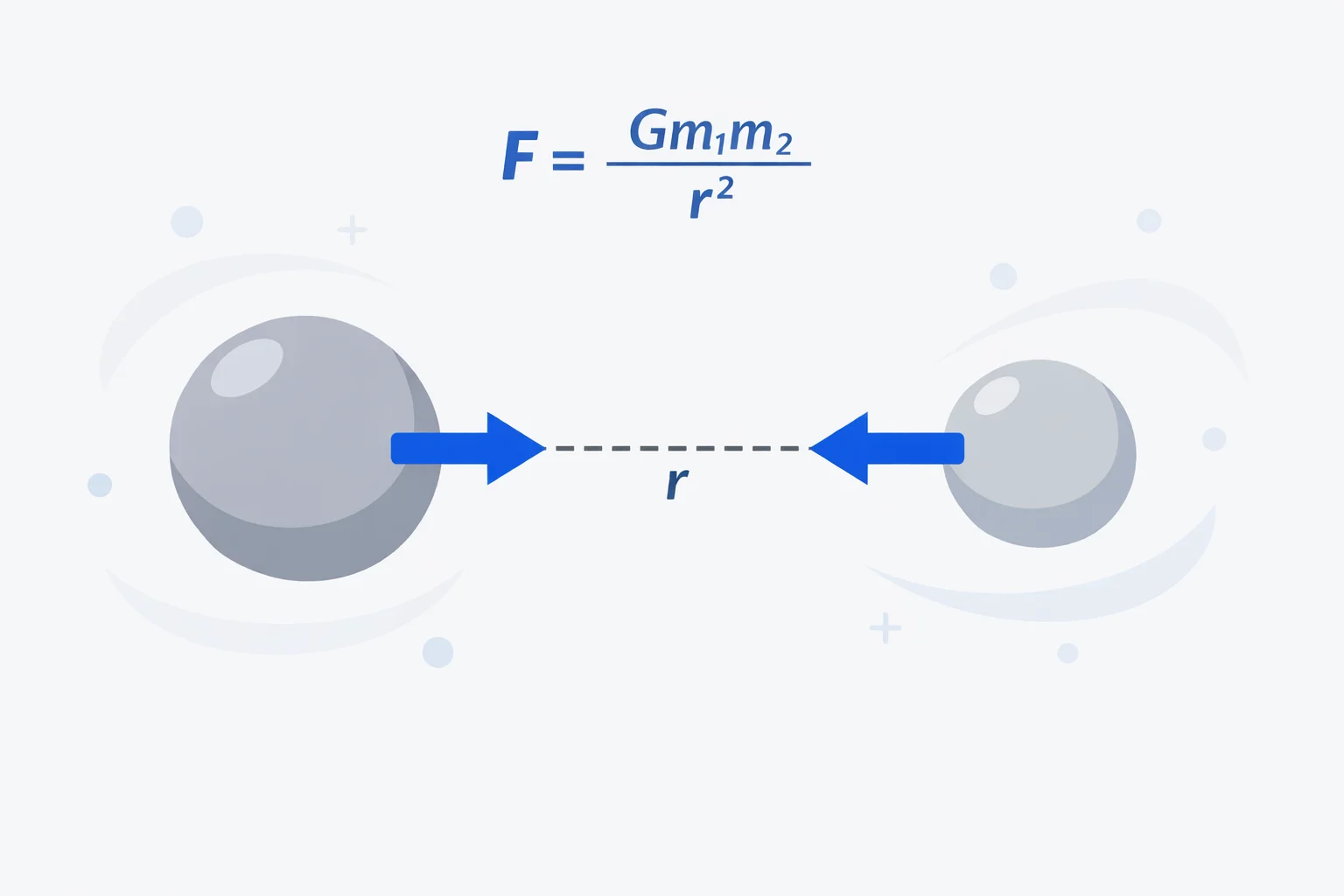
Sit two adults a meter apart and they pull on each other with a real, measurable gravitational force — about 3.3 × 10⁻⁷ N, roughly the weight of a single grain of fine sand. A gravitational force calculator built on Newton's law of universal gravitation, F = Gm₁m₂/r², will tell you that, and it will just as happily tell you that the same equation governs Jupiter wheeling around the Sun. One formula, written down in 1687, stretches from the imperceptible tug between people to the 4 × 10²³ N leash holding the largest planet in orbit. That enormous range is the most interesting thing about gravity, and it's worth understanding why.
Why You Can't Feel the Person Sitting Next to You
Gravity is, by a wide margin, the weakest of the four fundamental forces. The number that sets its strength — the gravitational constant G — is so small that two ordinary objects produce essentially nothing you could ever sense. Run the numbers for two 70 kg people 1 m apart: F = (6.674 × 10⁻¹¹ × 70 × 70) / 1² = 3.27 × 10⁻⁷ N. That's about 33 millionths of a newton. Your hand can't detect it; a lab needs a delicate torsion balance to measure it at all.
So why does Earth flatten you to a bathroom scale at 686 N? Mass. Earth packs 5.97 × 10²⁴ kg, and that single factor swamps the tiny G. Gravity never turns “on” at some threshold — it's always acting between every pair of masses in the universe. It's just that the force only climbs into the range you notice when one of the masses is planetary. That's the whole reason you feel the ground pulling you but never feel the refrigerator.
Inside F = Gm₁m₂/r²: What Each Symbol Carries
Newton's law says the gravitational attraction between two masses is proportional to the product of their masses and inversely proportional to the square of the distance between them. In symbols, F = Gm₁m₂/r². Each piece does specific work:
- m₁ and m₂are the two masses in kilograms. They multiply, so the force depends on their product — not their sum. Double either mass and the force doubles; double both and it quadruples.
- ris the distance between the two centers of mass in meters — and it's squared in the denominator, which is where most of the physics lives.
- G is the universal gravitational constant, 6.674 × 10⁻¹¹ N·m²/kg², the conversion factor that turns kilograms and meters into newtons.
One subtlety worth flagging: gravity always pulls along the line joining the two centers, and the forces on the two objects are equal and opposite. The Moon pulls Earth with the exact same 1.98 × 10²⁰ N that Earth uses on the Moon. Once you have that force, you can feed it straight into the force calculator to find how fast each body accelerates — the lighter one always speeds up more, because F = ma works backward from the same force.
Big G: The Tiniest Important Number in Physics
Don't confuse big G with little g. The gravitational constant G = 6.674 × 10⁻¹¹ N·m²/kg² is the same everywhere in the cosmos, from your kitchen to the edge of a galaxy. Little g (9.8 m/s² at Earth's surface) is just the acceleration gravity happens to produce at one location, and it changes from world to world: 1.6 on the Moon, 24.8 on Jupiter. You actually derive g by plugging Earth's mass and radius into this very formula.
G was the hardest constant in classical physics to pin down. Henry Cavendish measured it in 1798 with a torsion balance — lead spheres on a wire, twisting by a hair's width — in an experiment so sensitive he ran it from another room to avoid disturbing it with his own body heat. Even today, G is known to only about 4 or 5 significant figures, making it one of the least precisely measured constants in all of science — the current NIST CODATA value still carries an uncertainty in its fifth significant figure. That imprecision rarely matters for orbital mechanics, because the product GM for a body like Earth is known far more accurately than G alone.
The 1/r² Trap: Double the Distance, Quarter the Force
The single most common error in gravitation problems is forgetting that r is squared. Because the distance sits in the denominator squared, doubling the separation doesn't halve the force — it cuts it to a quarter. Triple the distance and the force drops to one-ninth. This is the inverse-square law, and it's the same geometry that dims a lightbulb and weakens a radio signal: the influence spreads out over the surface of a sphere, which grows as r².
Here's a concrete consequence. A satellite in low orbit at 400 km altitude is only about 6% farther from Earth's center than someone standing on the ground (6,771 km vs 6,371 km). Square that ratio and gravity up there is still roughly 89% of surface gravity — which surprises people who assume astronauts on the ISS are “beyond gravity.” They're not. They're in free fall, with nearly full-strength gravity bending their path into a circle, which is exactly the inward pull a centripetal force calculator quantifies for any orbit.
Worked Example: The Sun's Grip vs the Moon's
Here's a problem that breaks most people's intuition. Which pulls Earth harder — the Sun or the Moon? And if the Sun wins, why does the Moon dominate the tides?
Start with the Sun. Earth's mass is 5.972 × 10²⁴ kg, the Sun's is 1.989 × 10³⁰ kg, and the distance is one AU, 1.496 × 10¹¹ m. So:
F = (6.674 × 10⁻¹¹ × 5.972 × 10²⁴ × 1.989 × 10³⁰) / (1.496 × 10¹¹)² = 3.54 × 10²² N.
Now the Moon: mass 7.342 × 10²² kg at 3.844 × 10⁸ m. That gives F = (6.674 × 10⁻¹¹ × 5.972 × 10²⁴ × 7.342 × 10²²) / (3.844 × 10⁸)² = 1.98 × 10²⁰ N. The Sun wins by a factor of about 178 — it's not even close.
So why do we credit the Moon for the tides? Because tides aren't caused by the force, they're caused by the differencein force between the near side and far side of Earth. That differential falls off as 1/r³, not 1/r², and the Moon's closeness gives it the edge there — about 2 to 1 over the Sun. It's a perfect reminder that the raw gravitational force and its gradient are two different stories. If you want to track the energy side of an orbit instead, the potential energy calculator handles the near-surface mgh case where the field is effectively constant.
Gravitational Force Across the Solar System
Plugging real masses and distances into F = Gm₁m₂/r² produces numbers that span more than 30 orders of magnitude. These values use NASA planetary fact sheet data; the everyday rows show just how feeble gravity is until something planet-sized enters the picture.
| Pair of Objects | Distance (center-to-center) | Gravitational Force |
|---|---|---|
| Sun & Jupiter | 7.78 × 10¹¹ m (5.2 AU) | 4.16 × 10²³ N |
| Sun & Earth | 1.50 × 10¹¹ m (1 AU) | 3.54 × 10²² N |
| Earth & Moon | 3.84 × 10⁸ m | 1.98 × 10²⁰ N |
| Earth & ISS (420 t) | 6.78 × 10⁶ m (408 km up) | 3.66 × 10⁶ N |
| Earth & a 70 kg person | 6.37 × 10⁶ m (surface) | 686 N |
| Two 70 kg people, 1 m apart | 1 m | 3.27 × 10⁻⁷ N |
Notice the Earth-and-person row: 686 N is exactly a 70 kg person's weight. That's not a coincidence — weight is the gravitational force between you and the planet, which is the next section.
Your Weight Is Just Gravitation Read at the Surface
Students often treat “weight = mg” and “F = Gm₁m₂/r²” as two unrelated formulas. They're the same equation. Set m₂ to Earth's mass and r to Earth's radius, and the clutter collapses: GM_earth / r² works out to 9.8 m/s², which we rename g. So mg is nothing more than F = Gm₁m₂/r² with the constant parts pre-computed for Earth's surface. The dedicated weight calculator runs that surface shortcut for any planet, swapping in each world's g for you.
| Aspect | Newton's Gravitation (F = Gm₁m₂/r²) | Weight (W = mg) |
|---|---|---|
| What it describes | Force between any two masses, anywhere | Force on one object near a specific surface |
| Depends on distance? | Yes, as 1/r² | No — assumes fixed surface distance |
| Constant used | G = 6.674 × 10⁻¹¹ | g = 9.8 m/s² (Earth) — derived from G |
| Best for | Orbits, planets, satellites, large distances | Everyday objects on or near a surface |
The practical takeaway: use mg when you're near a surface and the distance barely changes (a falling apple, a box on a ramp). Reach for the full F = Gm₁m₂/r² the moment distance varies a lot — climbing thousands of kilometers into orbit, comparing two planets, or anything where r is part of the question.
Where Newton's Law Hands Off to Einstein
F = Gm₁m₂/r² is astonishingly good — it landed probes on Mars and kept Voyager on course for decades — but it's an approximation that assumes gravity is weak and space is flat. Three situations break it. First, extremely strong fields: near a black hole or neutron star, spacetime curves so sharply that you need Einstein's general relativity. Second, very high precision over long times: Mercury's orbit drifts by 43 arcseconds per century more than Newton predicts, a discrepancy relativity resolved exactly. Third, anything moving near light speed, where the idea of an instantaneous force-at-a-distance falls apart.
For the homework, lab, and engineering problems you'll actually meet, none of this matters — Newton's law is accurate to far more decimal places than your input data. But it's honest physics to know the fence around the model. The formula tells you the force; it doesn't claim to explain why mass curves space, which is the question Einstein took up.
Common Mistakes in Gravitation Problems
- Forgetting to square r. The most expensive slip. Using r instead of r² for the Earth-Moon distance turns a correct 1.98 × 10²⁰ N into a wildly wrong 7.6 × 10²⁸ N. Always square the distance.
- Measuring distance from the surface.For spheres, r is center-to-center. A person on Earth isn't 0 m from the planet — they're 6,371 km from its center. Use the surface distance and your answer blows up toward infinity.
- Swapping G for g. Big G is 6.674 × 10⁻¹¹; little g is 9.8. Drop g into F = Gm₁m₂/r² and your force is off by about 11 orders of magnitude.
- Adding the masses instead of multiplying. The formula uses the product m₁ × m₂. Adding them gives a meaningless number, especially when the two masses differ by many powers of ten.
- Mixing units.G is defined for kilograms and meters. Plug in grams, tonnes, or kilometers without converting and every digit of the answer is wrong — convert first, then calculate.