Centripetal Force in the Real World: From an Off-Ramp to a Spin Cycle
You're taking a flat highway off-ramp at 90 km/h. The road curves left, your coffee slides right, and you press into the door. Nothing is pushing you outward — your body just wants to keep going straight while the car turns underneath you. The thing actually bending your 1,500 kg car around that 100-meter arc is a single inward force: the centripetal force. Run the numbers and it comes to about 9,375 N, all of it supplied by friction from four tire contact patches no bigger than your palm.
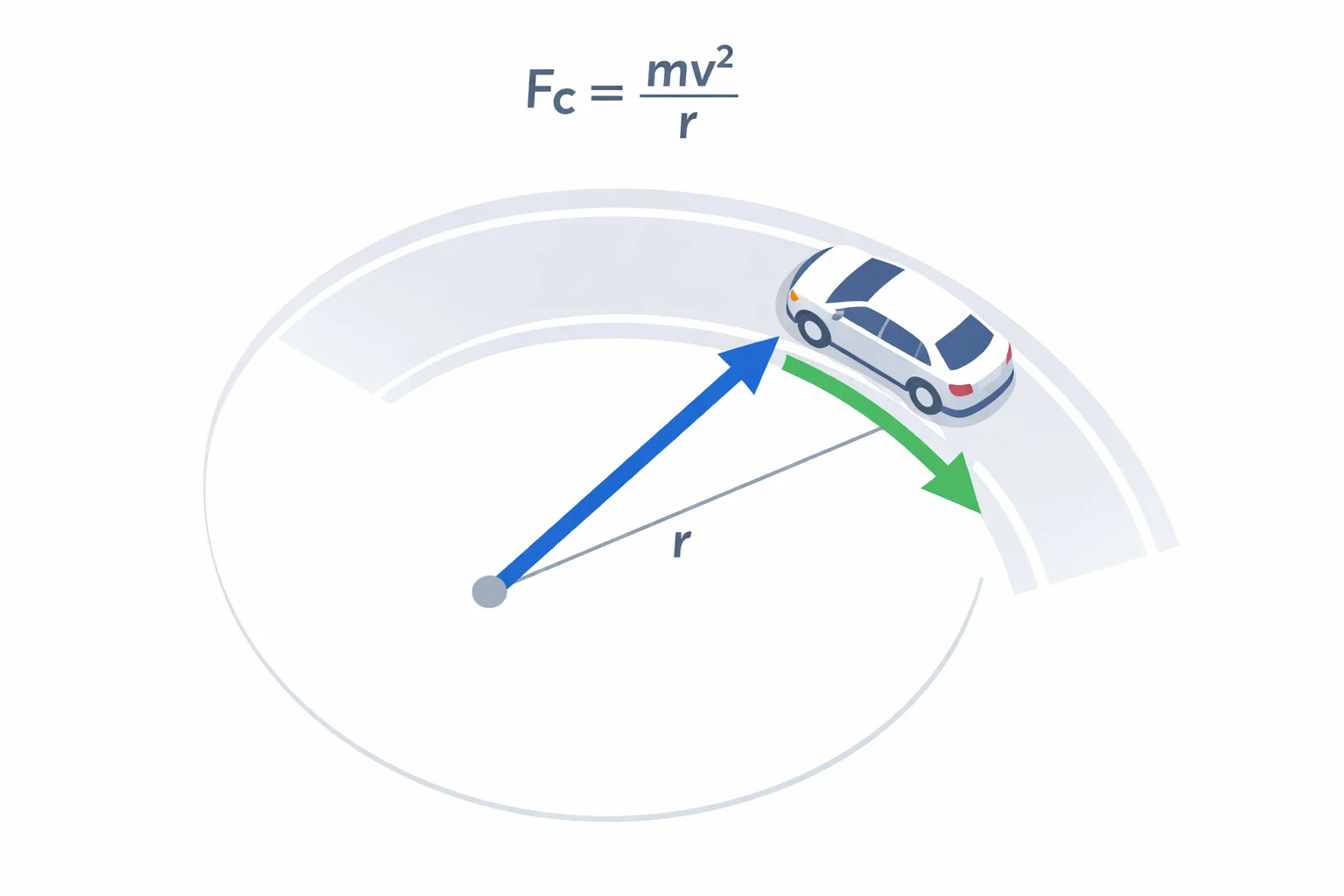
The 90 km/h Off-Ramp: Where Centripetal Force Comes From
Centripetal force isn't a new kind of force. It's a job description. Any object moving in a circle is constantly changing direction, and changing direction is acceleration even when the speed never budges. Newton's second law says acceleration needs a force, so something must always pull inward toward the center of the curve. Whatever provides that inward pull — friction, tension, gravity, a wall — is the centripetal force for that situation. On the off-ramp it's tire friction. Snap a string on a whirling stone and it was tension. For the Moon, it's gravity — the inward pull you can size with a gravitational force calculator using F = Gm₁m₂/r².
That's the mental shift that makes circular motion click: you never add centripetal force to a free-body diagram as a separate arrow. You identify which real force is already pointing toward the center and set it equal to mv²/r. Once you can name the supplier, the rest is arithmetic, and the force calculator handles the F = ma side of it.
Fc = mv²/r, Decoded Variable by Variable
The centripetal force formula is F꜀ = mv²/r: mass times velocity squared, divided by the radius. Mass m is in kilograms, speed v is the tangential speed in meters per second (the speed along the circle, not toward the center), and radius r is the distance from the center to the object in meters. The result is a force in newtons, always directed inward.
Work the off-ramp step by step. The car's speed is 90 km/h, which is 25 m/s — convert first, because leaving 90 in the equation is the most common way to wreck the answer. The centripetal acceleration is a꜀ = v²/r = 25² / 100 = 625 / 100 = 6.25 m/s². Multiply by mass: F꜀ = 1,500 × 6.25 = 9,375 N. If you prefer angular terms, the same force is mω²r, where ω = v/r is the angular velocity in radians per second. Both routes land on identical numbers because v = ωr is baked into the geometry.
Why Doubling Your Speed Quadruples the Force
Here's the part that bites drivers and students alike: speed is squared, radius is not. Take that same off-ramp at 50 m/s instead of 25 — double the speed — and the force doesn't double. It quadruples, to 37,500 N. The required friction coefficient leaps from 0.64 to 2.55, which no street tire on Earth can deliver. The car doesn't turn; it plows straight off the curve. This nonlinearity is why posted limits on tight bends feel overly cautious right up until the instant they don't.
The radius behaves more gently. Because rsits in the denominator to the first power, doubling the radius merely halves the force. A sweeping 200 m arc taken at 25 m/s needs only 4,688 N instead of 9,375 N. That trade-off — force scaling with v² but only 1/r — is the single most useful intuition the formula gives you, and it's why you brake hard for a hairpin but barely lift for a gentle freeway bend.
Centripetal vs Centrifugal: The Force That Isn't There
Almost everyone confuses these two, so let's settle it. Centripetal force is real and points inward. Centrifugal force is the apparent outward push you feel, and in an inertial frame it doesn't exist as a force at all — it's just your inertia resisting the change in direction. The door pushes you inward (centripetal); you press outward on the door only as a Newton's-third-law reaction. No invisible hand flings you toward the edge.
| Question | Centripetal Force | Centrifugal “Force” |
|---|---|---|
| Direction | Inward, toward the center | Outward, away from center |
| Is it a real force? | Yes — friction, tension, or gravity | No — an inertial effect |
| Where it appears | Every reference frame | Only in a rotating frame |
| On a free-body diagram | Drawn as a real arrow | Never drawn (inertial frame) |
| Everyday example | Tires gripping a curve | Feeling pushed against the door |
A spinning washing machine makes the point concretely. The drum wall pushes the wet clothes inward (centripetal). The water, which can slip through the drum holes, isn't pulled inward, so it carries on straight and exits the drum — that's the entire spin-dry principle. Nothing “throws” the water out; the drum simply stops curving its path.
Same Formula, Wildly Different Worlds
The reach of F꜀ = mv²/r is what makes it worth memorizing. The same equation governs a stone on a string and a space station, separated by orders of magnitude in force. These are computed values you can reproduce by loading each scenario in the calculator above.
| Scenario | Mass | Radius | Speed | F꜀ |
|---|---|---|---|---|
| Stone on a string (120 RPM) | 0.2 kg | 0.8 m | 10.1 m/s | 25 N |
| Hammer throw at release | 7.26 kg | 1.7 m | 28 m/s | 3,348 N |
| Roller-coaster loop bottom | 70 kg | 6 m | 15 m/s | 2,625 N |
| Car on a flat curve | 1,500 kg | 100 m | 25 m/s | 9,375 N |
| Washing machine (1200 RPM) | 2 kg | 0.25 m | 31.4 m/s | 7,896 N |
Notice the hammer throw: a 7.26 kg ball pulling 3,348 N on the wire is why throwers wear a glove and lean their whole body back — they're anchoring against roughly 340 kg-force. The wire in that system behaves exactly like the cases in the tension calculator, where the string tension is the centripetal force.
Banked Curves: Engineering Around Friction
Relying on tire friction alone is risky — add rain, ice, or worn rubber and the curve stops holding. So highway and racetrack engineers tilt the road. On a banked curve the road's normal force tips inward, and its horizontal component supplies centripetal force without any help from friction. The ideal bank angle satisfies tanθ = v²/(rg).
For our off-ramp at 25 m/s and 100 m radius, the frictionless bank angle is arctan(6.25 / 9.81) = arctan(0.637) ≈ 32°. Bank the road at that angle and a car at exactly 25 m/s rounds it on a sheet of ice, no grip required. Daytona's steepest turns hit 31° — that's deliberate, letting stock cars carry enormous speed through corners that would be undriveable flat. The normal force calculator breaks down how N redistributes once the surface tilts, and on a flat curve the friction force calculator tells you whether the available grip can cover the gap.
Common Mistakes That Sink Circular-Motion Problems
- Leaving speed in km/h.Plugging 90 into v² instead of 25 inflates the force by a factor of (90/25)² = 12.96. That's the difference between 9,375 N and 121,500 N — an answer off by more than ten times.
- Adding centripetal force as an extra arrow.It's not separate from friction or tension; it is them. Drawing it twice double-counts the inward force and gives nonsense.
- Using the diameter instead of the radius.If a track is “200 m across,” the radius is 100 m. Slip a diameter into r and your force comes out exactly half what it should be.
- Forgetting the squared speed in RPM problems. Convert RPM to ω, then square it for F꜀ = mω²r. Skipping the square on the spin cycle turns a 7,896 N answer into a wildly wrong 251 N.
When Fc = mv²/r Isn't the Whole Story
The clean formula assumes uniform circular motion— constant speed, constant radius. The moment the speed changes, a second, tangential acceleration appears alongside the centripetal one, and the total force is the vector sum of both. A car accelerating out of a corner lives exactly here: inward force to turn, forward force to speed up.
Vertical circlesadd gravity to the mix. At the top of a roller-coaster loop, gravity already points toward the center and helps provide the centripetal force, so the track pushes less — sometimes nothing at all, which is the floaty moment riders chase. At the bottom the track must overcome gravity and supply the inward force, which is why you feel heaviest there. The minimum speed to keep contact at the very top is v = √(gr); drop below it and the object leaves the track. For energy bookkeeping around the loop, the kinetic energy calculator pairs naturally with this one, since centripetal force itself does zero work and never changes that ½mv².