Friction Force: How f = μN Really Works on Flat Ground and on a Ramp
To calculate friction force in physics you only need one equation: f = μN. Friction equals the coefficient of friction times the normal force. That's it — two numbers multiplied together. The catch, and the reason students lose marks on it constantly, is that “μ” isn't a single number and “N” isn't always the weight. Get those two pieces right and friction problems collapse into arithmetic. Get them wrong and your answer can be off by a factor of two before you've made a single calculation error.
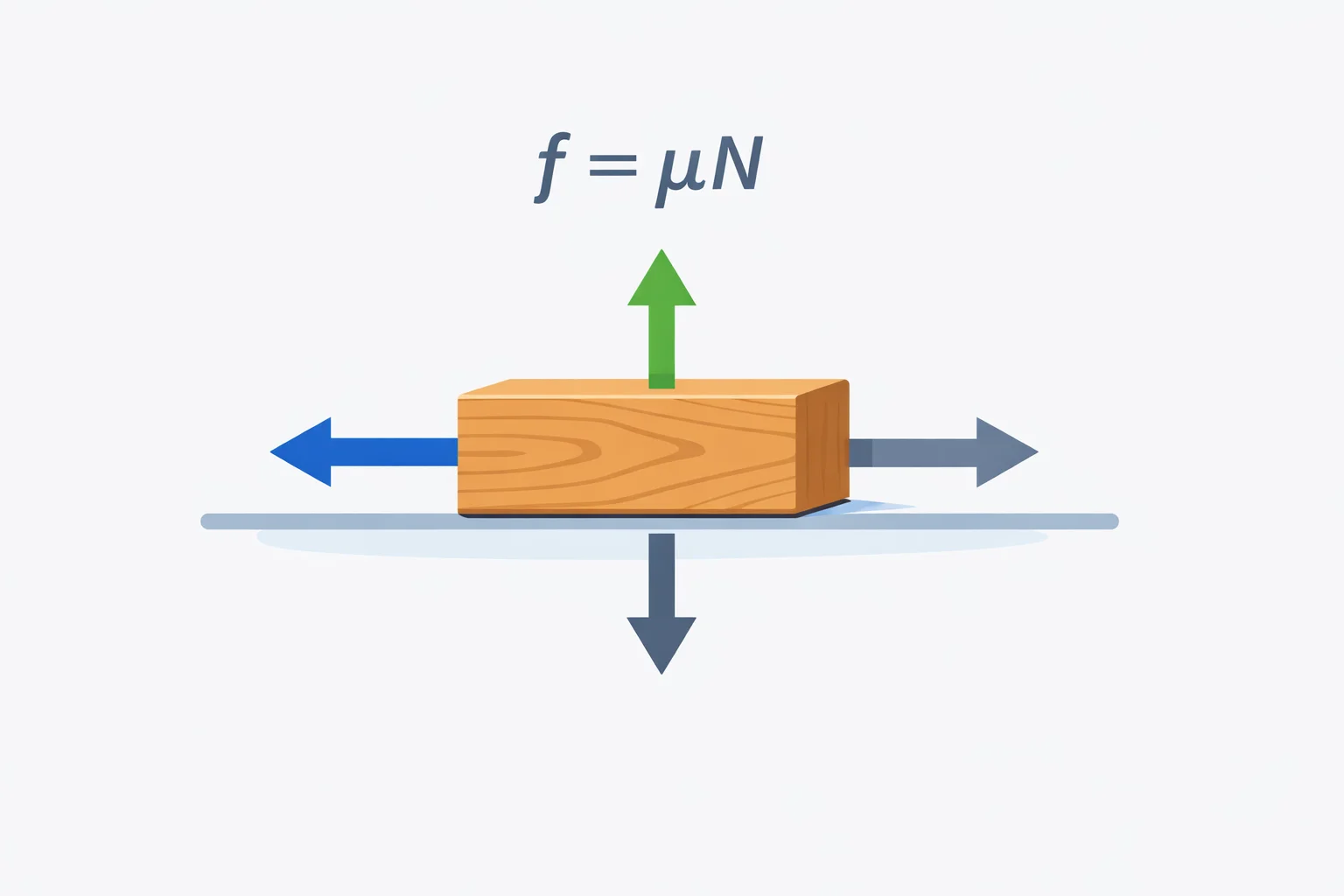
The Formula f = μN, and Why There Are Two μ Values
The normal force N is the perpendicular push a surface gives back to the object resting on it. On flat, level ground with nothing else pressing down, N equals the weight: N = mg. So friction on a flat floor becomes f = μmg. A 40 kg crate on a wooden floor (μ ≈ 0.5) sits on a normal force of 40 × 9.81 = 392.4 N, giving a friction force around 196 N. The moment you tilt the surface or press down on the object, N changes — which is exactly why the normal force calculator is the natural companion to this one.
Now the coefficient. There are two of them, and they describe two different physical states. The static coefficient μₛ governs an object that isn't moving yet; it sets the maximum grip before the object breaks free. The kinetic coefficient μₖ governs an object already sliding. For nearly every real surface pair, μₛ is larger than μₖ — steel on steel runs 0.74 static versus 0.57 kinetic. That single inequality explains a surprising amount of everyday physics, from why furniture lurches when it finally slides to why anti-lock brakes exist.
Static vs Kinetic: Why Starting Is Harder Than Sliding
Static friction is a reaction force. Push a parked crate with 50 N and static friction pushes back with exactly 50 N, holding it still. Push with 100 N and it pushes back with 100 N — right up until you exceed its ceiling of μₛN. Cross that threshold and the crate breaks loose, friction instantly drops to the lower kinetic value μₖN, and the surplus force accelerates the object. That sudden drop is why a stuck drawer flies open once it finally gives.
| Property | Static Friction | Kinetic Friction |
|---|---|---|
| When it acts | Object at rest | Object sliding |
| Formula | f ≤ μₛN (a maximum) | f = μₖN (a fixed value) |
| Magnitude | Adjusts to match the applied force | Constant once moving |
| Typical size | Larger (μₛ > μₖ) | Smaller |
| Everyday clue | Hard to get the box moving | Easier to keep it sliding |
Anti-lock braking systems (ABS) are a direct exploitation of this gap. A rolling tire grips with static friction; a locked, skidding tire drops to kinetic friction. Since μₛ for rubber on dry road sits near 0.9 and μₖ near 0.7, a skidding car loses roughly 20% of its braking grip and steering control at once. ABS pulses the brakes to keep the tire just shy of locking, holding it in the higher static regime. That same sideways grip is what bends a car around a bend — on a flat curve, friction is the entire centripetal force holding the car on its line, which is why an icy corner sends you straight off the road.
Worked Example: Will the Crate Slide Off the Truck Bed?
A 120 kg wooden crate sits on the steel bed of a flatbed truck (μₛ = 0.5, μₖ = 0.3 for this wood-on-painted-steel pairing). The driver brakes hard, decelerating at 4 m/s². Does the crate stay put or slide forward into the cab?
The crate needs a backward friction force to decelerate with the truck. The force required is F = ma = 120 × 4 = 480 N. The maximum static friction available is fs,max= μₛN = 0.5 × (120 × 9.81) = 0.5 × 1177.2 = 588.6 N. Since the 480 N needed is less than the 588.6 N available, friction wins — the crate rides along safely. The deceleration limit before it slides is a = μₛg = 0.5 × 9.81 = 4.9 m/s².
Here's the twist most people miss: that limit doesn't depend on the crate's mass at all. A 50 kg crate and a 500 kg crate both start sliding at the same 4.9 m/s² deceleration, because mass cancels out of μₛg. If the driver had braked at 5.5 m/s², every crate on that bed slides regardless of weight. Once you know the friction force and the leftover net force, the force calculator turns that net force straight into an acceleration with F = ma.
Friction on a Ramp and the Angle of Repose
Tilt the surface and two things change at once. The normal force shrinks to N = mg cosθ, so friction shrinks with it: fmax = μₛmg cosθ. Meanwhile gravity now has a component pulling the object down the slope: mg sinθ. The object stays put as long as the pull stays below the grip. It starts sliding the instant mg sinθ exceeds μₛmg cosθ.
Set those equal and the mass and g cancel beautifully: sinθ = μₛ cosθ, which means tanθ = μₛ. The angle where sliding begins is the angle of repose, θ = arctan(μₛ). This is genuinely useful outside the classroom: pour dry sand and it piles up at about 34°, which tells you the static coefficient of sand on sand is roughly tan(34°) ≈ 0.67. Geologists read landslide risk from it; engineers size grain silos and gravel piles with it.
Once the object is actually sliding down the ramp, kinetic friction takes over and the net force becomes mg sinθ − μₖmg cosθ. Divide by m and the acceleration is a = g(sinθ − μₖ cosθ). For a block on a 30° incline with μₖ = 0.3: a = 9.81 × (0.5 − 0.3 × 0.866) = 9.81 × 0.24 = 2.35 m/s². Set μₖ to zero and you recover the frictionless ramp result of g sinθ = 4.9 m/s². The net force calculator is handy when you want to add the slope pull, friction, and any rope tension as vectors.
Coefficient of Friction Reference Table
These are standard values from physics references. Treat them as starting estimates — real coefficients scatter by ±10–20% with surface finish, cleanliness, temperature, and humidity. Notice that μₛ beats μₖ on every line except Teflon, the famous near-exception. If you've measured your own surfaces, the coefficient of friction calculator works the table backward — it finds μ from a force reading, a ramp's slip angle, or a skid length.
| Surface Pair | Static μₛ | Kinetic μₖ | Angle of Repose |
|---|---|---|---|
| Rubber on dry concrete | 1.0 | 0.8 | 45.0° |
| Glass on glass | 0.94 | 0.40 | 43.2° |
| Steel on steel (dry) | 0.74 | 0.57 | 36.5° |
| Aluminum on steel | 0.61 | 0.47 | 31.4° |
| Wood on wood | 0.50 | 0.30 | 26.6° |
| Steel on steel (oiled) | 0.15 | 0.06 | 8.5° |
| Ice on ice | 0.10 | 0.03 | 5.7° |
| Teflon on steel | 0.04 | 0.04 | 2.3° |
The angle-of-repose column comes straight from arctan(μₛ). It tells you, at a glance, how steep a ramp each pair can hold before slipping. That oiled-steel value of 8.5° is why a drop of oil turns a walkable metal ramp into a slide.
What Friction Doesn't Care About (and It Surprises People)
Two factors that feel like they should matter mostly don't. Contact areadrops out of f = μN entirely. A brick lying on its broad face and the same brick balanced on its narrow end experience the identical friction force, because the normal force is the same and that's all the formula uses. Spreading the load over more area lowers the pressure but adds area in exact proportion, so μN never budges.
Sliding speedis the other one. The idealized kinetic friction force is the same whether the object creeps at 0.1 m/s or races at 10 m/s — μₖ is treated as constant. Both simplifications are approximations that hold remarkably well for dry, rigid materials at everyday speeds, which is why introductory physics leans on them so hard. They start to fail with soft rubber, very high speeds, and lubricated contacts, which is the subject of the last section.
Common Mistakes That Wreck Friction Answers
- Using N = mg on an incline.On a 25° ramp, a 30 kg box has N = 30 × 9.81 × cos 25° = 266.7 N, not 294.3 N. Since friction = μN, that 9% error in N flows straight into the friction force.
- Mixing up μₛ and μₖ. Use the static value to find the force that starts motion, the kinetic value for an object already sliding. Plugging μₖ into a “will it slip?” question underestimates the grip and predicts sliding too early.
- Treating static friction as a fixed number.It isn't μₛN unless the object is on the verge of slipping. Below that, static friction equals only the force trying to move the object — push with 30 N on a box that could hold 200 N and friction is 30 N, not 200 N.
- Assuming μ must be below 1. Clean rubber on dry concrete can hit 1.0–1.2, meaning the friction force exceeds the normal force. Nothing in the physics forbids it.
When f = μN Stops Working
The f = μN model is what physicists call the Coulomb friction model, and it's an approximation with real limits. Soft, sticky materialslike car-racing tires deliberately break it: their grip comes partly from molecular adhesion and rubber deformation, so their effective μ actually rises with contact area — the entire reason race cars run wide slicks. The textbook “area doesn't matter” rule assumes rigid surfaces it doesn't have.
Lubricated and high-speed contactsare governed by fluid dynamics, not Coulomb friction. A journal bearing riding on an oil film follows viscous drag laws where friction grows with speed — the opposite of the constant-μₖ assumption. And at the smallest scale, friction is really electromagnetic: microscopic surface asperities cold-weld and shear, and the “coefficient” is a tidy average over millions of these contacts. When you slide an object and it heats up, that's kinetic friction doing negative work on it. You can quantify that energy loss with the work calculator using W = −f·d.