How to Find the Coefficient of Friction From Real Measurements
Your teacher hands you a wooden block, a plank, and a protractor, then asks you to find the coefficient of friction — no force sensor, no fancy gear. How do you calculate mu in physics from that? You tilt the plank until the block slides and read the angle. That single number hands you μ through one line of trig. The coefficient of friction is never something you look up and trust blindly; it's something you measure, and there are three honest ways to do it depending on what you can actually observe — a force, an angle, or a skid.
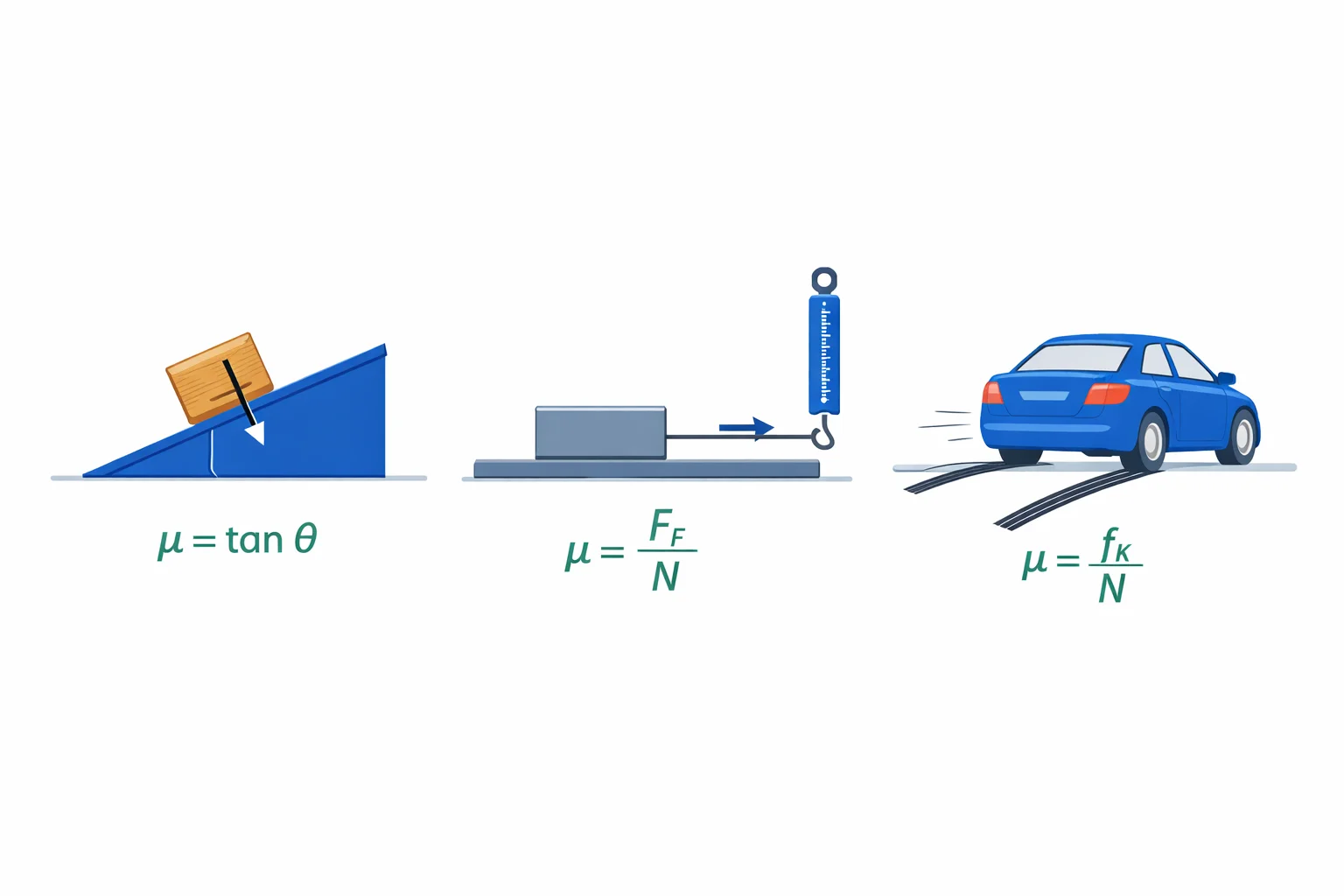
Three Ways to Pin Down μ Without Guessing
Mu (μ) is just a ratio — the friction force divided by the force pressing two surfaces together. Because it's a ratio of two forces, it has no units, and a μ of 0.5 measured on a lab bench means the exact same grippiness as a 0.5 measured from a car's skid mark. What changes between methods is what you measureand whether you end up with the static or the kinetic value. Here's how the three approaches stack up.
| Method | What You Measure | Formula | Gives You | Typical Spread |
|---|---|---|---|---|
| Spring scale | Friction force f and normal force N | μ = f / N | Static or kinetic | ±5–15% |
| Ramp tilt | Slip angle θ | μ = tan θ | Static (kinetic at constant-v angle) | ±5–10% |
| Skid distance | Speed v and skid length d | μₖ = v² / (2gd) | Kinetic only | ±15–25% |
Notice the ramp test is the most precise andneeds the least equipment — just an angle. The skid method has the widest spread because real road speeds and brake timing are hard to nail down, yet it's the only one that works after the fact, on a road, with no lab in sight.
The Direct Method: μ = f ÷ N
The cleanest definition of the coefficient of friction is μ = f / N, where f is the friction force and N is the normal force squeezing the surfaces together. On flat ground N equals the weight, mg. Say you drag a 6.0 kg stack of textbooks across a desk with a spring scale, and it slides at a steady, unchanging speed when the scale reads 14.7 N. Steady speed is the key clue: at constant velocity the net force is zero, so the scale reading equals the kinetic friction exactly.
N = mg = 6.0 × 9.81 = 58.86 N
μₖ = f ÷ N = 14.7 ÷ 58.86 = 0.25
To capture the staticcoefficient instead, watch the scale at the instant the books first jerk into motion. That peak reading — always a bit higher than the steady one — divided by N gives μₛ. If the books broke loose at 20.6 N, then μₛ = 20.6 / 58.86 = 0.35, comfortably above the 0.25 kinetic value. That gap between “starting” and “sliding” is the single most important feature of dry friction. Once you've measured μ, you can run the logic backward with the friction force calculator to predict the resisting force on any other load.
Tilt a Ramp Until It Slips: μ = tan θ
The tilt method is beautiful because the mass vanishes. Set an object on a board and slowly raise one end. Two forces compete along the slope: gravity pulling the object downhill with mg sin θ, and static friction resisting with up to μₛ(mg cos θ). The object lets go the instant the pull beats the grip:
mg sin θ = μₛ · mg cos θ
μₛ = sin θ / cos θ = tan θ
The mass m and gravity g cancel on both sides — they're gone. All that survives is the angle. A block that slips at 26.6° gives μₛ = tan(26.6°) = 0.50, the classic value for wood on wood. Want the kinetic coefficient from the same board? Lower the angle slightly, nudge the block, and find the angle where it glides down at constant speed. If that happens at 16.7°, then μₖ = tan(16.7°) = 0.30. You've now measured both coefficients with nothing but a protractor — no force sensor required. This same slip angle is what engineers call the angle of repose, and it's why a pile of dry sand always settles to about 34°.
Skid Marks and Speed: How Investigators Back Out μ
Accident reconstruction turns the friction problem inside out. A car skidding to a stop with locked wheels is decelerated by kinetic friction alone. Combine the work-energy theorem (friction does work μₖmg·d) with the car's kinetic energy (½mv²) and the mass cancels once again:
½mv² = μₖ · mg · d
μₖ = v² / (2gd)
Here's how it plays out at a real scene. To find μ for that stretch of road, an investigator runs a test skid: a vehicle braking hard from a known 15 m/s leaves a 22.9 m mark. That gives μₖ = 15² / (2 × 9.81 × 22.9) = 225 / 449.3 ≈ 0.50 — a typical dry-asphalt value. Now they apply that 0.50 to the suspect vehicle's 40 m skid and solve for speed instead:
v = √(2 · μₖ · g · d) = √(2 × 0.50 × 9.81 × 40)
v = √392.4 = 19.8 m/s ≈ 71 km/h (44 mph)
That number can decide a speeding case. And because mass dropped out, it doesn't matter whether the suspect was driving a hatchback or a loaded pickup — the skid length tells the same story. If you want to see how much kinetic energy that 40 m skid bled off as heat, the kinetic energy calculator handles the ½mv² side of the equation.
What Your Measured Number Actually Means
A coefficient on its own is abstract until you can place it. Once you have a number, this table tells you what surfaces typically land in that range — handy for sanity-checking a lab result or identifying a mystery pair. The values draw on standard references such as HyperPhysics and the engineering literature.
| Measured μ | Likely Surface Pair | What It Tells You |
|---|---|---|
| 0.02 – 0.05 | Teflon, oiled steel | Near-frictionless; barely resists motion |
| ~0.10 | Ice on ice | Slips at a mere 5.7° tilt |
| 0.30 – 0.60 | Wood, glass, metal on metal | The everyday range most lab results fall in |
| 0.60 – 0.80 | Rubber on wet or worn road | Tire grip in the rain |
| 1.0 – 1.2 | Clean rubber on dry concrete | μ above 1 — friction exceeds the normal force |
That last row catches people off guard. There's no law that caps μ at 1. A coefficient of 1.2 simply means the friction force is 1.2 times the normal force, which clean rubber on dry concrete genuinely achieves. If your measurement lands above 1.3, though, treat it as a red flag to recheck your numbers before trusting it.
Why Your Measured μ Doesn't Match the Textbook
Lab μ values almost never hit the table value on the nose, and that's normal — not a mistake. Here are the four reasons measurements drift, with what each one actually does to your number:
- Static vs kinetic mix-up.Measuring the peak “break-loose” force but comparing it to a kinetic table value will look 20–40% too high. Decide which coefficient you want before you read the instrument.
- Surface contamination.A fingerprint's worth of oil or a film of dust shifts μ by 10–20%. The same wood block on the same desk can read 0.28 one day and 0.34 the next purely from humidity and handling.
- Using N = mg on a tilt.If you measure friction on a ramp but forget the normal force is mg cos θ rather than mg, μ comes out too small. On a 20° ramp that's a 6% error before you start.
- Single-trial reporting.Friction scatters, so one reading isn't a measurement — it's a guess. Average 5–10 trials and quote the range. A result of “0.31 ± 0.04” is honest; “0.3127” from one pull is false precision.
When you do trust your μ, feed it into a net force calculation to combine friction with the other forces acting on the object.
When One μ Stops Telling the Whole Story
The μ = f / N model — Coulomb friction — assumes one tidy coefficient covers all conditions. It mostly does, for dry, rigid surfaces at ordinary speeds. But a few cases break it. Racing tires gain grip with temperature and contact area because their hold comes partly from molecular adhesion, so a single μ measured cold underpredicts their hot grip badly. Lubricated bearings follow viscous drag, where resistance climbs with speed rather than staying pinned at μₖN. And at very high sliding speeds, frictional heating softens the contact and the effective coefficient drops. In each case, measuring μ once and assuming it holds everywhere is the trap. Treat your measured coefficient as a snapshot of one pair of surfaces under one set of conditions — accurate where you took it, an estimate everywhere else.