Weight Calculator: How W = mg Sets Your Weight on Earth and Every Other World
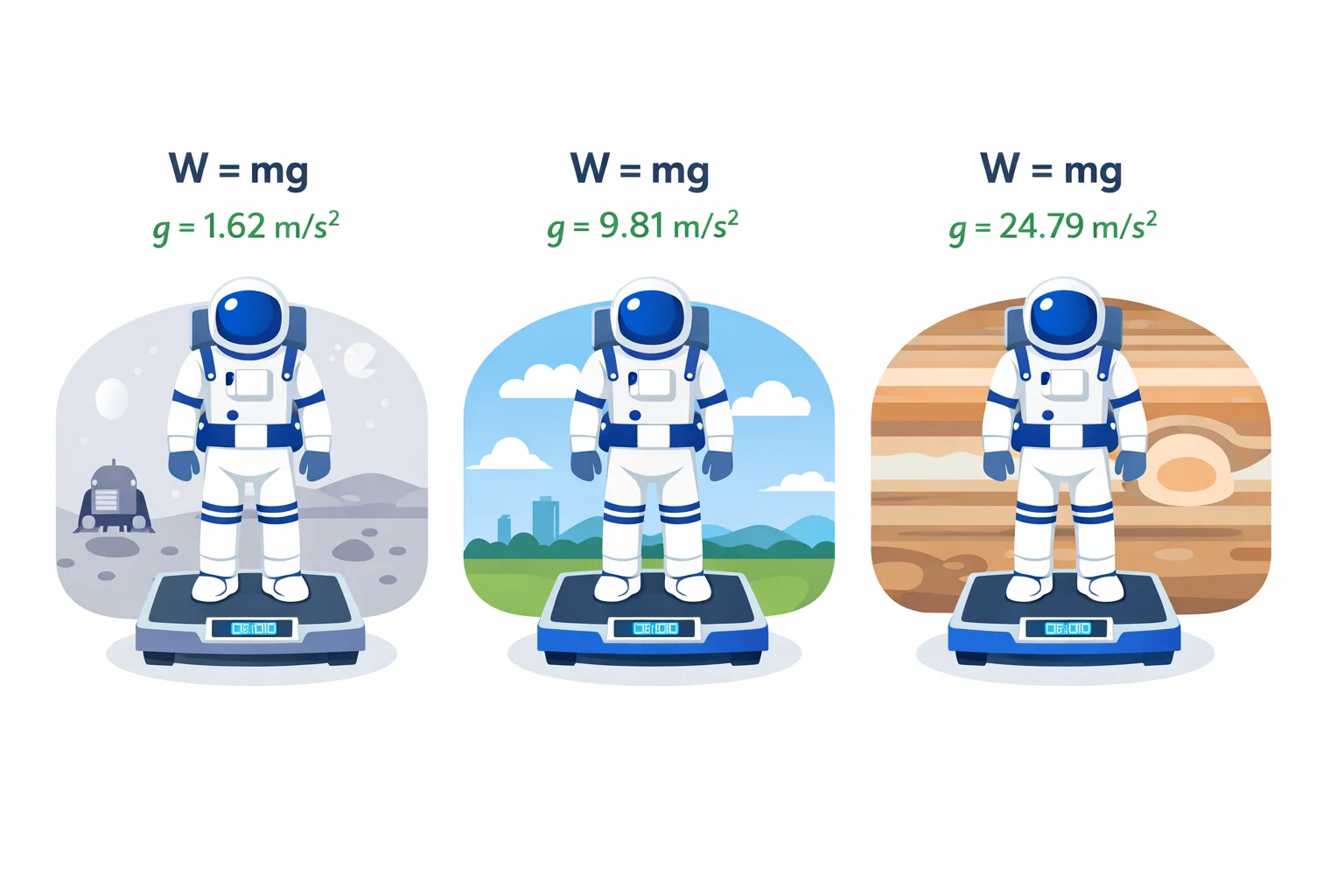
Your weight isn't really a property of you — it's a property of where you're standing. Move the same body from a beach to the Moon and the number on the scale drops to roughly a sixth, even though not one atom has left. That's the idea a weight calculator captures in physics: weight is the pull of gravity on a mass, written W = mg, and it travels with the local gravity rather than with the object. The tool above takes a mass, lets you choose a world, and returns the force gravity exerts there — in newtons, pounds, and the kilogram-equivalent a scale would display.
Weight Is a Force, Not an Amount of Stuff
Here's the distinction that trips up half of every introductory class: weight is measured in newtons, the unit of force, because weight isa force. A 70 kg adult standing on Earth presses down with 70 × 9.81 = 686 N — that's the actual force their feet transmit to the floor. Say "I weigh 70 kilograms" and you've technically named your mass, not your weight; the honest weight figure is 686 newtons. The shorthand works in daily life only because everyone is standing in the same 9.81 m/s² gravity, so the kilogram label never gets contradicted.
Mass and weight are joined at the hip but never the same number. Mass counts the matter and stays put — 70 kg in a kitchen, 70 kg in orbit, 70 kg on Pluto. Weight is what gravity does to that matter, and it swings with the value of g. If you want to go the other way and recover mass from a weight reading, the mass calculator runs m = W/g, the same relationship turned inside out.
Reading W = mg: Two Inputs, One Force
The whole formula is W = mg, and it has exactly two ingredients. m is mass in kilograms. gis the gravitational acceleration of wherever you are, measured in m/s² — 9.81 at Earth's surface, smaller on lighter worlds, larger on heavier ones. That g value isn't arbitrary; a gravitational acceleration calculator derives it from each planet's mass and radius with g = GM/r². Multiply m and g and the answer comes out in newtons. There's no hidden constant and no unit gymnastics: kilograms times metres-per-second-squared is a newton, by definition.
The thing to notice is that weight scales straight-line with both inputs. Double the mass and you double the weight; carry the same mass to a world with twice the gravity and you again double the weight. That linearity is why the calculator can fill an entire table for one mass in a single pass — every entry is just that mass multiplied by a different g. It also means weight is nothing more exotic than Newton's second law in disguise: W = mg is F = ma with gravity playing the role of the acceleration.
Working a Real Weight Problem Step by Step
Try one that isn't a tidy textbook number. A checked suitcase has a mass of 23 kg — the common airline limit. What does it actually weigh, and how hard does the baggage handler fight gravity to lift it onto the belt? Plug into W = mg: 23 kg × 9.81 m/s² = 225.6 N. That 225.6 N is the downward gravitational force; to raise the bag at steady speed, the handler must push up with at least that same 225.6 N. In familiar units it's about 50.7 pounds-force, which is exactly why a max-weight bag feels like a workout.
Now flip the scenario to something heavier and off-world. A Mars rover with a mass of 899 kg (roughly Curiosity's figure) weighs 899 × 9.81 = 8,819 N on Earth during testing, but only 899 × 3.72 = 3,344 N once it lands on Mars. Engineers care about both: the Earth weight sizes the crane that lowers it onto the test stand, while the Mars weight sizes the suspension and wheels that carry it across the surface. Same machine, two weights, one mass — and that gap is the whole reason Mars hardware can be built lighter than its Earth-test weight suggests.
Your Weight on Other Planets, Worked Out
This is where a weight calculator earns its keep. Because every world has its own surface gravity, the same mass registers a different weight on each — and the spread is enormous. Here is a 75 kg person carried across the solar system, using surface-gravity values from NASA's planetary fact sheet:
| Body | g (m/s²) | Weight of 75 kg (N) | Feels like (kg on Earth) |
|---|---|---|---|
| Pluto | 0.62 | 47 | 4.7 |
| Moon | 1.62 | 122 | 12.4 |
| Mars | 3.72 | 279 | 28.4 |
| Earth | 9.81 | 736 | 75.0 |
| Neptune | 11.15 | 836 | 85.2 |
| Jupiter | 24.79 | 1,859 | 189.5 |
| Sun | 274.0 | 20,550 | 2,095 |
The surprise in the table is Saturn. People expect the giant planets to flatten you, yet Saturn's surface gravity (10.44 m/s²) is only a hair above Earth's — its huge mass is spread through such a vast, low-density volume that the visible surface stays far from the center. Only the Sun delivers the science-fiction figure: a 75 kg person would weigh over 20,000 N there, like having a small car pressing down on you. The calculator highlights whichever world you pick so you can read your chosen weight against all the others at a glance.
Newtons, Pounds-Force, and the Kilogram Trap
Weight shows up in three units that get tangled constantly, so it's worth pinning them down. The newton (N) is the physics unit — the force that accelerates 1 kg at 1 m/s². The pound-force (lbf) is the everyday US unit, and 1 lbf ≈ 4.45 N, so a 686 N person weighs about 154 lbf. The slippery one is the kilogram-force (kgf), which is just weight wearing a mass costume: 1 kgf is the weight of 1 kg on Earth, about 9.81 N.
That kilogram-force is the root of the most common confusion. When a bathroom scale reads "70 kg," it's really reporting 70 kgf of force, which it converted from the 686 N it actually measured by dividing out Earth's gravity. The scale assumes g = 9.81 and bakes it in. Harmless on Earth, but it's why you can't trust a spring scale anywhere the gravity differs — and why physics problems insist you convert any weight-in-newtons back to mass before it enters something like kinetic energy or momentum, both of which want true mass in kilograms.
Elevators and Orbits: When the Scale Lies
What a scale reports isn't always your true gravitational weight — it's your apparent weight, the force you actually press into the surface. Stand in an elevator that accelerates upward at 2 m/s² and the floor must support your weight andshove you upward, so a 70 kg rider's scale jumps from 686 N to about 826 N. Nothing about your mass or Earth's gravity changed; the extra reading is pure acceleration. Let the elevator accelerate downward and the number drops below 686 N.
Push that to the limit and you get weightlessness. Astronauts on the Space Station aren't beyond gravity — at that altitude g is still about 8.7 m/s², nearly 90% of the surface value. They float because the station and everyone in it are in continuous free fall, curving around Earth together, so nothing presses on a scale. Their true weight (W = mg) is large; their apparent weight is zero. A free fall calculator captures the same regime on the way down to the ground: gravity acting alone, no surface pushing back.
Where W = mg Quietly Stops Being Exact
W = mg is excellent for everyday work, but it treats g as a single fixed number, and g isn't truly constant. It weakens with altitude because you move farther from a planet's center — atop Everest (about 8,850 m) Earth's g falls to roughly 9.77 m/s², trimming a 70 kg climber's weight by about 3 N. It even varies across Earth's surface, from 9.78 at the equator (where the planet bulges and spins) to 9.83 at the poles. For a 1,000 kg load that equator-to-pole gap is about 50 N, enough to matter when you're calibrating a precision scale.
For larger distances, W = mg gives way to the full inverse-square law, where weight depends on 1/r² rather than a flat g — that's the territory of the gravitational force calculator. The flat-g version is really the close-to-the-surface shortcut of that bigger formula, accurate to a fraction of a percent for anything sitting on or near the ground. Use W = mg for objects resting on a surface; reach for the inverse-square law once you're lifting satellites into orbit or comparing the pull at wildly different heights.