Center of Gravity Calculator: Pinning the Balance Point of Any System
Three movers grab a 220 kg crate that's clearly heavier on one end, and the question before anyone lifts is brutally practical: where do you grip it so nobody's wrist gives out? That single point — the one where the whole crate would balance on a fingertip — is its center of gravity, and finding it is pure arithmetic once you know each part's mass and position. The center of gravity calculator above runs that arithmetic for up to six objects at once, but the logic underneath is worth understanding, because it's the same logic that decides whether a forklift tips, where a satellite spins, and why a triangle balances a third of the way up. Let's solve the crate, then generalize.
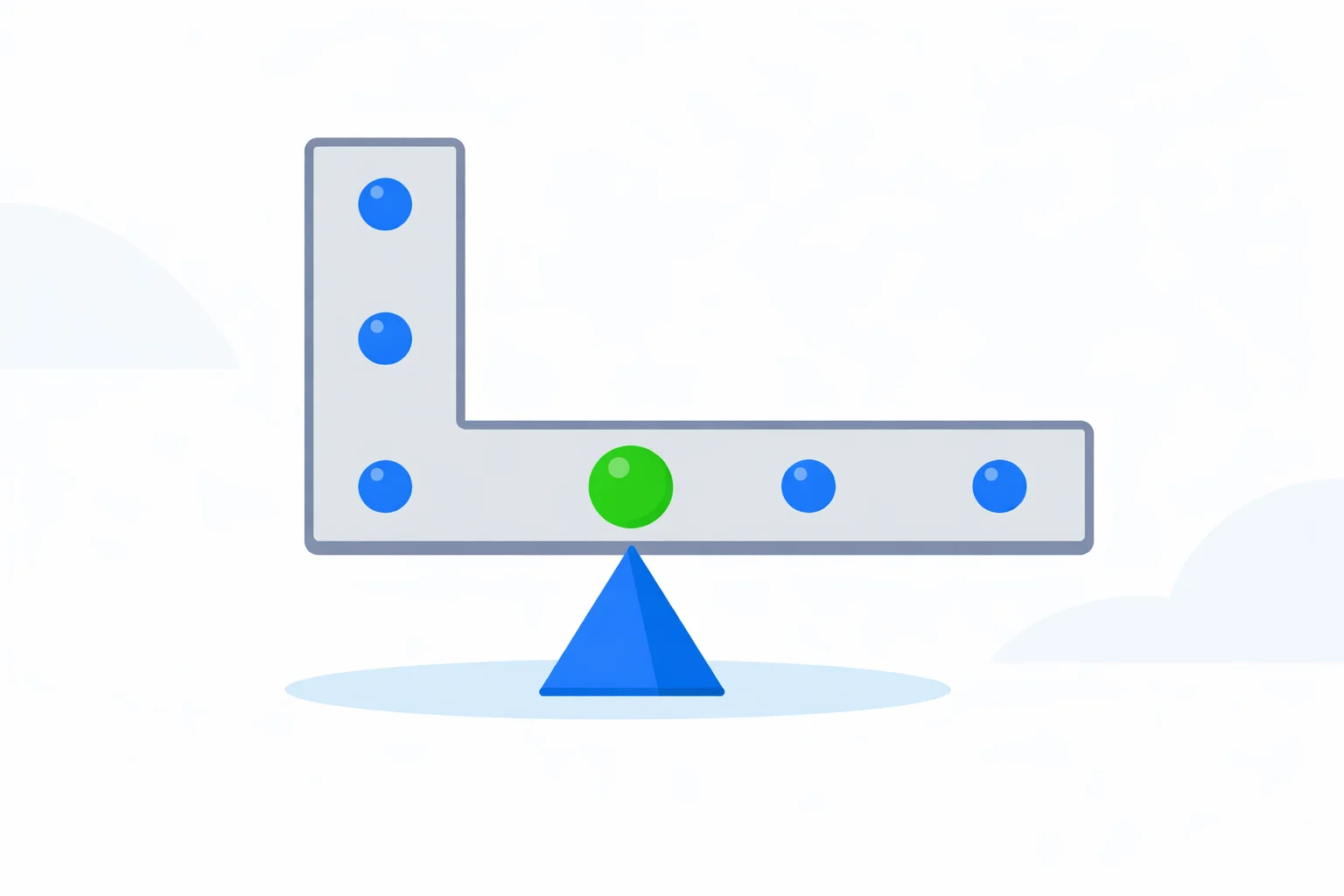
The Balance Point Is a Weighted Average, Nothing More
Strip away the intimidating name and the center of gravity is a weighted average of position, where the "weights" in the average are literally the weights (or masses) of the parts. Put a 6 kg mass at the 0 m mark and a 2 kg mass at the 8 m mark on a light rod. The midpoint sits at 4 m, but the balance point doesn't — it's pulled toward the heavy end, landing at (6·0 + 2·8) ÷ (6 + 2) = 16 ÷ 8 = 2 m. The heavier object wins the tug-of-war for the balance point in exact proportion to its mass.
Written out, the formula for one dimension is xcg= Σ(mᵢxᵢ) ÷ Σmᵢ. The numerator Σ(mᵢxᵢ) is the sum of each mass times its position — engineers call each mᵢxᵢ a "moment" about the origin. The denominator is just the total mass. Divide the total moment by the total mass and you get the single position where one combined weight would produce the same moment. That's why the calculator shows the running Σ(mx) and Σm: those two sums are the entire calculation. Knowing each part's mass is the only input the formula truly needs.
Pick an Origin First, Then the Formula Falls Out
Here's the step students skip and then can't figure out why two people get two answers: you have to fix an origin before any position means anything. The good news is the choice doesn't change the physical balance point — it only changes the number you report. Measure the 6 kg/2 kg rod from the left and the CG is at 2 m; measure it from the right and the same point reads as 6 m from that end. Same spot on the rod, different label, because you counted from a different zero.
For a 2D layout — a metal plate, a floor plan, a drone with motors at four corners — you run the identical average twice, once for x and once for y: ycg= Σ(mᵢyᵢ) ÷ Σmᵢ. The two coordinates are independent, so a mass off in the corner pulls the balance point diagonally toward itself. Pick the easiest origin you can (a corner usually beats the center), keep every measurement in the same units, and the calculator's 2D mode plots each object as a bubble sized by its mass with the combined CG marked by the green crosshair.
Worked Example: Where to Lift a Lopsided Crate
Back to that crate. Model it along its 2.4 m length as three lumped masses: a 40 kg motor at 0.3 m from the left, an 80 kg transformer at 1.2 m, and a 100 kg battery pack crammed at 2.1 m. Total mass is 220 kg. The moment sum is (40·0.3) + (80·1.2) + (100·2.1) = 12 + 96 + 210 = 318 kg·m. Divide: 318 ÷ 220 = 1.45 m from the left end. That's where a single sling should go to lift the crate level — not the geometric middle at 1.2 m, but 25 cm toward the heavy battery side.
The 25 cm offset is the whole point. Sling it at the midpoint and the crate rotates battery-end down, dumping load onto whoever's standing there. This is exactly how riggers, crane operators, and aircraft loadmasters work: they compute the balance point, then place the hook or set the cargo so the loaded center of gravity lands inside a safe envelope. The same Σ(mx)/Σm you'd punch into the calculator is what keeps a loaded cargo plane trimmed for takeoff.
Center of Gravity vs Center of Mass: When They Split
People use "center of gravity" and "center of mass" interchangeably, and for almost everything you'll ever calculate, that's fine — they sit at the same point. The distinction only appears when the gravitational field isn't uniform across the object. Center of mass is the mass-weighted average position, full stop. Center of gravity is the weight-weighted average, and weight is mass times the local gravitational acceleration g. When g is the same everywhere on the object, the two averages collapse onto each other.
| Aspect | Center of Mass | Center of Gravity |
|---|---|---|
| Weighted by | Mass (mᵢ) | Weight (mᵢ·gᵢ) |
| Depends on gravity? | No — same in deep space | Yes — shifts if g varies |
| Where they differ | Never (by definition) | Only in a non-uniform field |
| Typical example | Spinning wrench in orbit | A 100 km space elevator tether |
| Practical size of gap | — | Sub-millimeter for any building |
So when does the gap actually bite? Only at enormous scales. For a 100 km tether, the bottom end feels measurably stronger gravity than the top, so its center of gravity sits slightly below its center of mass. For your physics homework, a car, or a bridge, treat them as the same point and you'll never be wrong by anything you could measure.
Centroids of Common Shapes
When an object is a solid uniform shape rather than a few lumped masses, its balance point is the geometric centroid — and for standard shapes that location is already worked out, no integration required. These are measured from the listed reference point, and they assume uniform density; a heavy core or hollow section shifts them. The values match the centroid tables in standard engineering references like HyperPhysics.
| Shape | Centroid location | Measured from |
|---|---|---|
| Rectangle / square | Center: (w/2, h/2) | A corner |
| Triangle | h/3 above the base | Midpoint of the base |
| Semicircle | 4r / 3π ≈ 0.424r | Center of the flat edge |
| Quarter circle | 4r / 3π along each axis | The square corner |
| Cone (solid) | h/4 above the base | Center of the base |
| Hemisphere (solid) | 3r / 8 ≈ 0.375r | Center of the flat face |
For an irregular shape, the trick is to chop it into these standard pieces, find each piece's centroid and area (or mass), then feed those as separate objects into the weighted average. An L-bracket becomes two rectangles; a keyhole becomes a circle plus a rectangle. Cut-out holes get a negative mass — a clever shortcut that subtracts the missing material's moment automatically.
The Tipping Test: When the CG Leaves the Base
The balance point isn't just trivia — it decides stability. An object stays upright as long as a vertical line dropped from its center of gravity lands inside its base of support. Tilt it far enough that the line crosses the edge of the base, and gravity's pull now produces a tipping torque instead of a restoring one. That's the moment it goes over. A wide base and a low CG buy you a bigger tilt angle before that line escapes.
Run the numbers on a forklift and it gets vivid. An unloaded forklift keeps its CG well inside the wheelbase, but hoist a 1,500 kg pallet out front and the combined center of gravity lurches forward toward the front axle. Raise that same load three meters and the CG climbs too, shrinking the tilt the truck can survive on a ramp. Once the combined CG passes the front wheels, no amount of counterweight in back helps — the net force and its torque flip the machine. It's the same physics as a person leaning back in a chair until the CG clears the rear legs.
Where the Balance-Point Formula Stops Working
Σ(mx)/Σm is exact, but it quietly assumes things that don't always hold. First, it treats mass as fixed in place. The instant your system changes shape — a diver tucking, fuel sloshing in a tank, a crane swinging its boom — the center of gravity moves, and a single snapshot is already stale. Race engineers obsess over this because a half-full fuel cell shifts the CG every corner.
Second, the simple sum assumes uniform gravity; across anything smaller than a continent that's perfectly safe, but for orbital mechanics you need the weight-weighted version from the comparison above. And third, treating real objects as point masses is an approximation — fine for locating the balance point, useless for how the object spins, which depends on how the mass is spread out, not just where it averages to. For that you'd reach past the center of gravity into moment of inertia. Locate the balance point first; it's the anchor every other rotational calculation hangs from.