Density Calculator: Using ρ = m/V to Tell Gold From Pyrite (and Ice From Steel)
A jeweler hands you a ring and swears it's solid gold. You don't have to trust them — you have physics. Weigh the ring, measure how much water it pushes aside, and calculate density in physics the same way Archimedes reportedly did in his bathtub over 2,000 years ago. Gold has a density of 19.3 g/cm³, and almost nothing else cheap comes close. If your ring works out to 11 g/cm³, it's probably gold-plated lead, and the density calculator above just saved you from a bad deal. Density, ρ = m/V, is one of the few numbers that fingerprints a material no matter its size or shape.
The Crown Problem: How Density Catches a Fake
The classic version is King Hiero's crown. He suspected his goldsmith had swapped some gold for cheaper silver, but the crown weighed exactly what he'd paid for, so the scale alone couldn't catch the fraud. The trick is that silver (10.49 g/cm³) is far less dense than gold, so a crown cut with silver has the same mass but a larger volume than a pure-gold one would. Measure the volume, divide the mass by it, and a fake gives you a density stuck somewhere between gold and silver instead of a clean 19.3.
That's the entire power of density as a detective tool: mass and volume each lie on their own, but their ratio tells the truth. A 200 g lump could be a golf-ball of gold or a grapefruit of cork. Only when you pin mass against the space it occupies does the material reveal itself. The same logic shows up in airport security scanners, recycling sorters, and the assay office that stamps a karat number on jewelry.
Reading ρ = m/V Without Mixing Up the Pieces
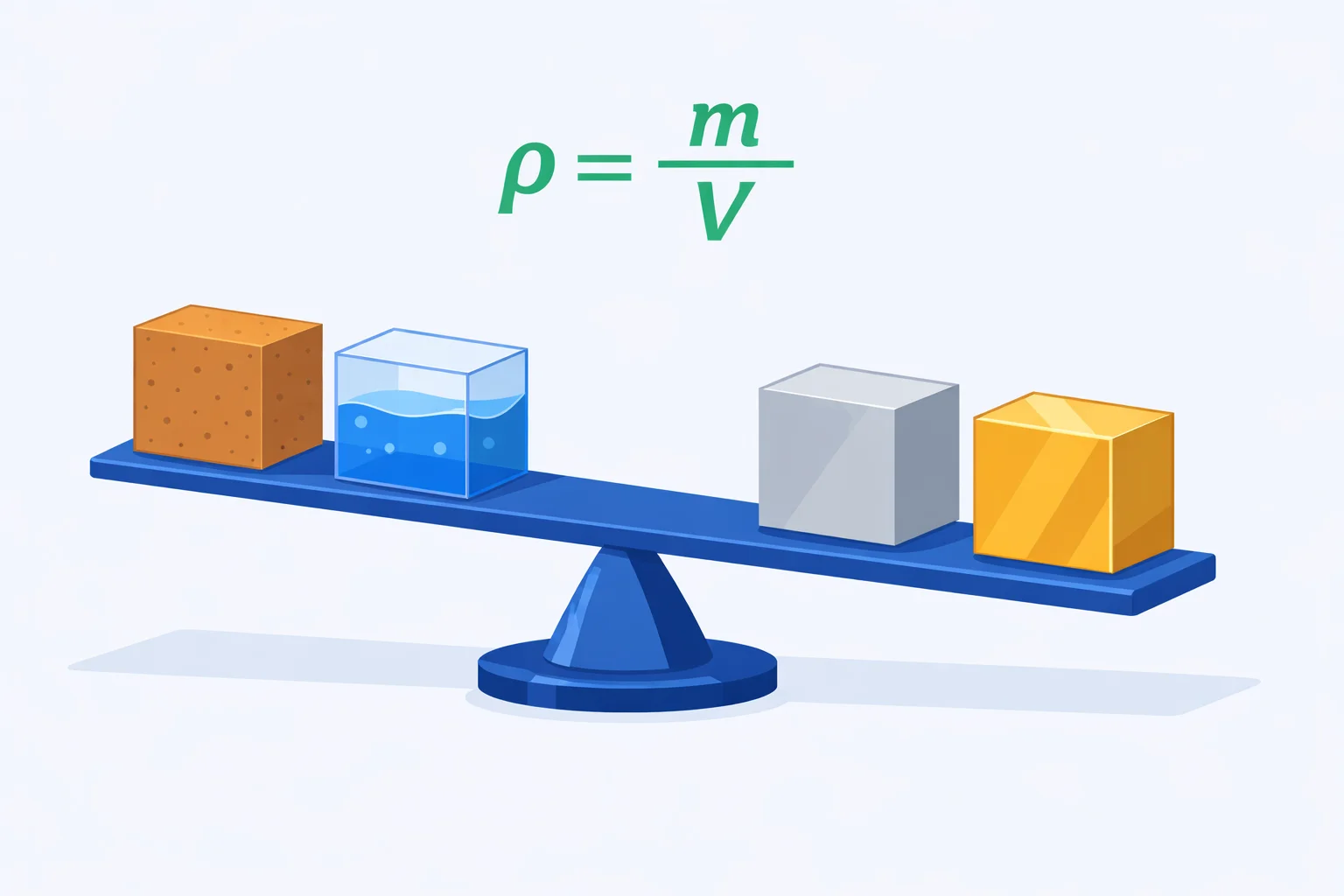
Density is mass divided by volume: ρ = m / V. The Greek letter ρ ("rho") is the standard symbol, m is mass, and V is volume. Read it as "how much stuff is packed into each chunk of space." A cubic centimeter of water holds 1 gram; a cubic centimeter of lead holds 11.34 grams of the same-sized box. That's why a small lead fishing weight feels absurdly heavy for its size — you're holding eleven times the mass water would put in that volume.
The formula rearranges two ways, which is why the calculator has three modes. Need mass? Multiply: m = ρV. Need volume? Divide the other way: V = m/ρ. If you know a coin is brass (8.5 g/cm³) and measures 1.4 cm³, its mass must be 8.5 × 1.4 ≈ 11.9 g without ever touching a scale. Going from a material density to a mass is exactly what the mass calculator automates when you can't weigh something directly.
Measuring Volume When the Shape Is Awkward
Mass is easy — any scale gives it to you. Volume is where students get stuck, because real objects aren't tidy cubes. For a regular shape you use geometry: a sphere of radius 2 cm has V = (4/3)πr³ ≈ 33.5 cm³. But for a crown, a rock, or a crumpled key, reach for water displacement. Fill a measuring cylinder, note the level, lower the object in fully, and read the new level. The difference is the object's volume, because a submerged solid shoves aside exactly its own volume of water.
Say a chunk of metal raises the water in a cylinder from 40.0 mL to 58.5 mL. It displaced 18.5 mL, which is 18.5 cm³ (1 mL = 1 cm³, a conversion worth memorizing). If that chunk weighs 145.7 g, its density is 145.7 ÷ 18.5 = 7.88 g/cm³ — a dead ringer for iron. Keep in mind that a 1 mL cylinder reads to about ±0.5 mL, so the volume here carries real measurement uncertainty that propagates straight into the density. This displacement method is also the bridge between density and buoyancy, since the weight of the water pushed aside is also the upward force that decides whether the object floats.
Why Ice Floats but a Steel Nail Sinks
Floating is a density comparison, full stop. An object floats when it's less dense than the fluid around it and sinks when it's denser. Ice is 917 kg/m³ and water is 1,000, so ice floats — barely. A steel nail at 7,850 kg/m³ doesn't stand a chance and drops straight to the bottom. Swap the fluid and the verdict can flip: that same steel would float on liquid mercury (13,534 kg/m³), which is why old mercury barometers could suspend bits of iron right on the surface.
There's a precise payoff here. A floating object sinks until it displaces its own weight, so the fraction left underwater equals the density ratio ρ_object ÷ ρ_fluid. Ice in seawater (1,025 kg/m³) gives 917 ÷ 1,025 ≈ 0.89 — about 89% hidden below the surface, the "tip of the iceberg" made literal. The float-test panel in the calculator runs this exact ratio for any fluid you pick, so you can watch cork ride high and a glass marble vanish.
The g/cm³ vs kg/m³ Factor-of-1000 Trap
Here's the mistake that wrecks more density problems than any formula slip: mixing units. Water's density is 1 g/cm³, but it's also 1,000 kg/m³ — the same water, two unit systems, separated by a clean factor of 1,000. Convert grams to kilograms (÷1,000) and cm³ to m³ (÷1,000,000) at once, and the net result is ×1,000. Forget this and you'll report aluminum as 2.7 kg/m³ (lighter than air!) instead of 2,700, or quote a planet's density a thousand-fold wrong.
A simple habit fixes it: pair grams with cubic centimeters, or kilograms with cubic meters, and never cross the streams. The calculator above shows every result in g/cm³, kg/m³, and lb/ft³ at once precisely so you can sanity-check which scale you're working in. If a number looks 1,000× off, it almost always is — that's the unit trap, not a broken formula.
Densities of Common Materials
These are measured values at roughly room temperature, the kind printed in engineering handbooks like the Engineering ToolBox material database. Notice how tightly the metals cluster and how dramatically gold and platinum stand apart — that gap is exactly what makes density such a reliable test for precious metals.
| Material | g/cm³ | kg/m³ | Floats on water? |
|---|---|---|---|
| Cork | 0.24 | 240 | Yes |
| Pine wood | 0.42 | 420 | Yes |
| Ice | 0.917 | 917 | Yes (just) |
| Water | 1 | 1,000 | — |
| Aluminum | 2.7 | 2,700 | No |
| Iron | 7.87 | 7,870 | No |
| Copper | 8.96 | 8,960 | No |
| Lead | 11.34 | 11,340 | No |
| Mercury | 13.53 | 13,534 | No |
| Gold | 19.3 | 19,300 | No |
Worked Example: Naming an Unknown Metal
A lab gives you a dull gray cylinder and asks what it's made of. You measure it: 2.0 cm across and 5.0 cm tall, so the radius is 1.0 cm and the volume is V = πr²h = π × 1.0² × 5.0 ≈ 15.71 cm³. On the scale it reads 42.4 g. Density is 42.4 ÷ 15.71 = 2.70 g/cm³. Check that against the table and there's only one common match: aluminum. Not steel, not titanium — the number alone names the metal.
Now suppose the same-sized cylinder had weighed 123.5 g instead. Then ρ = 123.5 ÷ 15.71 = 7.86 g/cm³, which lands on iron or steel, not aluminum — a 3× jump in density from an object that looks identical. That's the lesson worth keeping: identical dimensions, wildly different materials, and density is the single measurement that tells them apart. Once you know the mass behind that density, the weight calculator converts it to the actual force you'd feel lifting the cylinder.
When ρ = m/V Isn't the Whole Story
The formula is exact, but the assumption that a material has one fixed density isn't. Temperatureshifts it: heat almost anything and it expands, so the same mass spreads over more volume and density drops. Water is the rebel — it's densest at 4 °C, not at freezing, which is why ice forms on top of a pond and fish survive the winter underneath. For gases the effect is huge, so a gas density is meaningless unless you state its temperature and pressure.
Porosity and mixturestrip people up too. A "density" you measure for a chunk of dry sand or a loaf of bread is really an averageof solid material plus the air trapped in the gaps — change how tightly it's packed and the number moves. And for objects that aren't uniform, like a hollow steel ball or a chocolate-coated cherry, ρ = m/V gives an overall average that hides what's inside — and that uneven distribution drags the center of gravity toward the dense side. Density still works perfectly; you just have to remember it answers "mass per total volume," not "what is this made of at every point." For the average density of an entire planet, that same ratio scaled up is what a gravitational acceleration calculator leans on to explain why a giant like Saturn would float in a big enough bathtub.