Uncertainty Calculator: How to Propagate Error Through Physics Measurements
A digital balance reads 24.37 g and a measuring cylinder reads 9.0 mL. Divide one by the other and your calculator proudly returns a density of 2.707777… g/mL. But that string of digits is a fiction — the cylinder could only be trusted to about ±0.5 mL, which drags the honest answer somewhere between 2.56 and 2.86 g/mL. An uncertainty calculator exists to track that fuzziness instead of hiding it: it takes the ± attached to every reading and works out the ± on your final result. The rules are short, but they trip up more lab reports than any formula error, because uncertainty refuses to combine the way ordinary numbers do.
Every Measurement Is Really a Range
No instrument hands you a perfect number. A 30 cm ruler marked in millimetres can't resolve anything finer than its smallest division, so a length read as 12.4 cm honestly means "somewhere near 12.4, give or take half a millimetre." That give-or-take is the uncertainty, written 12.4 cm ± 0.05 cm. The ± isn't pessimism or sloppiness — it's the most useful part of the measurement, because it tells the next person exactly how far they can trust your number before it stops meaning anything. The entire job of error propagation is keeping that ± alive as a value flows through your equations.
Absolute, Relative, and Percent Uncertainty
The same uncertainty wears three outfits, and you need all of them. Absolute uncertainty carries the measurement's units: ±0.05 cm. Relative (fractional) uncertainty divides that by the value, 0.05/12.4 = 0.004, and has no units at all. Percent uncertainty is just the relative value times 100, so 0.4%. Absolute uncertainty is what you write in a final answer; relative uncertainty is what you actually do arithmetic with once measurements start getting multiplied or divided. Knowing which form a given step needs is half the battle — which is why the calculator above shows all three side by side for every result. If you only need that final percentage — and want to combine it across a whole formula at once — the dedicated percent uncertainty calculator weights each term by its exponent and shows which measurement dominates. All three describe precision, not accuracy — to see how far your result lands from the accepted value, the percent error calculator does that comparison.
Adding and Subtracting: Absolute Uncertainties Pile Up
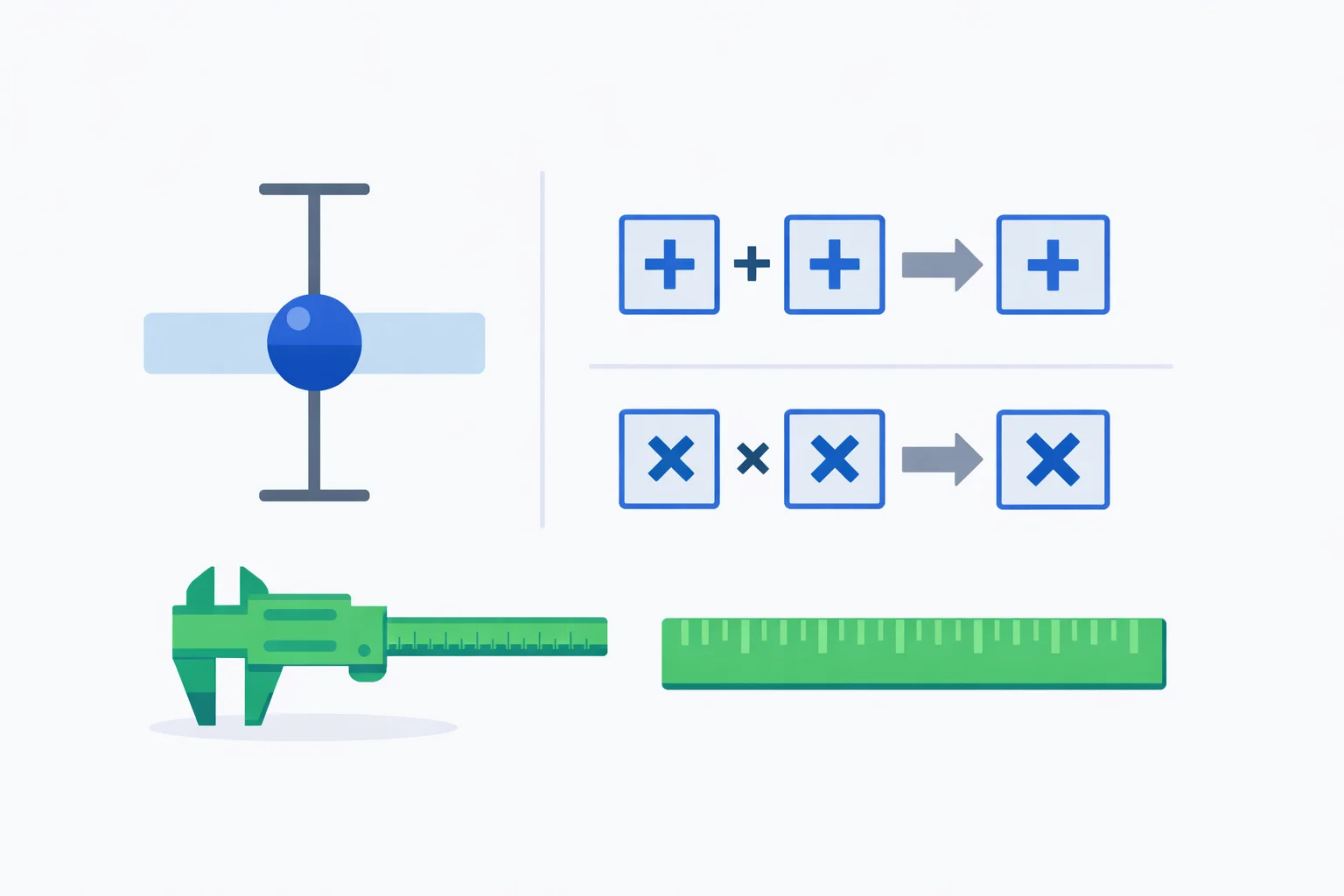
When you add or subtract measurements, the absolute uncertainties add — and it's addition for subtraction too, never subtraction. Lay a rod measured 84.2 cm ± 0.1 cm end to end with one measured 61.5 cm ± 0.1 cm and the combined length is 145.7 cm ± 0.2 cm. The two small errors can't be allowed to cancel, because you have no idea which way each one leans, so the safe assumption is that they stack. The same logic governs the difference between two voltages or two stopwatch times: you keep adding the ± values no matter what sign sits between the measurements.
Multiplying and Dividing: Switch to Percentages
For multiplication and division the rule changes shape: now the relativeuncertainties add. Compute electrical power from a current of 2.00 A ± 0.05 A and a voltage of 12.0 V ± 0.1 V. The current is good to 0.05/2.00 = 2.5%, the voltage to 0.1/12.0 = 0.83%, so P = IV = 24.0 W carries 2.5% + 0.83% = 3.3%, about ±0.8 W. You can watch this happen in the electrical power calculator by nudging each input by its error and seeing the output shift. The classic trap is mixing the two rules — adding absolute uncertainties straight into a product, which is dimensionally meaningless, since you can't add amps to volts. Convert to percentages first, add those, then turn the total back into absolute units only at the very end. This page adds the percentages directly for a conservative worst case; if your errors are independent and random, the error propagation calculator also shows the smaller add-in-quadrature result that most university labs prefer.
Why a 1% Length Becomes a 3% Volume
A power is just repeated multiplication, so its uncertainty rule drops straight out of the product rule: raise a quantity to the power n and its relative uncertainty multiplies by |n|. Measure a cube's edge to ±1% and the area of one face (side²) is uncertain by 2%, while the volume (side³) is uncertain by 3%. This is why precision in a base measurement matters far more than people expect — a careless length quietly feeds a tripled error into any volume you build from it. Roots count the same way: a square root is a power of ½, so it halvesthe percent uncertainty. That's the unexpected good news when you measure gravitational acceleration from a pendulum, where g depends on the period through a square root that softens the timing error.
Worked Example: Density of an Aluminium Block
Here's a problem that actually needs two rules at once. You measure an aluminium block's mass on a balance as 162.4 g ± 0.1 g, and its three sides with calipers as 2.00 cm ± 0.01 cm, 3.00 cm ± 0.01 cm, and 10.00 cm ± 0.01 cm. Density is mass ÷ volume, and volume is itself a triple product, so the percentages chain together. Start with the volume: V = 2.00 × 3.00 × 10.00 = 60.0 cm³, with relative uncertainty 0.01/2.00 + 0.01/3.00 + 0.01/10.00 = 0.5% + 0.33% + 0.1% = 0.93%.
Now the density: ρ = 162.4 / 60.0 = 2.707 g/cm³. The mass is good to 0.1/162.4 = 0.06%, so the total relative uncertainty is 0.06% + 0.93% = 0.99%, essentially 1%. Convert back to absolute: 2.707 × 0.0099 ≈ 0.027, so ρ = 2.71 ± 0.03 g/cm³ — comfortably consistent with aluminium's accepted 2.70 g/cm³. Notice how little the expensive balance mattered: almost all the uncertainty came from the smallest side, the 2 cm edge, because a fixed ±0.01 cm is a much bigger fraction of a small number. Run the same values through the density calculator to confirm the central value before you attach the error bar.
Reading Uncertainties for Common Lab Instruments
Before you can propagate anything, you need a sensible ± for each raw reading. For an analogue instrument the convention is half the smallest scale division; for a digital one it's ±1 in the last displayed digit. These are the figures that show up over and over in school and undergraduate labs:
| Instrument | Smallest division | Typical uncertainty |
|---|---|---|
| Metre ruler | 1 mm | ±0.5 mm per reading |
| Vernier calipers | 0.1 mm | ±0.05 mm |
| Micrometer screw gauge | 0.01 mm | ±0.005 mm |
| Digital balance (0.01 g) | 0.01 g | ±0.01 g |
| 50 mL measuring cylinder | 1 mL | ±0.5 mL |
| Stopwatch (hand-timed) | 0.01 s | ±0.2 s (reaction-time limited) |
That last row is the honest one. A stopwatch reads to a hundredth of a second, but your reaction time of roughly 0.2 s swamps that resolution — so quoting a hand-timed result as ±0.01 s flatters your data badly. The instrument's display precision and its real uncertainty are two very different things, and a good experimenter quotes the larger one. The honest way to pin down that reaction-time scatter is to time the event several times and run the readings through the standard deviation calculator, which turns the spread of your repeats into a measured uncertainty instead of a guessed one.
The Subtraction Trap That Wrecks Precision
Subtraction has a nasty habit of destroying precision, and it catches people off guard. Suppose you find the thickness of a single coin by stacking measurements: a stack of paper plus the coin measures 50.8 mm ± 0.1 mm, and the paper alone measures 50.2 mm ± 0.1 mm. The coin works out to 0.6 mm ± 0.2 mm — a 33% uncertainty, even though each original reading was good to better than 0.2%. The absolute errors stayed exactly the same size, but the result shrank to almost nothing, so the relative error exploded. The practical lesson: whenever you can measure a quantity directly rather than as the small difference of two large numbers, do it. Experienced experimenters design their procedures specifically to dodge this trap.
Rounding Uncertainty the Way Mark Schemes Expect
Once you have a result like 9.81736 m/s² ± 0.04213, you're not finished — you have to round it properly, and there are two firm conventions. First, round the uncertainty to one significant figure: 0.04213 becomes 0.04. (Some courses allow a second figure when the uncertainty starts with a 1, like 0.012.) If counting significant figures is the part that trips you up, that tool highlights which digits actually count. Second, round the measured value to the same decimal place as the rounded uncertainty, giving 9.82 ± 0.04 m/s². Writing 9.81736 ± 0.04 is self-contradictory — you're claiming five-decimal precision and admitting two-decimal error in the same line. Markers notice instantly, and it's an easy mark to drop on a number that was otherwise dead right. These reporting conventions aren't arbitrary classroom rules — they trace back to formal metrology guidance like the NIST reference on measurement uncertainty, which professional labs follow worldwide.
Uncertainty Mistakes That Cost Lab Marks
- Adding absolute uncertainties to a product. For × and ÷ you add relative (percent) uncertainties, never absolute ones. Adding the raw ± of a current to the raw ± of a voltage is dimensionally nonsense.
- Subtracting uncertainties when you subtract values. Uncertainties always add. The − sign in A − B applies to the values, not to their errors.
- Forgetting that powers multiply the percent error. If a radius is ±2%, an area (r²) is ±4% and a volume (r³) is ±6%. Carry the value as a percent through the power, then convert back to absolute.
- Quoting too many digits. The uncertainty decides how many figures the answer earns. Round the error to one sig fig first, then match the value to it.
- Trusting an instrument's display over its real precision. A stopwatch shows 0.01 s, but reaction time makes a hand-timed reading good only to roughly ±0.2 s. Quote the larger, honest figure.