Watts, Volts, and Amps: How P = IV Ties Every Electrical Quantity Together
Every electrical power calculator boils down to three versions of the same idea: power equals voltage times current, P = IV. That's it. But here's the part that isn't obvious from the formula alone — the way these three quantities trade off against each other explains everything from why your phone charger is warm to the touch, to why high-voltage transmission towers exist, to why a 15-amp breaker can handle a vacuum cleaner but not a vacuum cleaner and a hair dryer at the same time.
If you've ever stared at an appliance label showing "1500W" and wondered what that actually means for your electric bill or your circuit panel, you're in the right place. Let's pull apart the three electrical power formulas, see where each one is most useful, and work through some real numbers.
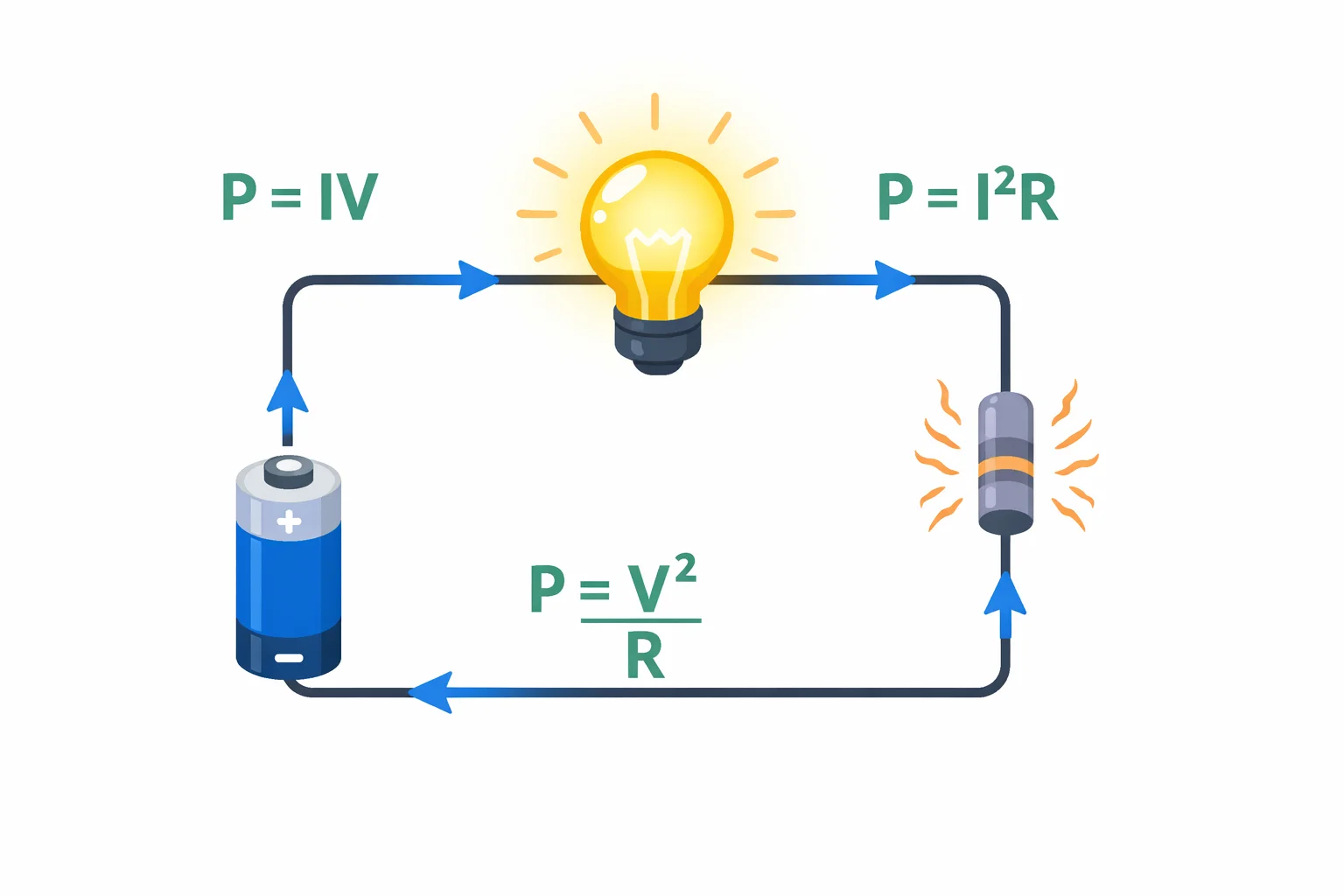
Three Formulas, One Underlying Law
Electrical power has only one fundamental definition: P = IV — power in watts equals voltage in volts times current in amps. The other two formulas are just algebraic shortcuts you get by substituting Ohm's law (V = IR) into P = IV:
- P = IV— Use when you know voltage and current directly. Most common with multimeter readings or appliance labels.
- P = I²R— Use when you know current and resistance. This form shows that power scales with the squareof current — double the current, quadruple the heat.
- P = V²/R— Use when you know voltage and resistance. Ideal for household calculations where you know the outlet voltage (120 V or 230 V) and the device resistance.
They're not three separate laws. They're the same law wearing different hats. The trick is picking the hat that matches the two quantities you actually have. If you already know voltage and resistance but not current, reaching for P = IV means you first have to go find current from I = V/R — or you just plug straight into P = V²/R and skip a step.
Worked Example: Why Your Space Heater Trips the Breaker
Your apartment has a 120 V, 15 A circuit. You plug in a 1,500 W space heater. Does the breaker hold?
Start with P = IV, rearranged: I = P/V = 1,500/120 = 12.5 A. That's under 15 A, so far so good. Now you plug your laptop charger (65 W → 0.54 A) and a desk lamp (60 W → 0.5 A) into the same circuit. Total: 12.5 + 0.54 + 0.5 = 13.54 A. Still under 15. But if someone turns on a hair dryer on that same circuit — even a modest 1,000 W model pulling 8.3 A — the total jumps to 21.84 A and the breaker trips instantly.
The heater alone was fine. It was the combinationthat killed it. And the key calculation that tells you this is P = IV, rearranged to find current. Every electrician, every building inspector, and every student who's lost marks on a circuit problem has done exactly this calculation.
I²R Losses — The Reason Power Lines Run at 500,000 Volts
Here's a number that surprises people: a typical high-voltage transmission line carries electricity at 345,000 to 765,000 volts. That sounds terrifying. Why not use a friendlier voltage? Because P = I²R means that the power wasted as heat in the wires depends on current squared.
Say you need to deliver 1,000 MW to a city. At 1,000 V, that requires 1,000,000 A of current. The wire resistance might be 0.1 Ω per kilometer, so every kilometer wastes I²R = (10&sup6;)² × 0.1 = 100 GW — a hundred times more power than you're trying to deliver. Absurd.
At 500,000 V, the same 1,000 MW requires only 2,000 A. Now each kilometer wastes (2,000)² × 0.1 = 400,000 W — 0.4 MW. That's 0.04% per kilometer, not 10,000%. The entire high-voltage power grid exists because someone worked out P = I²R and realized that raising voltage (to lower current) was the only way to move electricity over long distances without losing most of it.
Watts vs. Kilowatt-Hours: Power Is Not Energy
Students mix these up constantly, and it costs exam points every year. Watts measure the rateof energy use — how fast, not how much. Kilowatt-hours measure total energy consumed. A 2,000 W space heater running for 3 hours uses 6 kWh. A 200 W TV running for 30 hours also uses 6 kWh. Same total energy, vastly different power levels.
Your electric bill charges per kilowatt-hour (roughly $0.12–$0.30/kWh depending on where you live). To estimate monthly cost for any appliance: multiply its wattage by hours of daily use, divide by 1,000 to get kWh, multiply by your rate, and multiply by 30. That space heater running 8 hours a day at $0.16/kWh costs about $57.60 per month. The mechanical power calculator covers the P = W/t side of power if you need to convert between work and time.
The Appliance Power Detective Method
Not every appliance has its wattage printed on the label. Some only list voltage and current. Others only show the amperage. Here's how to decode them:
- Label says "120V, 10A":Multiply. P = 120 × 10 = 1,200 W.
- Label says "1,800W" only:Divide by your outlet voltage. I = 1,800/120 = 15 A. That thing maxes out a standard US circuit.
- Label says "5V 2.4A" (USB charger):P = 5 × 2.4 = 12 W. Now you know why USB chargers barely get warm and space heaters are like portable bonfires.
- No label at all:Measure current with a clamp meter, read the outlet voltage with a multimeter, multiply. Or measure the resistance of the heating element with an ohmmeter and use P = V²/R.
AC vs. DC Power — When These Formulas Need a Footnote
P = IV works perfectly for DC circuits and purely resistive AC loads (heaters, incandescent bulbs, toasters). But AC circuits with motors, capacitors, or transformers introduce a wrinkle: the power factor.
In these circuits, voltage and current can fall out of phase. The actual usable power (called "real power" or "true power") is P = IV × cos(φ), where φ is the phase angle. A power factor of 1.0 means voltage and current are perfectly in sync — all the power does useful work. A power factor of 0.8 means 80% does work and 20% sloshes back and forth without contributing.
For household appliances on a residential bill, the utility usually absorbs the power factor issue. But industrial customers pay for it, which is why factories install power factor correction capacitors. For the calculations in this page, we assume a power factor of 1 (resistive loads), which covers most day-to-day scenarios.
Circuit Breaker Sizing: A Practical Survival Guide
A circuit breaker's amp rating tells you the maximum continuous current it allows before tripping. The National Electrical Code (NEC) says you should only load a breaker to 80% of its rating for continuous loads (anything running more than 3 hours). So a 20 A breaker has a practical limit of 16 A continuous.
To figure out if a breaker can handle your devices, add up the wattage of everything on the circuit and divide by voltage. For a 120 V, 20 A circuit: max continuous load = 0.80 × 20 × 120 = 1,920 W. That's one space heater and basically nothing else.
For a 240 V, 50 A circuit (like an electric range): max = 0.80 × 50 × 240 = 9,600 W. Plenty for an oven, but don't wire a hot tub to the same circuit.
Mistakes That Blow Fuses (and Exam Scores)
After years of seeing students and DIY electricians make the same errors, here are the five that come up most:
- Mixing up watts and watt-hours.Your 60 W bulb doesn't use 60 Wh per hour unless it runs for exactly one hour. If it runs for 20 minutes, it uses 20 Wh.
- Forgetting the squared term.In P = I²R, doubling the current quadruples the power. Students who forget the exponent predict 2× when the answer is 4×.
- Using the wrong voltage.In the US, some outlets are 120 V and some are 240 V. Plugging 240 V into a formula when the device runs on 120 V gives you 4× the correct power (because voltage is also squared in P = V²/R).
- Treating power as additive in parallel.This one is actually correct — total power in parallel is P₁ + P₂ + ... But students who are used to the resistance rules (which differ for series vs. parallel) sometimes second-guess themselves. Power always adds up, period.
- Ignoring wire resistance.In theory, wires have zero resistance. In practice, a long extension cord might have 1–2 Ω, which at 15 A wastes 225–450 W as heat. That's why extension cords get warm and why electricians care about wire gauge.