Projectile Motion Calculator: How to Find Range, Maximum Height, and Flight Time
A jet-pack stunt rider leaves a ramp of spray at roughly 18 m/s, angled near 40° above the lake. Where does the rider come down, and how high do they get? Strip away the spectacle and you have pure projectile motion: an object launched into the air with nothing but gravity acting on it. The same math predicts a golf drive, a fountain's arc, an artillery shell, and a textbook ball thrown off a balcony. A projectile motion calculator turns the launch speed and angle into the three answers people actually want — how far (range), how high (maximum height), and how long it's airborne (time of flight) — plus the full curved path in between.
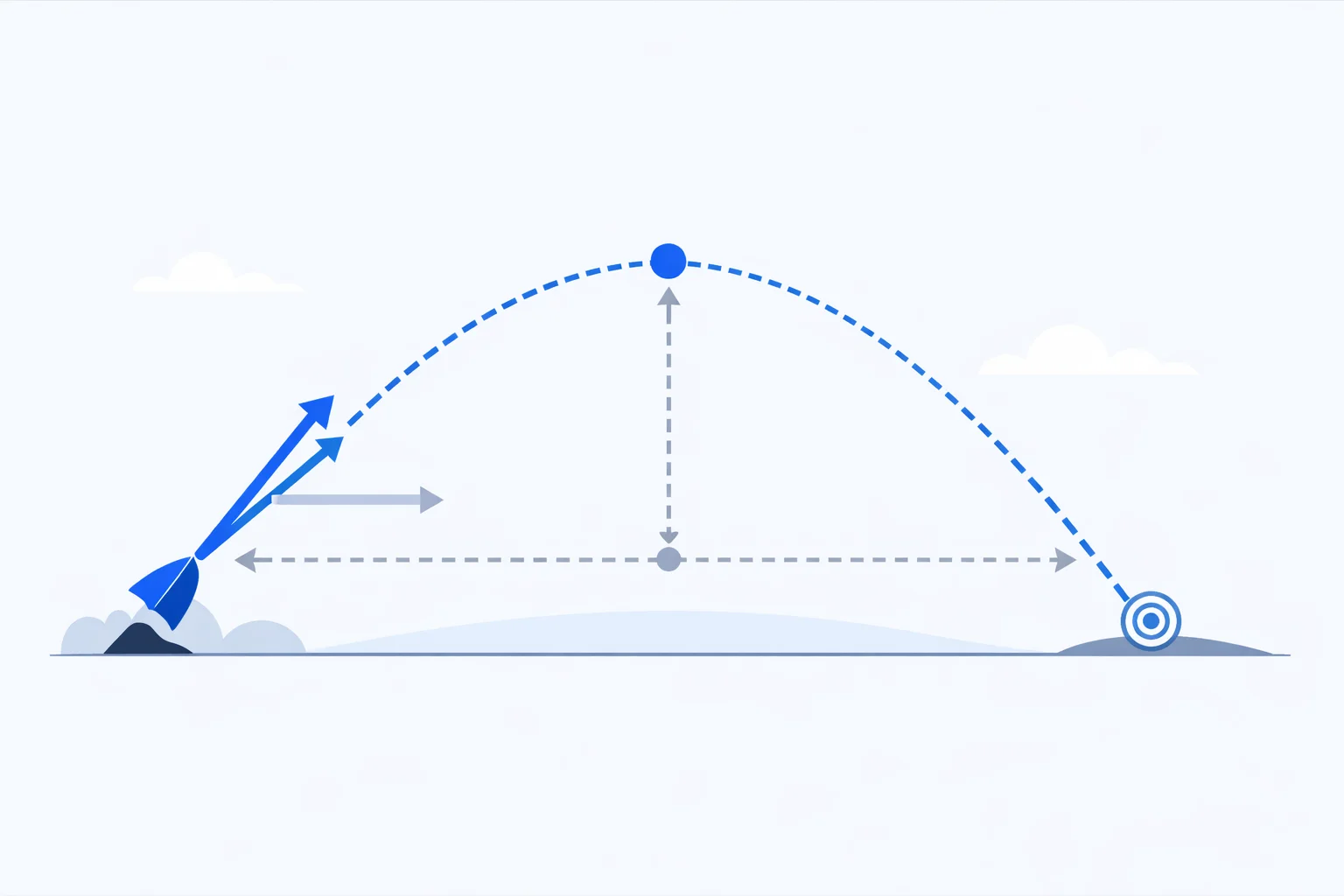
Every Projectile Is Two Motions Glued Together
The single insight that unlocks every projectile problem: the horizontal and vertical motions are completely independent. Gravity only pulls down, so it never touches the sideways motion. That means the horizontal velocity stays constant for the entire flight, while the vertical velocity behaves exactly like an object thrown straight up and falling back — it's really vertical displacement under gravity riding on top of steady horizontal travel. Split the launch velocity with a little trig and you get the two pieces: vₓ = v₀·cos θ stays fixed, and v_y = v₀·sin θ shrinks, hits zero at the top, then grows downward. A ball launched at 25 m/s and 45° starts with vₓ = 17.7 m/s and v_y = 17.7 m/s; one second later vₓ is still 17.7 m/s but v_y has dropped to 7.9 m/s. The horizontal speed genuinely never cares that gravity exists.
This is why a bullet fired horizontally and a bullet dropped in free fall from the same height hit the ground at the same instant — a result that stuns most students. Both have zero initial vertical velocity, so both fall under the same 9.8 m/s² and take identical time to drop. The fired bullet just travels a long way sideways while it falls. Splitting any launch into its horizontal and vertical velocity components is always the first move.
The Three Numbers: Range, Height, and Flight Time
For a launch and landing at the same height, the three headline results come straight from the component velocities. Time of flight is twice the time to reach the top, since the trip up mirrors the trip down: t = 2·v₀·sin θ / g. Maximum height is how far the vertical motion climbs before v_y hits zero: H = v₀²·sin²θ / (2g). And range is just the constant horizontal speed multiplied by the flight time, which simplifies to the compact R = v₀²·sin(2θ) / g.
Run the numbers for a soccer goal kick at 25 m/s and 45° on flat ground: t = 2·25·sin45° / 9.8 = 3.61 s, H = 25²·sin²45° / 19.6 = 15.9 m, and R = 25²·sin90° / 9.8 = 63.8 m. That 64 m carry matches a real long goal kick almost exactly. Notice range scales with the square of launch speed — bump the kick to 30 m/s and the range jumps to 91.8 m, not 76. Squeezing 20% more speed out of a launch buys you 44% more distance, which is exactly why exit velocity matters so much in baseball and golf.
Why 45° Wins on Flat Ground — and When It Loses
The range formula R = v₀²·sin(2θ) / g is maximized when sin(2θ) = 1, which means 2θ = 90°, so θ = 45°. That's the famous result, and it holds perfectly — but only when the launch and landing heights are equal. The moment you launch from a height, the rule shifts. Gravity now has extra time to convert that height into horizontal distance, so a slightly flatter launch wins. Throw from 10 m up at 20 m/s and the optimal angle drops to about 42°; from the top of a tall building it can fall to 35° or lower. Try it in the calculator: set a launch height, then sweep the angle slider and watch where the range peaks. It won't be 45°.
This is the trap behind a lot of "just aim for 45°" advice. A shot putter releases the shot from about 2 m above the ground, so their optimal angle is closer to 42°, and because it's physically easier to generate speed at a lower angle, elite throwers actually use around 37°. The geometry and the body mechanics both push below the textbook 45°.
Worked Example: A Cannon Fired From a Sea Cliff
Here's a setup the simple R = v₀²·sin(2θ)/g formula can't handle, because the projectile lands lower than it launched. A signal cannon sits on a 40 m sea cliff and fires a flare at 30 m/s, angled 25° above horizontal. How far out to sea does it splash down?
Start with the components: vₓ = 30·cos25° = 27.2 m/s, v_y = 30·sin25° = 12.7 m/s. The flare lands when its height returns to 0, so solve 0 = 40 + 12.7·t − 4.9·t². The quadratic formula gives t = [12.7 + √(12.7² + 2·9.8·40)] / 9.8 = [12.7 + √945] / 9.8 = (12.7 + 30.7) / 9.8 = 4.43 s. Multiply by the horizontal speed: R = 27.2 × 4.43 = 120.5 m. The 40 m of extra drop adds roughly 50% to the range a flat launch would have given. If you wanted the splashdown speed, you'd take that flight time into the final velocity calculator with v_y = 12.7 − 9.8·4.43 = −30.7 m/s, then combine with vₓ for an impact speed of √(27.2² + 30.7²) = 41 m/s.
Complementary Angles Land in the Same Spot
One of the most useful facts in projectile motion is hiding inside the sin(2θ) term. Because sin(2 × 30°) = sin(60°) and sin(2 × 60°) = sin(120°) are equal, a 30° launch and a 60° launch at the same speed produce exactly the same range on flat ground. Any pair of angles adding to 90° matches. The high-angle shot just trades a flat, fast path for a tall, slow one — same landing point, very different flight. Here's how a fixed 25 m/s launch plays out across angles:
| Launch angle | Range (m) | Max height (m) | Flight time (s) |
|---|---|---|---|
| 15° | 31.9 | 2.1 | 1.32 |
| 30° | 55.2 | 8.0 | 2.55 |
| 45° | 63.8 | 15.9 | 3.61 |
| 60° | 55.2 | 23.9 | 4.42 |
| 75° | 31.9 | 29.7 | 4.93 |
Read it across and the symmetry pops out: 15° and 75° both carry 31.9 m, 30° and 60° both carry 55.2 m, and 45° tops the range chart at 63.8 m. But look at the height and time columns — the steeper of each pair always climbs higher and hangs longer. That's why a quarterback throwing a deep ball picks a higher angle than pure range would suggest: the extra hang time lets the receiver run under it.
The Velocity at the Top Is Not Zero
Ask a class what a projectile's velocity is at the peak of its arc and a good chunk will say zero. It's the most common projectile misconception, and it's only half right. The verticalvelocity is zero at the top — that's the very definition of the highest point, the instant the upward motion stops before the fall begins. But the horizontalvelocity is still chugging along at v₀·cos θ, completely unchanged, because nothing ever pushed against it. A projectile launched at 25 m/s and 45° is still sailing sideways at 17.7 m/s when it's at its highest. The velocity isn't zero at the top; it's purely horizontal.
This also explains the shape of the impact. On flat ground with no launch height, the trajectory is a symmetric parabola, so the projectile strikes the ground at the same speed and the same angle it launched — just mirrored downward. Launch at 30° and you land at 30° below horizontal with your original speed restored. That symmetry breaks the instant you add a launch height or air resistance, which is exactly where idealized projectile math starts to part ways with reality.
When the Parabola Lies: Drag and Real Projectiles
Every formula on this page assumes a vacuum — no air, no spin, no wind. For dense, slow, short-range objects that's a fine approximation: a shot put, a thrown rock, a long jumper's body. But for light, fast, or far-flying projectiles, air resistance reshapes the path from a clean parabola into a lopsided curve that falls steeper than it rose and lands well short. The table shows how badly the vacuum prediction overshoots once drag is in play.
| Projectile | Vacuum prediction | Real-world result |
|---|---|---|
| Shot put (~14 m/s, 37°) | ~20 m | ~19.5 m — drag barely matters |
| Baseball (~49 m/s, 30°) | ~210 m | ~120 m — drag cuts it nearly in half |
| Golf ball (~70 m/s, 12°) | ~350 m flat | ~250 m — but backspin adds lift |
| Ping-pong ball (~20 m/s, 45°) | ~41 m | ~8 m — drag dominates completely |
The pattern comes down to the ratio of drag force to weight. A dense shot put barely notices the air, so the vacuum math nails it. A ping-pong ball is almost all drag and almost no mass, so the idealized formula is off by a factor of five. The optimal angle shifts too: with drag, real baseballs carry farthest around 30–35°, not 45°, because a lower, faster trajectory spends less time bleeding speed to the air. Use this calculator for the clean physics and the conceptual relationships — and remember that for a real long fly ball or a windy field, the honest answer needs a drag model the simple parabola can't provide. For the straight-up-and-down vertical piece of any launch, the constant 9.8 m/s² of gravity is still doing all the work.