Final Velocity Calculator: Picking the Right Equation to Solve for vf
A car brakes hard and leaves 38 meters of skid marks before stopping. No one had a stopwatch running. So how do investigators know it was doing 90 km/h when the driver hit the brakes? They run the final velocity calculation backward — and the key is that they never needed the time. Learning how to calculate final velocity in physics really comes down to one decision: which of two kinematic equations to use, based on whether you know the time or the distance. Get that choice right and the arithmetic is the easy part.
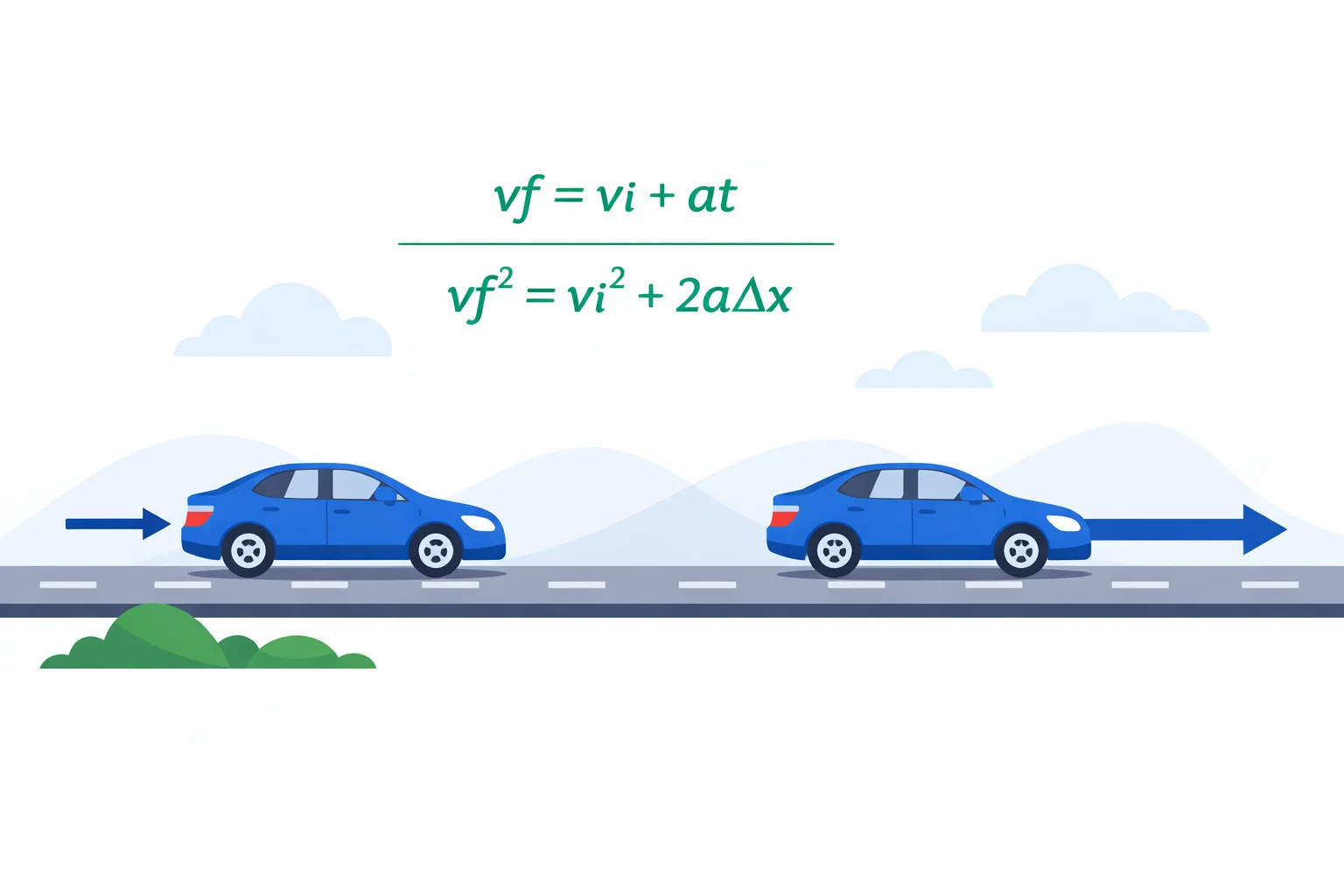
The Skid-Mark Problem: vf Without a Stopwatch
Start with the accident-reconstruction case, because it shows exactly when the famous vf = vᵢ + at equation lets you down. The car ends at rest, so its final velocity is 0 m/s. Tire-and-asphalt friction gives a deceleration of about −7 m/s². The skid is 38 m long. Notice what's missing: nobody measured how many seconds the skid took. That single gap rules out the time equation and forces you to the other one, vf² = vᵢ² + 2aΔx, rearranged to solve for the initial speed instead.
Plug in the stop: 0² = vᵢ² + 2(−7)(38), so vᵢ² = 532, and vᵢ ≈ 23 m/s — about 83 km/h. The whole reconstruction hinges on having an equation that connects velocity to distancerather than time. This is why "final velocity" problems trip students up: the formula you reach for first often isn't the one the problem can actually feed.
Two Equations Find vf — the Missing Variable Picks One
For constant acceleration, two of the standard kinematic equations isolate final velocity. They give the identical answer; they just take different ingredients. vf = vᵢ + at runs on time. vf² = vᵢ² + 2aΔx runs on displacement. Picture them as two doors into the same room — you walk through whichever one your data has the key for. If the problem tells you how long the acceleration acted, use the first. If it tells you over what distance, use the second. The calculator above just automates that choice: pick the mode, and it loads the matching formula and shows the substituted numbers.
There's also a third, quieter case. If you know the displacement and the time but not the acceleration, you can still get vf from the definition of average velocity: since Δx = (vᵢ + vf)/2 × t for constant acceleration, a little algebra gives vf = 2Δx/t − vᵢ. The calculator's third mode handles this and even back-calculates the acceleration it implies.
vf = vᵢ + at: The Time Route
This is the most intuitive of the kinematic equations because it's almost a definition. Acceleration is how much velocity changes each second, so after t seconds you've added a × t to wherever you started. A motorcycle pulling away from a light at vᵢ = 0 with a = 4 m/s² reaches vf = 0 + 4 × 6 = 24 m/s after 6 seconds. Simple multiplication, then add.
The sign of a carries all the drama. When acceleration points the same way as motion, vf grows. When it opposes motion — braking, drag, gravity on a rising ball — ais negative and vf shrinks. Take a ball thrown straight up at 15 m/s with a = −9.8 m/s². After 1 second, vf = 15 − 9.8 = 5.2 m/s, still climbing. After 2 seconds, vf = 15 − 19.6 = −4.6 m/s — the negative sign announces it's now falling. This is exactly how the vertical component behaves in projectile motion, where the horizontal speed holds steady while v_y runs through this same rise-and-fall. If you ever need to recover the acceleration that links two velocities, an acceleration calculator inverts this same relationship.
vf² = vᵢ² + 2aΔx: The Distance Route
This one looks stranger — velocity is squared, and time has vanished — but it's the workhorse for any problem stated in terms of distance. It comes from combining the two time-based equations and algebraically eliminating t, which is precisely why it survives when the clock data doesn't exist. To use it, compute vᵢ² + 2aΔx, then take the square root. The free-fall case is the cleanest: drop something from rest (vᵢ = 0) and it reduces to vf = √(2gh). It's one of the five members of the kinematic equations, and the only one that drops time out entirely.
That free-fall shortcut produces some genuinely useful reference numbers. Because vf scales with the square root of height, doubling the drop only multiplies the impact speed by about 1.41 — a fact that surprises people estimating fall danger. Here's what different drop distances produce, ignoring air resistance:
| Drop height | Final velocity √(2gh) | Roughly |
|---|---|---|
| 1 m (off a table) | 4.4 m/s | 16 km/h |
| 5 m (first-floor window) | 9.9 m/s | 36 km/h |
| 20 m (six storeys) | 19.8 m/s | 71 km/h |
| 45 m (high diving cliff) | 29.7 m/s | 107 km/h |
Notice the diving-cliff figure. A real cliff diver hits the water near this speed because water entry is brief and drag has little time to build — but a skydiver falling thousands of meters never reaches the equivalent value, because over long falls air resistance dominates and caps speed near 55 m/s. The equation is exact; the world adds friction.
Which Equation to Reach For
The hardest part of these problems is almost never the algebra — it's matching the question to the right formula in the first few seconds. Build the habit of asking "what am I missing?" before "what do I plug in?" This table is the decision shortcut:
| You know | You're missing | Use |
|---|---|---|
| vᵢ, a, t | distance | vf = vᵢ + at |
| vᵢ, a, Δx | time | vf² = vᵢ² + 2aΔx |
| vᵢ, Δx, t | acceleration | vf = 2Δx/t − vᵢ |
| all four of vᵢ, a, t, Δx | nothing | either — cross-check both |
The ± Trap: Why the Square Root Has Two Answers
The distance equation hides a subtlety that catches even careful students. When you take the square root of vᵢ² + 2aΔx, you technically get both a positive and a negative root — and both are physically real. They represent the same speed heading in opposite directions. Imagine a ball thrown up that passes a 3rd-floor window at +8 m/s on the way up; on the way back down it passes the same window at −8 m/s. Same vf², opposite sign.
So which root do you keep? The one that matches the direction the object is actually moving at the moment you care about. The calculator defaults to the root that continues your initial direction of travel, and lists the other root beside it so you don't lose it. On an exam, a problem asking for the velocity "just before impact" almost always wants the downward (negative, if up is positive) root — picking the wrong sign is a classic way to lose a mark on an otherwise perfect solution.
When These Equations Quietly Stop Working
Every kinematic equation on this page assumes one thing: acceleration is constant. The moment that fails, the formulas give wrong answers without warning. A car's acceleration tapers as it approaches top speed. A falling skydiver's acceleration drops toward zero as drag rises. A rocket burning fuel actually accelerates harder over time as it gets lighter. In every one of these, plugging into vf = vᵢ + at overestimates or underestimates the real final velocity.
When acceleration changes, you need calculus, not algebra — velocity becomes the integral of acceleration over time, and you'd read it off the slope of a position curve with an instantaneous velocity calculator instead. A good rule of thumb: if the problem says "constant acceleration," "uniform acceleration," or describes free fall over a short distance, you're safe. If it mentions air resistance, changing thrust, or a velocity-dependent force, these equations are only a rough first estimate.
Mistakes That Lose Easy Exam Marks
- Forgetting to square vᵢ in the distance equation.It's vᵢ² + 2aΔx, not vᵢ + 2aΔx. Skip the square and a starting speed of 20 m/s contributes 20 instead of 400 — your answer comes out wildly low, and the units don't even work out.
- Dropping the negative sign on a deceleration. Braking and rising-against-gravity both need a negative a. Enter +9.8 for a ball thrown upward and the calculator will tell you it speeds up on the way to the top — the opposite of reality.
- Mixing units before solving. If velocity is in km/h but distance is in meters, vf² = vᵢ² + 2aΔx silently produces nonsense. Convert everything to meters and seconds first. A speed entered as 90 (km/h) instead of 25 (m/s) inflates vᵢ² by a factor of about 13.
- Choosing the wrong square root.Both roots are valid speeds; only one matches the direction of travel. Read the question — "final" usually means the last instant of the described motion, so match the sign to where the object is heading then.