Kinematic Equations Calculator: The Missing-Variable Method for SUVAT Problems
There are exactly five of them: v = u + at, s = ut + ½at², s = ½(u + v)t, v² = u² + 2as, and s = vt − ½at². A kinematic equations calculator exists for one reason — to take any three of the five motion variables you know and hand back the two you don't, without you having to remember which formula fits. Those five variables are displacement (s), initial velocity (u), final velocity (v), acceleration (a), and time (t), the "SUVAT" quintet that describes every object moving with steady acceleration, from a dropped wrench to a braking train. Learn the one idea that ties the equations together and they stop being a wall of symbols to memorize.
Five Equations, Not Four — and Why the Fifth Earns Its Place
Open most physics textbooks and you'll find four kinematic equations. This calculator carries five. The one that usually gets cut is s = vt − ½at², the only equation in the set that contains no initial velocity u. Teachers leave it out because you can always work around a missing u by finding it first — but that's an extra step, and on a timed exam extra steps are where mistakes breed. If a problem tells you a car crosses a line at 30 m/s, decelerates at 4 m/s² for 5 seconds, and asks how far it travelled, that fifth equation gives s = 30 × 5 − ½ × 4 × 25 = 150 − 50 = 100 m in a single line. No detour through u required.
The other four are the familiar workhorses. v = u + at links the velocities through time. s = ut + ½at² is the displacement equation you'll use most. s = ½(u + v)t treats displacement as average velocity times time. And v² = u² + 2as is the time-free shortcut. Five equations, five variables — and a clean pattern hiding underneath.
The Missing-Variable Trick for Picking an Equation
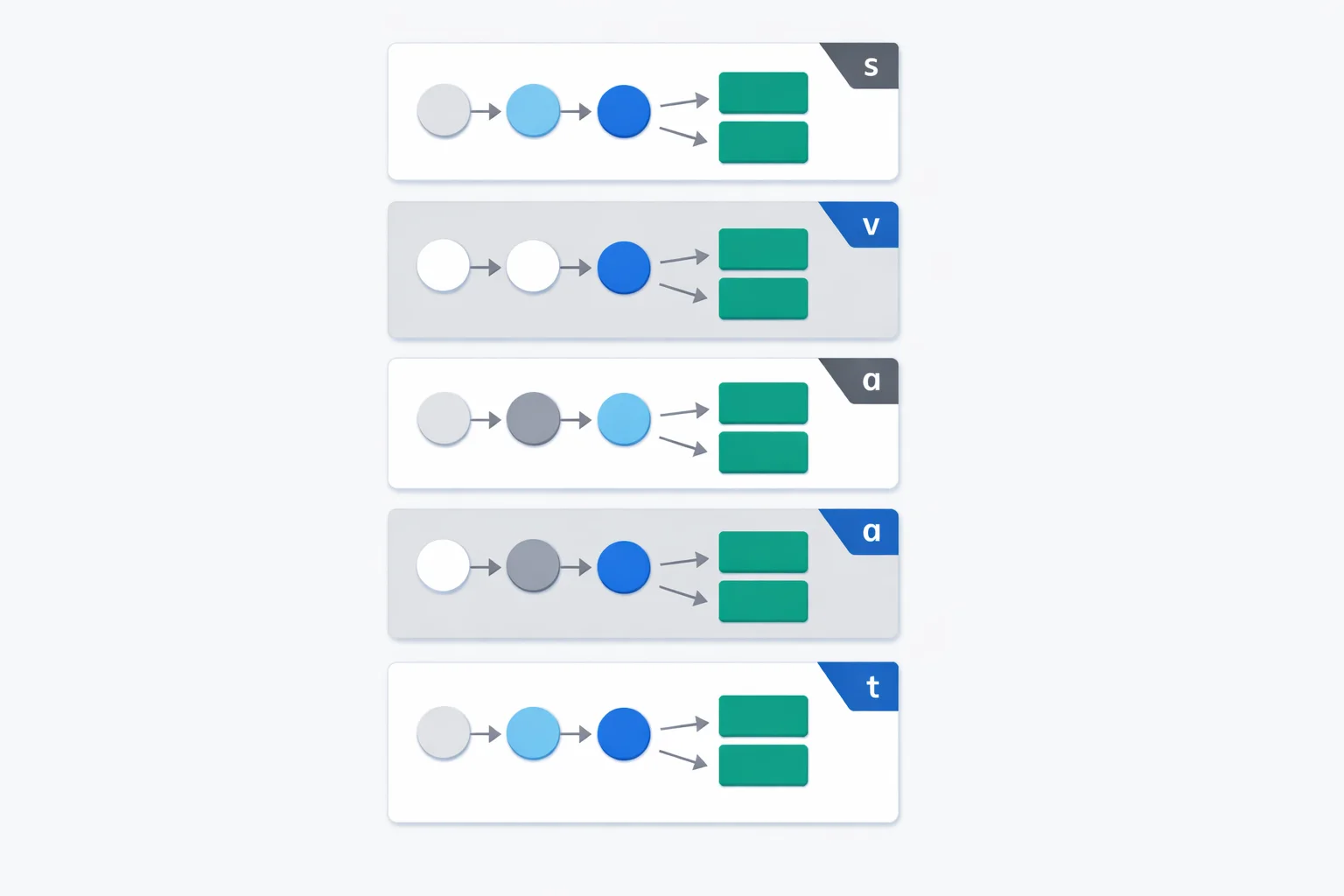
Here's the insight that turns five formulas into one method: each equation leaves out exactly one of the five variables. v = u + at has no s. s = ut + ½at² has no v. s = ½(u + v)t has no a. v² = u² + 2as has no t. And s = vt − ½at² has no u. So when you face a problem, you don't hunt for the "right" equation — you find the one variable you neither know nor care about, and pick the equation that omits it.
Say a ball rolls down a ramp from rest, covers 3 m, and you want its final speed — but the problem never mentions time and doesn't ask for it. Time is the throwaway variable, so reach for the equation with no t: v² = u² + 2as. That's the entire decision. The calculator above automates exactly this logic — mark your three knowns and it highlights which of the five equations the missing variable points to. If you only ever need the end speed, the dedicated final velocity calculator runs the same v² = u² + 2as logic on its own.
All Five Kinematic Equations in One Table
Keep this table next to you while you practice. The right-hand column is the part that actually matters — it tells you, at a glance, which equation to grab based on the variable you want to dodge.
| Equation | Variables it uses | Leaves out | Reach for it when… |
|---|---|---|---|
| v = u + at | u, v, a, t | s | you don't know or want displacement |
| s = ut + ½at² | s, u, a, t | v | the final velocity is unknown |
| s = ½(u + v)t | s, u, v, t | a | acceleration isn't given |
| v² = u² + 2as | s, u, v, a | t | time is never mentioned |
| s = vt − ½at² | s, v, a, t | u | you don't have the starting speed |
Worked Example: A Subway Train Leaving the Platform
A subway train pulls out of a station from a standstill and accelerates at a steady 1.3 m/s². The platform is 120 m long, and the driver needs to know the train's speed the instant the rear car clears the end of the platform. Strip the problem to its variables: u = 0 (it starts from rest), a = 1.3 m/s², s = 120 m. We want v, and nobody asked about time — so time is the throwaway variable. The equation that omits t is v² = u² + 2as.
Substitute: v² = 0² + 2 × 1.3 × 120 = 312, so v = √312 = 17.7 m/s, about 64 km/h. That's already faster than a city bus, which is why platforms have that yellow line. Now suppose the operations team also wants the time it took. Switch your knowns to u, v, and a and the equation with no s — v = u + at — gives t = (17.7 − 0) / 1.3 = 13.6 seconds. Notice we solved the same scenario two ways by changing which variable we let go of. To isolate that steady 1.3 m/s² from a velocity-and-time pair instead, the acceleration calculator handles a = (v − u)/t directly.
Where the Equations Come From in 30 Seconds
You don't have to take the five equations on faith — two of them generate the rest. Start with the definition of constant acceleration: velocity changes by the same amount every second, so v = u + at. That's equation one, straight from "acceleration is rate of change of velocity." Next, because acceleration is steady, the average velocity over the trip is simply the midpoint of the start and end speeds, (u + v)/2. Displacement is average velocity times time, which gives s = ½(u + v)t — equation three.
Everything else is algebra. Substitute v = u + at into s = ½(u + v)t and the v disappears, leaving s = ut + ½at². Substitute t = (v − u)/a instead and the time disappears, leaving v² = u² + 2as. The five "equations" are really one idea — constant acceleration — wearing five outfits. That's reassuring when you forget one mid-exam: you can rebuild it from v = u + at and the average-velocity rule in under a minute.
Why v² = u² + 2as Can Hand You Two Answers
The time-free equation has a quirk worth understanding before it surprises you on a test. Because it solves for v², taking the square root gives both a positive and a negative value — and sometimes both are physically real. Throw a stone straight up at 20 m/s and ask how fast it's moving when it's 15 m high. With a = −9.8, v² = 20² + 2 × (−9.8) × 15 = 400 − 294 = 106, so v = ±10.3 m/s. The +10.3 is the stone on its way up; the −10.3 is the same stone passing 15 m again on the way back down. Both answers are correct, just at different moments.
The calculator handles this by keeping the root that produces a positive, physical time for your scenario, but it's worth recognizing the double answer yourself — examiners love to ask "at what two times is the object at this height?" If your problem is specifically a vertical drop with no upward throw, the free fall calculator locks a to gravity and skips the sign bookkeeping entirely.
The One Assumption That Breaks Everything
Every one of these five equations rests on a single assumption: acceleration is constant for the whole motion. Break that, and the math quietly lies to you. A real car doesn't brake at a fixed rate — the deceleration is fiercer when the brakes first bite and eases near the stop. A rocket's acceleration climbs as it burns fuel and gets lighter, even with constant thrust. And anything falling through air hits drag that grows with speed, so its acceleration drops from 9.8 toward zero at terminal velocity.
In all those cases the SUVAT equations give answers that are wrong, sometimes badly. The honest way to model changing acceleration is calculus or a numerical step-by-step simulation. The good news: for the scenarios these calculators are built for — a ball in free fall over a few seconds, a train accelerating at a fixed rate, a puck sliding on ice — constant acceleration is either exact or close enough that the error is smaller than your measurement. Just know the boundary, so you don't trust a clean number from a messy situation.
Reading a Word Problem for Its Hidden Fourth Value
The hardest part of any kinematics problem isn't the algebra — it's spotting the variable the question hands you without naming it. "Starts from rest" means u = 0. "Comes to a stop" or "brings the car to rest" means v = 0. "Dropped" or "released" means u = 0 and a = 9.8 m/s² downward. "Maximum height" secretly means v = 0 at that instant, because the object pauses before falling back. Each phrase is a free value that takes you from two knowns to the three you need.
Once you train your eye for these, most problems collapse into "I have three, find two," which is precisely what this tool and its siblings do. For the displacement half of any setup, the displacement calculator walks through s = ut + ½at² with the area-under-the-graph picture, and the time calculator handles the trickier cases where solving for t means a quadratic with two valid roots. Master the missing-variable trick once and every kinematics question — on a worksheet, a lab report, or the AP exam — becomes the same short routine.