Average Velocity Calculator: The Δx/Δt and (vᵢ + v_f)/2 Formulas Explained
Average velocity has a one-line definition that hides a genuine subtlety. Write it as v̄ = Δx/Δt — the change in position divided by the change in time — and you have everything you need for most problems. But there's a second formula, v̄ = (vᵢ + v_f)/2, that physics courses hand you in the same week, and the two are not interchangeable. Knowing exactly when the second one is allowed, and when it quietly lies to you, is what this average velocity calculator is built around — and it's the part most students never get told.
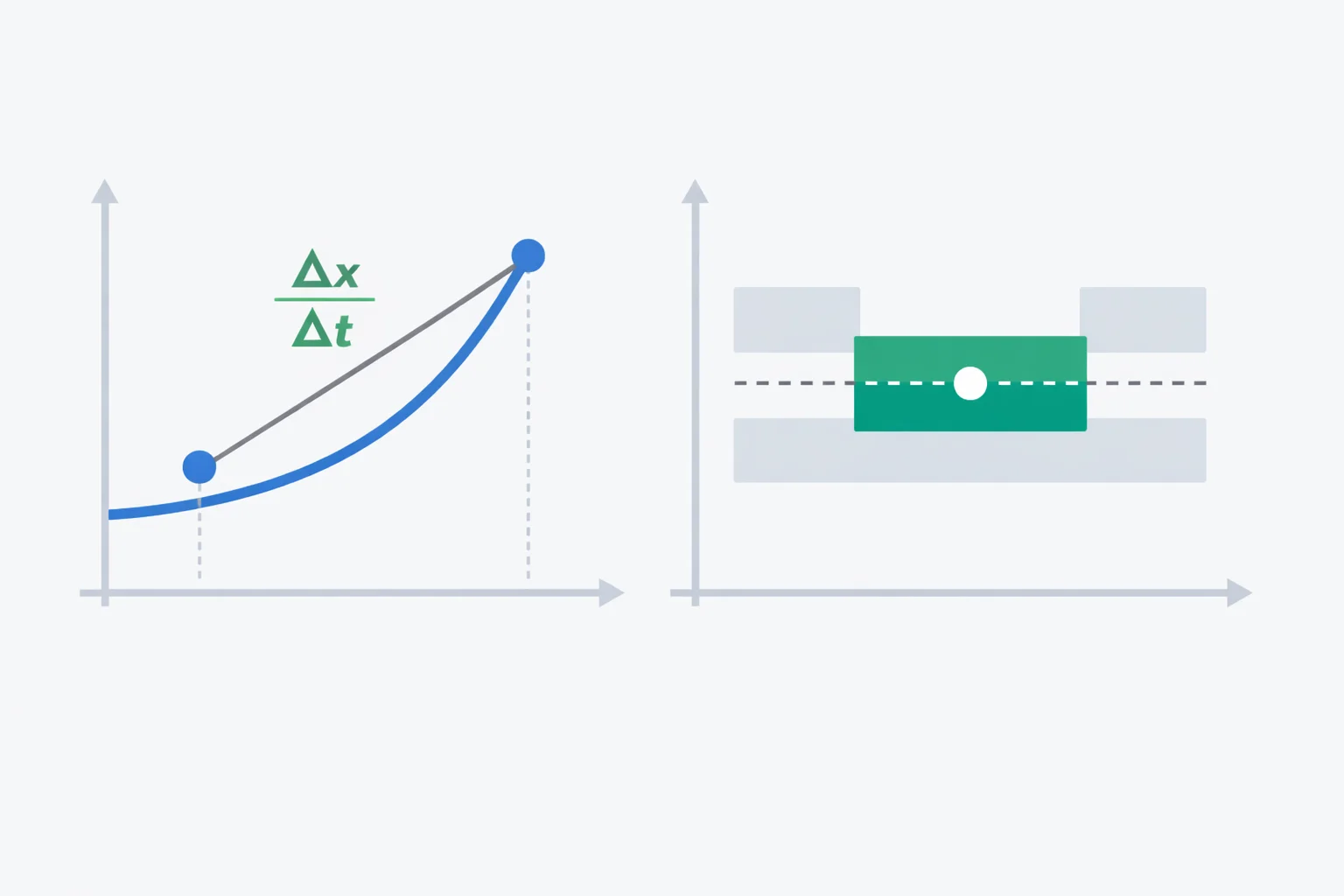
Average Velocity Has Two Formulas, Not One
The definition that always works is v̄ = Δx/Δt. It says nothing about how the object moved in between — it only looks at where it started, where it ended, and how long that took. The second expression, v̄ = (vᵢ + v_f)/2, is the plain arithmetic mean of the starting and ending velocities. It looks like it should always hold, and that's the trap: it equals Δx/Δt only when the acceleration is constant. Take a sprinter who builds from 0 to 10 m/s at a steady rate — the midpoint formula gives 5 m/s, and so does displacement over time. Now take a car that idles at 0, jumps to 30 m/s, and coasts there: the velocities still average to 15, but the real Δx/Δt sits much closer to 30 because almost the whole interval was spent at top speed.
That's why the calculator above splits into two modes. The positions mode is the safe, universal one — it never assumes anything about the motion in between. The constant-acceleration mode is the fast shortcut for the specific case where the velocity-time graph is a straight line. Feed the same uniformly-accelerated motion into both and they agree to the decimal; feed the shortcut a stop-and-go trip and it will be off by a wide margin.
Δx/Δt: Final Position Minus Initial Position
The numerator Δx is a displacement, and displacement is a subtraction of coordinates: x_f − xᵢ. This is where the sign comes from. If a beetle walks from the 12 cm mark to the 5 cm mark on a ruler, its displacement is 5 − 12 = −7 cm, and over 14 seconds its average velocity is −0.5 cm/s. The minus sign isn't a mistake to erase; it tells you the net motion ran toward smaller coordinates. Strip the sign and you'd be reporting average speed, a different quantity that never carries direction.
The denominator Δt is t_f − tᵢ, which is why the calculator asks for a start time and an end time rather than a single duration. Most of the time you'll start the clock at 0, but a graph-reading question on an exam hands you an interval like "between t = 2 s and t = 6 s," and there Δt = 4 s, not 6. Get the interval wrong and even a perfect displacement gives the wrong velocity. The displacement that lands in the numerator is exactly what a displacement calculator isolates when the geometry gets more involved than a single straight line.
Worked Example: A Train Between Two Markers
A commuter train passes the 1.2 km post on a straight track at the instant a conductor starts a stopwatch, and passes the 4.8 km post 90 seconds later. What was its average velocity over that stretch? Keep the units consistent. Displacement: Δx = 4.8 − 1.2 = 3.6 km = 3600 m. Time: Δt = 90 s. So v̄ = 3600 ÷ 90 = 40 m/s, which is 144 km/h or about 89.5 mph. Notice we never asked whether the train sped up or slowed down between the posts — the Δx/Δt definition doesn't care, and that's its great strength.
Now push it one step further. Suppose the train then reverses and drifts back to the 3.0 km post over the next 60 seconds. For this second leg, Δx = 3.0 − 4.8 = −1.8 km = −1800 m over 60 s, so v̄ = −30 m/s — the negative sign marking the reversal. For the whole 150-second journey, the net displacement is 3.0 − 1.2 = 1.8 km = 1800 m, giving an overall average velocity of 1800 ÷ 150 = 12 m/s. The two legs averaged +40 and −30, but you cannot average those two numbers to land on 12 — you have to return to net displacement over total time, which weights each leg by how long it lasted.
The (vᵢ + v_f)/2 Shortcut and Its One Condition
When acceleration is constant, the velocity-time graph is a straight line, and the average height of a straight line over an interval is just its midpoint — the mean of the two endpoints. That's the entire justification for v̄ = (vᵢ + v_f)/2. It earns its place because it lets you find average velocity without knowing either the displacement or the time. A motorcycle accelerating uniformly from 8 m/s to 24 m/s has an average velocity of (8 + 24)/2 = 16 m/s across that interval, full stop.
Pair it with a time and it unlocks the rest of the kinematics. If that motorcycle took 4 seconds, its displacement is v̄·t = 16 × 4 = 64 m, and its acceleration is (24 − 8)/4 = 4 m/s². That's exactly what the constant-acceleration mode returns when you add the optional time field. The midpoint average is the quiet bridge between the velocity equations and the displacement equations — it's why Δx = vᵢt + ½at² and Δx = ½(vᵢ + v_f)t turn out to be the same statement wearing different clothes.
Average Velocity in Free Fall Is Half the Final Velocity
Free fall from rest is the cleanest place to watch the midpoint formula earn its keep. Drop an object and gravity gives it a constant 9.8 m/s² downward, so its velocity climbs linearly from zero. Because vᵢ = 0, the average velocity over any interval starting at the drop is just (0 + v_f)/2 = v_f/2 — exactly half the speed it's travelling at the end. The table below traces a stone dropped off a bridge, using g = 9.8 m/s².
| Time falling | Final velocity v_f (m/s) | Average velocity v̄ (m/s) | Distance fallen (m) |
|---|---|---|---|
| 1.0 s | 9.8 | 4.9 | 4.9 |
| 2.0 s | 19.6 | 9.8 | 19.6 |
| 3.0 s | 29.4 | 14.7 | 44.1 |
| 4.0 s | 39.2 | 19.6 | 78.4 |
Read the last two columns together: the distance fallen always equals the average velocity times the time. At 3 seconds, v̄ = 14.7 m/s and the stone has dropped 14.7 × 3 = 44.1 m. That "half the final velocity" trick is a fast way to sanity-check free-fall answers in your head — and it works only because the acceleration stays constant the whole way down, which is the entire reason the shortcut is legal here. That final velocity v_f is itself an instantaneous velocity, the derivative of position at the exact moment the stone lands — and you can pin it down directly with a final velocity calculator using vf = vᵢ + at.
When the Midpoint Formula Gives the Wrong Answer
The shortcut fails the instant acceleration stops being constant, and the failure can be enormous. Picture a drag car that launches hard from 0 to 80 m/s in the first 4 seconds, then holds a near-steady 80 m/s for the next 6 seconds before the chute deploys. Its initial velocity is 0 and its final velocity is roughly 80, so the midpoint formula whispers (0 + 80)/2 = 40 m/s. But the car spent most of those ten seconds already at 80, so the real average — total displacement over total time — climbs to about 64 m/s. Trusting (vᵢ + v_f)/2 here would underestimate the run by hundreds of meters.
The rule to carry into an exam: reach for (vᵢ + v_f)/2 only when you can honestly say the acceleration was uniform across the whole interval — a falling object, a cart on a frictionless ramp, a car braking steadily. For anything that accelerates in bursts, idles, or changes its rate partway through, fall back to Δx/Δt and the positions mode. When you simply don't know how the velocity varied in between, the displacement-based definition is the only one you're entitled to use.
Average Velocity vs Average Speed in One Table
These two get blurred constantly, and the gap between them is exactly the gap between displacement and distance. Average velocity divides the straight-line change in position by time; average speed divides the total path length by time. They agree on a one-way straight trip and split apart on anything that turns around.
| Property | Average velocity | Average speed |
|---|---|---|
| Numerator | Displacement Δx (signed) | Total distance (always +) |
| Direction | Carries a sign or angle | None — pure scalar |
| Round-trip value | Zero (back to start) | Large and positive |
| Which is larger? | ≤ average speed, always | ≥ |average velocity| |
A walker who heads 300 m east, then 100 m back west in a total of 200 seconds has a displacement of 200 m but a path of 400 m. Average velocity is 200/200 = 1 m/s east; average speed is 400/200 = 2 m/s. Same trip, double the speed, because the backtrack adds to the path while subtracting from the displacement. For the full direction-and-components treatment, the velocity calculator handles the 2D case where displacement becomes a vector with an angle.
Mistakes That Quietly Cost Exam Marks
- Using (vᵢ + v_f)/2 on non-uniform motion. The midpoint average is valid only for constant acceleration. On a velocity graph that curves or has flat spots, it returns a confidently wrong number — go back to Δx/Δt.
- Averaging two leg velocities directly. If one leg averages +40 m/s and the next −30 m/s, the trip average is not 5 m/s. You must recombine net displacement over total time, which weights each leg by its duration.
- Reading Δt as the end time."Between t = 2 s and t = 6 s" means Δt = 4 s, not 6 s. Forgetting to subtract the start time is the single most common slip on graph-interval questions.
- Dropping the negative sign. A negative average velocity is a complete, correct answer — it encodes direction. Erasing it turns velocity back into speed and throws away the very thing the question is testing.