Conservation of Momentum: How to Solve Any Collision or Explosion
Two railway boxcars drift toward each other on the same track. One weighs 12 tonnes and rolls at 3 m/s; the other sits at rest. They meet with a heavy clang, couple, and roll off together — but how fast? You don't need to know anything about the forces in the coupler, how much the steel flexes, or how long the impact lasts. One rule answers it in a single line, and this conservation of momentum calculator is built around that rule: the total momentum of an isolated system is the same after a collision as it was before. Enter the masses and starting velocities, pick how the objects interact, and you get every final velocity, the momentum on both sides, and how much kinetic energy the crash quietly turned into heat.
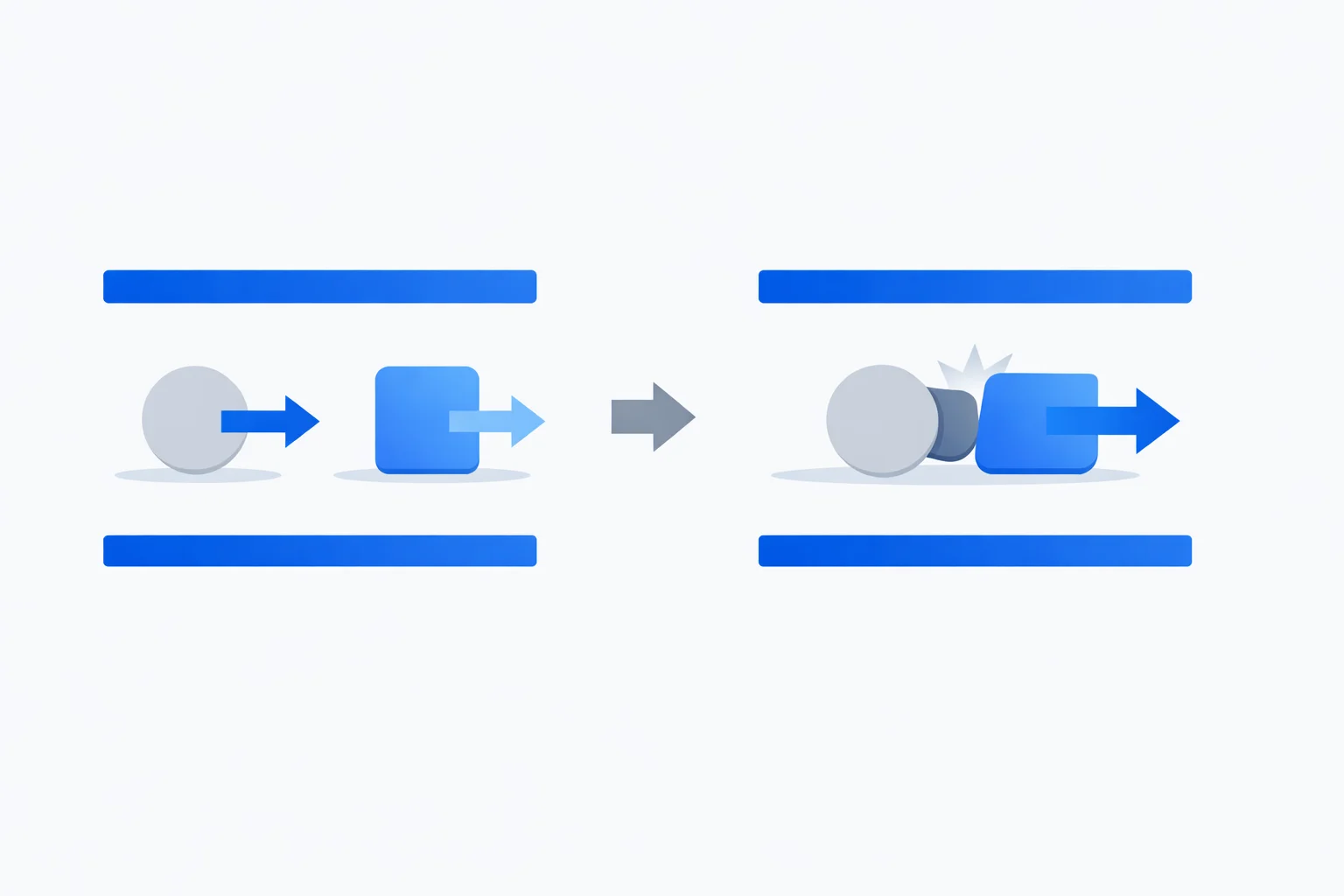
Total Momentum Before Equals Total Momentum After
For any collision between two objects, conservation of momentum is one equation:
m₁u₁ + m₂u₂ = m₁v₁′ + m₂v₂′
The left side is the total momentum before the hit — each object's mass times its starting velocity, added up. The right side is the same sum afterward, with the primes marking the new velocities. Put mass in kilograms and velocity in meters per second and every term is in kilogram-meters per second (kg·m/s). Each object's individual momentum is just linear momentum, p = mv; conservation is what happens when you add two of them together and demand the total hold steady.
Why should it hold steady? Because during the collision, object 1 pushes on object 2 exactly as hard as object 2 pushes back — Newton's third law. Those two forces are equal and opposite, so whatever momentum one object gains, the other loses. Inside the system they cancel perfectly, and the total never budges. That's the entire reason momentum is conserved, and it's why the law doesn't care whether the collision is a gentle nudge or a demolition.
Coupling Two Boxcars, Start to Finish
Back to the boxcars. Object 1 is the moving car: m₁ = 12,000 kg at u₁ = 3 m/s. Object 2 is the parked car: m₂ = 8,000 kg at u₂ = 0. Because they couple and move as one, this is a perfectly inelastic collision, and both share a single final velocity v′. Start with the momentum before:
- p before = (12,000)(3) + (8,000)(0) = 36,000 kg·m/s
After coupling, the combined 20,000 kg carries that same 36,000 kg·m/s, so:
- v′ = 36,000 ÷ 20,000 = 1.8 m/s
Check it: the pair's momentum after is 20,000 × 1.8 = 36,000 kg·m/s — a perfect match, which is how you know the algebra is right. Now look at the energy. Before the coupling there was ½(12,000)(3²) = 54,000 J of kinetic energy; afterward, ½(20,000)(1.8²) = 32,400 J. Roughly 40% of the kinetic energy vanishedinto the crunch of the couplers, yet the momentum came through untouched. That split — momentum preserved, energy spent — is the signature of every inelastic collision.
The Fine Print: It Only Works for an Isolated System
Conservation of momentum has one condition, and skipping it is the fastest way to get a wrong answer that looks reasonable. The system has to be isolated— no net external force acting on it during the interaction. A hand still shoving one cart, a wall it slams into, gravity pulling it down an incline: each of those is an outside force that adds or removes momentum, and the tidy "before equals after" bookkeeping no longer closes.
Friction is the sneaky one. A real air-track cart feels a little friction the whole time, so strictly the system isn't perfectly isolated. Here's the rescue: collision forces are huge and last only milliseconds, while friction is puny by comparison. Across the brief instant of the actual impact, the friction impulse is negligible, so momentum is conserved to an excellent approximation right through the hit. Apply the law across the collision, not across the long slide afterward — over those later seconds friction genuinely does bleed the pair to a stop. If you ever need to confirm the outside forces really do cancel, add them up with the net force calculator before you trust the conservation shortcut.
Run the Collision Backward and You Get an Explosion
An explosion is a collision played in reverse: instead of two objects coming together, one system flies apart. The same equation runs it. Picture an 800 kg cannon and a 5 kg ball, both at rest. Total momentum before firing is zero, so it has to stay zero. Fire the ball forward at 120 m/s and it carries (5)(120) = 600 kg·m/s in the positive direction. To keep the total at zero, the cannon must carry 600 kg·m/s the other way:
- cannon recoil = −600 ÷ 800 = −0.75 m/s
The minus sign says "backward," exactly what recoil feels like. This is the calculator's explosion mode: you type in the one velocity you know (the ball's), and conservation hands you the other (the cannon's). The twist versus a crash is the energy. A collision loses kinetic energy; an explosion gainsit, because chemical energy in the powder converts into motion. Momentum still starts and ends at zero — the newly minted kinetic energy is split between the pieces in whatever way keeps their momenta canceling. Rockets, recoiling rifles, and an astronaut shoving a tool tank all run on this identical zero-sum arithmetic.
Momentum Always Survives — Kinetic Energy Sometimes Doesn't
The reason a single calculator can handle crashes and explosions is that momentum is conserved in all of them. What changes from one type to the next is what happens to the kinetic energy. Here's how the three cases line up:
| Collision type | What the objects do | Total momentum | Kinetic energy | Everyday example |
|---|---|---|---|---|
| Perfectly elastic | Bounce cleanly apart | Conserved | Conserved | Billiard balls, gas molecules |
| Partially inelastic | Bounce but lose some energy | Conserved | Partly lost | A dropped basketball |
| Perfectly inelastic | Stick and move as one | Conserved | Maximum loss | Coupling boxcars, a clay ball |
| Explosion | Fly apart from rest or together | Conserved | Increases | Cannon recoil, fireworks |
Notice the middle column never changes: momentum is conserved every single time. Only the energy column tells the collisions apart. That's genuinely useful — compute the kinetic energy before and after, and if it matches, the collision was perfectly elastic; if it dropped, it was an inelastic collision; if it grew, something released stored energy. Momentum sets the stage; energy reveals the plot.
The Minus Sign That Sinks Head-On Problems
Momentum is a vector, and the most common wreck in these problems is treating it like a plain number. Take two 0.5 kg carts sliding straight at each other, each at 3 m/s. Pick rightward as positive: cart 1 is +3 m/s, cart 2 is −3 m/s. The true total momentum is (0.5)(3) + (0.5)(−3) = 0— they'll rebound as a mirror image or, if they stuck, stop dead. Now drop the minus sign by accident and you'd compute (0.5)(3) + (0.5)(3) = 3 kg·m/s, and predict the pair drifting off to the right after a head-on hit. That's not a rounding error; it's a physically impossible answer born from one missing sign. Assign a positive direction before you write down a single number, and put a minus on everything pointing the other way. The calculator above expects exactly that convention.
How to Check a Collision Answer in Ten Seconds
Conservation gives you a free built-in checker. Once you have the final velocities, add up m₁v₁′ + m₂v₂′ and compare it to the m₁u₁ + m₂u₂ you started with. If the two totals don't match, you made an arithmetic or sign slip — go find it before trusting the result. A couple of sanity checks catch the rest: in a stick-together collision, the combined speed can never exceed the faster object's starting speed, and the kinetic energy afterward can never be larger than before unless something exploded. When you feed a problem into an impulse calculation next — to find the force one object felt — that force must be consistent with the exact momentum change conservation just gave you. The numbers all have to agree.
Where Conservation of Momentum Fits
Reach for this calculator whenever two objects interact and you care about their velocities afterward: collisions, couplings, recoil, explosions, and the classic ballistic-pendulum problem are all squarely conservation-of-momentum territory, and all of it shows up on AP Physics 1 and any first-year mechanics course. Start with the masses and starting velocities, choose whether the objects stick, bounce, or blow apart, and read off the final speeds plus the momentum check. When the same problem asks whether the collision was elastic, switch to the kinetic energy tool; when it asks what force one object felt, switch to impulse. For a deeper walk through the principle itself, The Physics Classroom keeps a thorough lesson on the momentum conservation principle. Master this one equation and a whole class of "what happens after they hit?" questions collapses into simple addition.