Elastic Collision Calculator: How to Find Final Velocities in 1D and 2D Collisions
Here is the pair of equations this elastic collision calculator is built on, and everything else follows from them:
m₁u₁ + m₂u₂ = m₁v₁′ + m₂v₂′
½m₁u₁² + ½m₂u₂² = ½m₁v₁′² + ½m₂v₂′²
The top line is conservation of momentum; the bottom line is conservation of kinetic energy. A collision that satisfies both is perfectly elastic — the objects bounce apart with exactly the energy of motion they came in with, none of it lost to heat, sound, or a dent. Steel bearings, gas molecules, and pool balls come close. Enter two masses and two velocities above and the calculator solves both equations at once, in 1D or 2D, and shows the momentum and energy checks side by side so you can watch both hold.
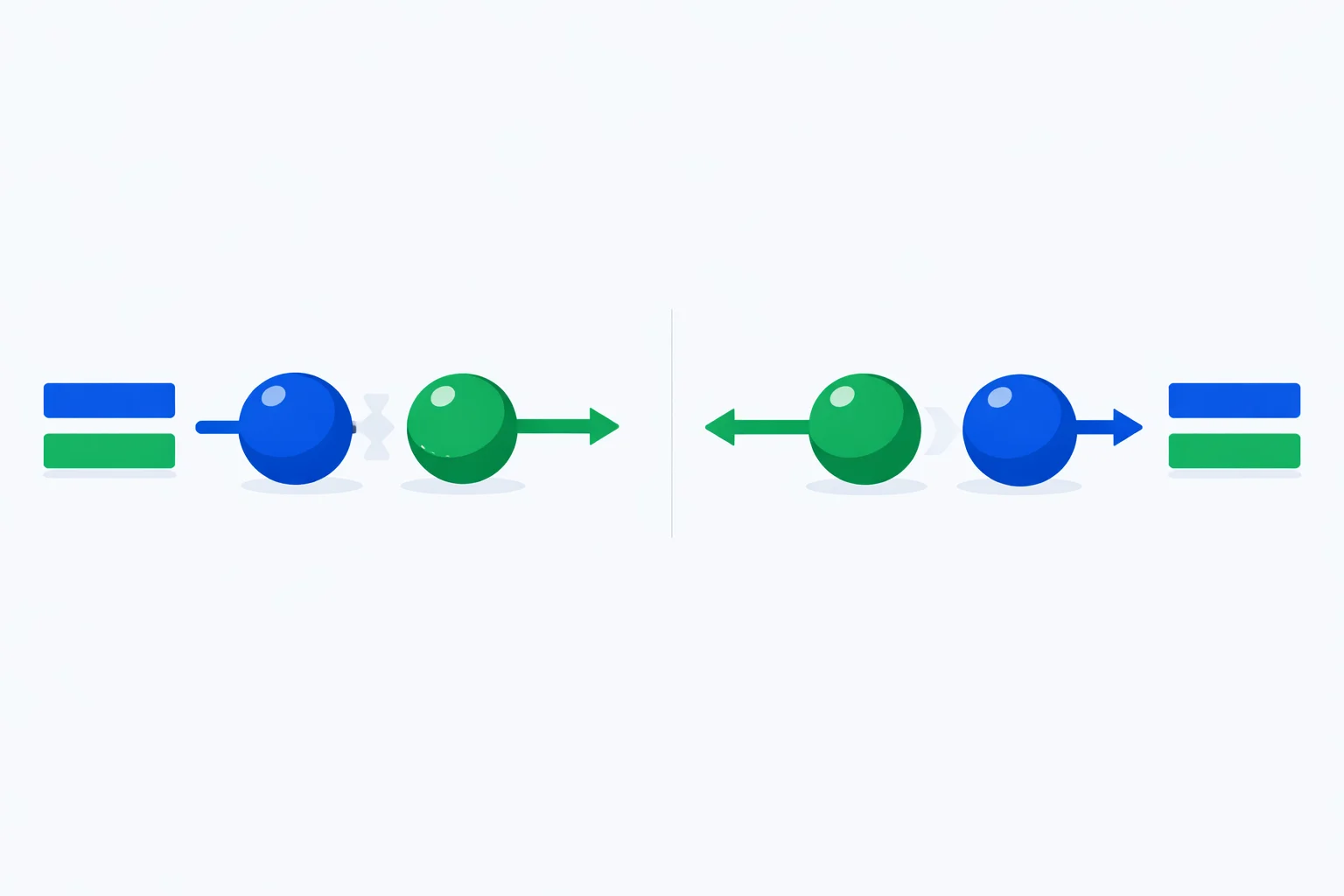
An Elastic Collision Obeys Two Conservation Laws at Once
Every isolated collision conserves momentum — that's Newton's third law showing up as bookkeeping, and it holds whether two cars crumple together or two magnets repel without touching. What sets an elastic collision apart is the second condition: the total kinetic energy is the same before and after. Nothing gets converted into heat or permanent deformation. That extra rule is doing real work. With only the momentum equation you'd have one equation and two unknown final velocities — unsolvable. The energy equation supplies the second relationship, and two equations fix two unknowns. This is why an inelastic collision needs extra information (like "the objects stick together") while an elastic one is fully determined by the masses and starting speeds alone.
Solving the Two Equations for the Final Velocities
Grinding through the algebra — subtract, factor the difference of squares, and divide — collapses those two messy equations into two clean formulas for a one-dimensional elastic collision:
v₁′ = [(m₁ − m₂)u₁ + 2m₂u₂] / (m₁ + m₂)
v₂′ = [(m₂ − m₁)u₂ + 2m₁u₁] / (m₁ + m₂)
Notice the symmetry: swap the labels 1 and 2 and one formula turns into the other. The whole answer hinges on the mass difference in the numerator and the mass sum in the denominator. When the two masses match, that (m₁ − m₂) term dies, and the result is startlingly simple — more on that below. Feed a stationary target (u₂ = 0) into the second formula and you get v₂′ = 2m₁u₁ / (m₁ + m₂), the launch speed of whatever you hit.
A Worked Example: Why Reactors Slow Neutrons With Carbon
Nuclear reactors need to slow fast neutrons to a crawl before they'll reliably split more uranium, and they do it with elastic collisions. A neutron (mass ≈ 1 atomic unit) fired head-on into a stationary carbon-12 nucleus (mass 12) is a textbook 1D elastic problem. Using u₂ = 0:
- Neutron after: v₁′ = (1 − 12)/(1 + 12) × u₁ = −0.846 u₁ — it rebounds backward at about 85% of its speed.
- Fraction of energy lost:the maximum energy transfer in a head-on elastic hit is 4m₁m₂/(m₁ + m₂)² = 4(1)(12)/13² = 0.284.
So a neutron sheds at most about 28% of its kinetic energy in one bounce off carbon. Compare that to hitting a hydrogen nucleus (mass 1), where 4(1)(1)/2² = 1.0 — a neutron can lose allof its energy in a single equal-mass collision, exactly the velocity swap the formula predicts. That's why water is such an efficient moderator per collision, and why a graphite (carbon) reactor needs many more bounces: slowing a fission neutron to thermal speeds takes roughly 110 collisions in graphite versus about 18 in water. Same two equations, wildly different engineering.
The Telltale Sign: Approach Speed Equals Separation Speed
There's a shortcut hidden in those formulas that's worth memorizing. In any 1D elastic collision, the speed at which the two objects separate afterward equals the speed at which they approached beforehand:
u₁ − u₂ = −(v₁′ − v₂′)
Two carts closing at a combined 6 m/s will part at 6 m/s. That ratio of separation speed to approach speed is the coefficient of restitution, e, and for a perfectly elastic collision e = 1 exactly — the calculator reports it next to every 1D result. It gives you a second, independent way to check an answer: compute the final velocities, then confirm their difference matches the starting difference. If it doesn't, the collision you're modeling isn't truly elastic, or a sign slipped. A partially bouncy collision has e between 0 and 1; a stick-together crash has e = 0.
Three Mass Ratios, Three Very Different Outcomes
The single most useful thing to internalize about elastic collisions is how wildly the outcome depends on the mass ratio when the target starts at rest. Three regimes cover almost everything you'll meet:
| Situation | What object 1 does | What object 2 does | Everyday example |
|---|---|---|---|
| Equal masses (m₁ = m₂) | Stops dead | Leaves at object 1's full speed | Newton's cradle, straight billiard shot |
| Heavy hits light (m₁ » m₂) | Barely slows, keeps going | Rockets off at nearly 2× object 1's speed | Bowling ball scattering a marble |
| Light hits heavy (m₁ « m₂) | Rebounds at nearly its original speed | Hardly moves | Ping-pong ball off a bowling ball, ball off a wall |
That middle row surprises people: a struck light object can leave at up to twicethe striker's speed. It never breaks energy conservation, because the tiny mass carries little energy even at double the speed (energy goes as v² but only as m to the first power). The bottom row is the physics of a bouncing ball — the "heavy" object is the entire Earth, which absorbs a negligible recoil, so the ball comes back up at almost the speed it fell.
Elastic Collisions in 2D and the 90° Billiards Rule
Real balls rarely hit dead center. When object 1 strikes a stationary object 2 off-center, both fly off at angles, and the collision spreads into two dimensions. Momentum is now conserved separately along two axes — the original line of motion and the perpendicular — while kinetic energy still gives one more equation. That's three equations for four unknowns (two speeds, two angles), so one angle stays free: it depends on exactly how squarely the objects hit, which is why the calculator lets you dial in object 1's deflection angle and solves the rest.
The famous special case is equal masses. When m₁ = m₂ and the target starts at rest, the two objects always leave exactly 90° apart, no matter how glancing or square the contact. Pool players lean on this constantly: after a non-straight hit, the cue ball and object ball separate at a right angle, which is how you predict whether the cue will scratch. Change the mass ratio and the right angle disappears — a heavier projectile stays closer to its original path and can only be deflected up to a maximum angle where sin θ = m₂/m₁. Try the "Heavy projectile clip" preset and watch the calculator refuse angles beyond that ceiling.
Why No Real Collision Is Perfectly Elastic
Perfectly elastic collisions are an idealization. Every real macroscopic bounce loses a little energy to sound, heat, and permanent deformation, so the separation speed always comes back a touch lower than the approach speed. How much lower is captured by the coefficient of restitution — here are typical measured values for common materials:
| Colliding objects | Coefficient of restitution (e) | Kinetic energy retained |
|---|---|---|
| Hardened steel bearings | ~0.95 | ~90% |
| Glass marbles | ~0.94 | ~88% |
| Billiard / pool balls | ~0.90–0.96 | ~81–92% |
| Superball (polybutadiene) | ~0.85–0.90 | ~72–81% |
| Wooden ball | ~0.50 | ~25% |
| Ball of clay or putty | ~0 | ~0% (sticks) |
The pattern to notice: because energy scales with the square of the speed ratio, an e of 0.95 still preserves about 90% of the kinetic energy, but an e of 0.5 keeps only a quarter of it. So treat the elastic formulas as an excellent approximation for hard, springy objects and a poor one for anything soft. When you know the collision loses real energy — a car crash, a clay ball, a dropped phone — you want the inelastic collision calculator instead, where the missing energy is the whole point.
The Mistake That Wrecks Half of Elastic-Collision Problems
The classic error is trying to solve an elastic collision with the momentum equation alone. Students write down m₁u₁ + m₂u₂ = m₁v₁′ + m₂v₂′, see two unknowns, and get stuck — or worse, invent a second assumption that isn't true. The fix is to remember that "elastic" hands you the energy equation for free; use both. The other frequent slip is a dropped sign in a head-on problem. Velocity is a vector, so an object moving left needs a negative velocity before you plug anything in. Get the sign wrong on a head-on hit and you'll predict two objects drifting off together after what should have been a clean rebound. Pick a positive direction first, mark everything moving the other way as negative, and let each object's individual momentum, p = mv carry its own sign.
Where the Elastic Collision Calculator Fits
Reach for this tool whenever two hard objects bounce and you care about their speeds and directions afterward: cart-track experiments, billiards, Newton's cradles, atomic and nuclear scattering, and the elastic-collision questions that turn up on every AP Physics 1 and first-year mechanics exam. Start in 1D for head-on hits, switch to 2D for glancing blows, and read the momentum and energy checks to confirm both are conserved. When the collision isn't elastic — the objects stick, crumple, or lose energy — move over to the conservation of momentum calculator, which handles inelastic crashes and explosions from the single momentum equation. For a rigorous derivation of the 1D formulas, HyperPhysics keeps a clear elastic collision reference. Master the two-equation setup and a whole class of "what happens after they bounce?" problems becomes routine.