How to Calculate Momentum (p = mv) — and Why It Isn't Kinetic Energy
Momentum and kinetic energy are built from the same two numbers — an object's mass and its velocity — so it's tempting to treat them as two names for the same idea. They're not, and confusing them is one of the quietest ways to lose points on a mechanics exam. This momentum calculator computes linear momentum with p = mv, but it also shows the kinetic energy right next to every answer, because seeing the two together is the fastest way to learn how differently they behave. If you want to know how to calculate momentum in physics — and why a slow bowling ball can out-momentum a rifle bullet — this is the place to start.
p = mv: What Each Piece Actually Means
Linear momentum is defined as p = mv— mass times velocity. Put mass in kilograms and velocity in meters per second, and momentum comes out in kilogram-meters per second (kg·m/s). A useful thing nobody tells you up front: one kg·m/s is exactly one newton-second (N·s), which is why momentum and impulse share a unit. That shared unit is a hint about how they're connected, and we'll come back to it.
The vin the formula is a velocity, not just a speed, so momentum inherits a direction — it's a vector that points wherever the object is heading. The m is straightforward mass. If a problem hands you weight or density instead, get the mass first with the mass calculator and pull the speed from the velocity calculator. Because both mass and velocity appear to the first power, momentum is perfectly linear: double either one and you double the momentum. A 0.145 kg baseball thrown at 40 m/s has p = 0.145 × 40 = 5.8 kg·m/s. Throw it twice as fast and it's 11.6 kg·m/s. Nothing squared, nothing hidden.
A Fastball Has More Momentum Than a Bullet
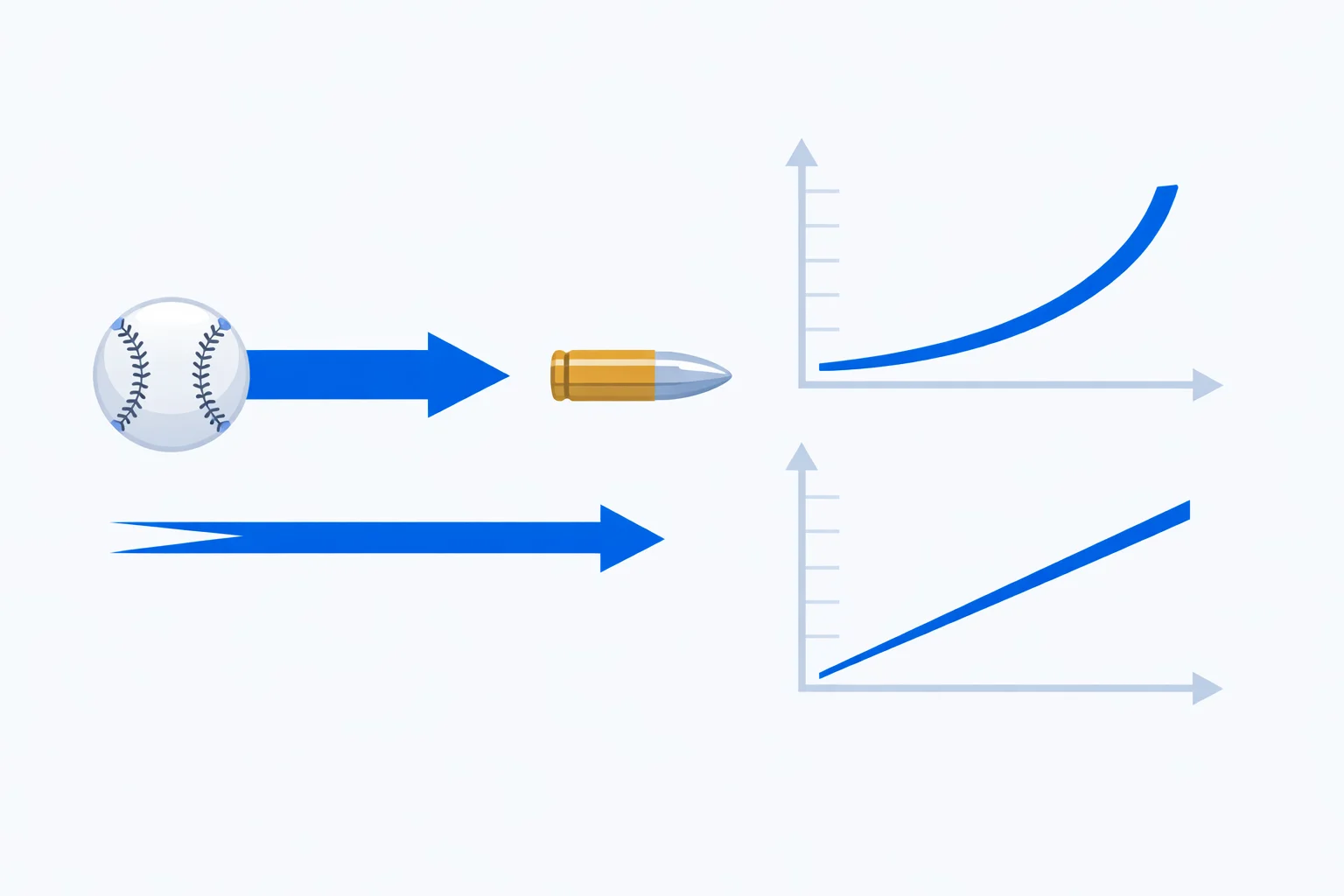
Here's a matchup that surprises almost everyone. Take a 0.145 kg baseball leaving a pitcher's hand at 40 m/s (about 90 mph) and a 9 mm bullet, roughly 8 grams, leaving the muzzle at 380 m/s. Which one carries more momentum?
- Baseball: p = 0.145 × 40 = 5.8 kg·m/s
- 9 mm bullet: p = 0.008 × 380 = 3.04 kg·m/s
The baseball wins on momentum by nearly two to one. Now look at the kinetic energy of each, the number you'd get from the kinetic energy calculator: the ball's ½mv² is about 116 J, while the bullet's is roughly 578 J — five times more. So the ball has more momentum but the bullet has far more energy. That's not a contradiction; it's the whole point. Momentum measures how much impulse it takes to stop something. Kinetic energy measures how much work it can do while stopping. A bullet penetrates because it dumps a lot of energy into a pinhead-sized area; a fastball shoves you harder overall but spreads its effect across a mitt. Ranking "how dangerous" by a single number is where the mistake begins.
Momentum vs Kinetic Energy: Same Ingredients, Different Rules
Because p = mv and KE = ½mv² recycle the same mass and velocity, the only way to keep them straight is to line up the rules they each follow. They disagree on almost everything that matters:
| Property | Momentum (p = mv) | Kinetic Energy (KE = ½mv²) |
|---|---|---|
| Depends on speed | Linearly — double v, double p | By the square — double v, 4× KE |
| Direction | Vector (has a direction and sign) | Scalar (no direction) |
| Can it be negative? | Yes — the sign is direction | Never — v² is always positive |
| Units | kg·m/s (= N·s) | joules (J) |
| Conserved in a collision? | Always, if the system is isolated | Only in a perfectly elastic collision |
| Link between them | p = √(2m · KE) | KE = p² / 2m |
That last row is worth memorizing: KE = p²/2m. For the same momentum, a lighter object has more kinetic energy, which is exactly why the light, fast bullet out-energizes the heavier, slower baseball even though the ball has more momentum. Two objects can share an identical momentum and still be nowhere near each other in energy.
Why Two Objects Can Have Zero Total Momentum
Treat momentum as a plain number and head-on collisions stop making sense. Picture two 0.2 kg air-hockey pucks sliding straight at each other, each at 3 m/s. One has momentum +0.6 kg·m/s, the other −0.6 kg·m/s, so the total momentum of the pair is zero. Yet each puck still has ½(0.2)(3²) = 0.9 J of kinetic energy, for 1.8 J in the system. Zero momentum, real energy — because momentum vectors can cancel while energies, being scalars, only ever add.
This is the seed of every collision problem. When those pucks meet head-on and stop dead, the system's momentum stays zero the whole way through (it started at zero), and all 1.8 J of kinetic energy converts to heat, sound, and a satisfying clack. If you'd tracked only a scalar "amount of motion," you could never explain how both objects come to rest without breaking a conservation law. The sign is doing the heavy lifting.
Momentum Is Conserved Even When Energy Isn't
The reason momentum earns its own calculator is conservation. In an isolated system — no net external force — total momentum before an interaction equals total momentum after, no matter how messy the interaction is. Kinetic energy gets no such guarantee: it's only conserved in perfectly elastic collisions, and lost to heat and deformation in every real crash.
Recoil is the cleanest demonstration. Fire an 8 g bullet at 380 m/s from a 4 kg rifle. Before the shot, nothing moves, so total momentum is zero. The bullet leaves with 0.008 × 380 = 3.04 kg·m/s forward, which means the rifle must carry 3.04 kg·m/s backward to keep the total at zero. Its recoil speed is 3.04 / 4 = 0.76 m/s. Same physics launches rockets (exhaust one way, ship the other) and pushes a skater backward when they shove off a wall. The wall, incidentally, is an external force — which is the loophole that lets a single skater change their own momentum.
Changing Momentum Takes Both Force and Time
If momentum is conserved without outside forces, then changing it requires one. The bridge is impulse: J = FΔt = Δp. Rearranged, F = Δp/Δt — the force needed to change an object's momentum depends on how quickly you make the change. Stop the same momentum in a tenth of the time and you need ten times the force, which is precisely how an airbag saves you. A 75 kg driver going 15 m/s carries 1,125 kg·m/s. Stop that in a rigid 0.02 s and the force is about 56,000 N; let an airbag stretch it to 0.2 s and the force drops to 5,600 N. Same Δp, one-tenth the force. You can chase the force side of this with the force calculator once you know the momentum change.
Mistakes That Quietly Wreck Momentum Problems
- Dropping the direction.Adding momenta as if they were positive numbers turns a head-on collision into nonsense. Assign a + and − axis before you add anything.
- Reaching for the wrong quantity.If a question asks what force stops an object or what happens in a collision, that's momentum. If it asks about work, heat, or "how much damage," that's kinetic energy. Using ½mv² where you needed mv (or vice versa) is the most common slip.
- Skipping the unit conversion.A car at 108 km/h is at 30 m/s. Plug 108 straight in and your momentum is 3.6× too big. Convert speed to m/s and mass to kg first — the calculator does this when you pick the right unit.
- Assuming momentum is always conserved.It's only conserved for an isolated system. Friction, gravity, and walls are external forces that legitimately change a system's momentum, so check whether the system is really closed before writing "p before = p after."
Where This Calculator Fits With Your Other Tools
Reach for momentum whenever a problem involves collisions, recoil, or the force it takes to change an object's motion over time — standard territory for AP Physics 1 and any introductory mechanics course. Start from mass and velocity to get p, or flip the toggle to recover a missing mass or speed from a known momentum. When the same problem asks about the energy of the motion instead of its "quantity," switch to the kinetic energy calculator, and when it asks what force produced or absorbed the change, use the net force calculator. For a deeper treatment of the conservation law itself, HyperPhysics has a clear reference on momentum and its conservation. Momentum, energy, and force are three views of the same motion — knowing which one a problem is really asking about is half the battle.