Inelastic Collision Calculator: Combined Velocity, Energy Lost, and the Ballistic Pendulum
Fire a 4-gram bullet into a hanging block of wood and something strange happens to the bookkeeping: the bullet loses more than 99% of its kinetic energy in a few thousandths of a second, yet the block barely twitches. That vanished energy is the entire story of an inelastic collision, and this inelastic collision calculatoris built to track it — the shared velocity when two objects stick, the exact joules turned into heat, and the classic ballistic-pendulum trick that once let physicists measure a musket ball's speed with nothing but a block and a ruler. Enter your masses and speeds above, or reverse a measured swing height back into the projectile's velocity.
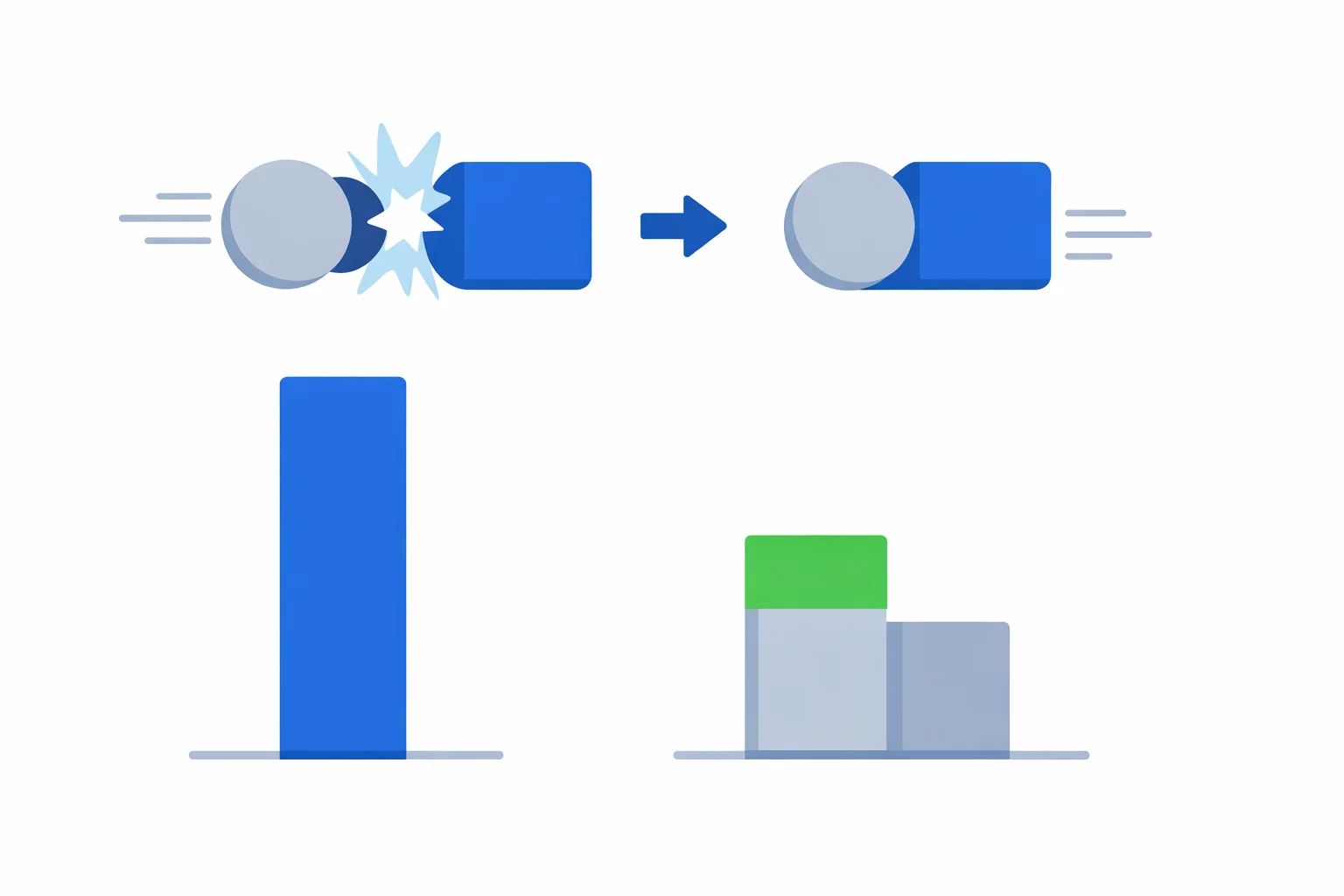
How a Block of Wood Clocks a Bullet
Before high-speed cameras and chronographs, how did anyone know a musket ball flew at 250 m/s? Benjamin Robins answered it in 1742 with the ballistic pendulum: fire the ball into a heavy block hanging from strings, and measure how high the block swings. The device works precisely because it splits into two phases that obey different conservation laws. In the first phase the ball buries itself in the block — a perfectly inelastic collision where momentum is conserved but most of the kinetic energy is destroyed. In the second phase the block-plus-ball swings up like a pendulum, and now energy conservation takes over, trading the kinetic energy it has left for height. Keep those two phases separate and the whole problem falls apart into two clean steps.
The One Formula Behind Every Stick-Together Collision
A perfectly inelastic collision is the simplest case in all of collision physics, because the two objects share one final velocity. Start from conservation of momentum and set both final velocities equal, and the algebra collapses to a single line:
v′ = (m₁u₁ + m₂u₂) / (m₁ + m₂)
The combined velocity is just the total momentum divided by the total mass. Take a 1,500 kg car rolling at 20 m/s into a stationary 1,200 kg car: (1,500 × 20 + 0) / 2,700 = 11.1 m/s for the tangled pair. Notice what you didn'tneed — no spring constants, no contact time, no detail about how the metal folded. That's the payoff of the stick-together assumption: one equation, one answer. The calculator's stick-together mode runs exactly this, then checks that the momentum before matches the momentum after so you can catch a stray sign.
Where the Missing Kinetic Energy Actually Goes
Momentum survives every collision, but kinetic energy is a different animal. The amount destroyed in a two-body collision has a beautifully compact form built from the reduced mass, μ = m₁m₂/(m₁+m₂):
ΔKE = ½ · μ · (u₁ − u₂)²
Only the relativevelocity matters — the (u₁ − u₂) term — which is why two objects already moving together lose nothing when they merge. For the two cars, μ = (1,500 × 1,200)/2,700 = 667 kg, and ΔKE = ½ × 667 × 20² ≈ 133 kJ, about 44% of the starting energy, gone into crumpled sheet metal and heat. That's not an accounting error; it's the physics that lets crumple zones save lives. The car is designed to turn that 133 kJ into folding steel instead of into the people inside. Compare the kinetic energy before and after and the missing chunk is the collision's fingerprint.
Working a Ballistic Pendulum From Swing Height Back to Speed
Here's the reverse problem the pendulum was invented for. A 10-gram bullet embeds in a 2 kg block, and the block swings up 8 cm. What was the bullet's speed? Work the two phases in reverse order:
- Phase 2 (energy, the swing): the block rose h = 0.08 m, so its speed right after impact was V = √(2gh) = √(2 × 9.81 × 0.08) = 1.25 m/s.
- Phase 1 (momentum, the impact): that combined 2.010 kg carried 2.010 × 1.25 = 2.52 kg·m/s, all of it delivered by the bullet, so v = 2.52 / 0.010 = 252 m/s.
A tidy 252 m/s from a ruler and a scale. Try inverting it: the bullet arrived with ½ × 0.010 × 252² ≈ 318 J, but the block-plus-bullet left the impact with only about 1.6 J. More than 99% of the bullet's energy was destroyed on the way in — which is the whole reason this trick works. If energy had been conserved in the impact, the block would have launched far higher and the method would give nonsense.
Why a Bullet Loses Almost Everything but a Truck Barely Notices
When the target starts at rest, the fraction of the incoming object's kinetic energy that gets destroyed in a stick-together hit is startlingly simple: m₂/(m₁+m₂). The striking object's mass barely appears. That single ratio explains a whole family of everyday collisions:
| Collision (target at rest) | Mass ratio | Energy destroyed | Why |
|---|---|---|---|
| 4 g bullet into 5 kg block | 1 : 1,250 | ~99.9% | Tiny striker, huge target |
| Ball of clay into equal ball | 1 : 1 | 50% | Equal masses split it evenly |
| 1,500 kg car into 1,200 kg car | 1 : 0.8 | ~44% | Comparable masses |
| 40 t truck into 1,200 kg car | 33 : 1 | ~2.9% | Huge striker, small target |
The bullet loses nearly all of its energy because the block it embeds in is enormous by comparison, and momentum forces the combined object to crawl — a slow, heavy object carries very little kinetic energy no matter how much momentum it holds. Flip the ratio and a truck plowing through a car keeps almost all of its energy, barely slowing. Same formula, opposite extremes. It's the counter-intuitive heart of inelastic collisions, and it's why forensic ballistics leans on heavy pendulum blocks: you want nearly all the energy dumped so the swing stays small and measurable.
Between a Clean Bounce and a Dead Splat
Real collisions rarely stick perfectly or bounce perfectly. Most land somewhere in between, and the coefficient of restitution, e, is the dial that measures where. It's the ratio of separation speed to approach speed: e = 0 means the objects don't separate at all (they stick), e = 1 means they separate exactly as fast as they came together (a perfectly elastic collision), and everything in between is partially inelastic. The energy loss picks up a single extra factor:
ΔKE = ½ · μ · (u₁ − u₂)² · (1 − e²)
Because the loss scales with (1 − e²), a collision with e = 0.5 still destroys 75% of the energy a perfectly inelastic one would — restitution has to climb well above a half before much energy is spared. Drag the calculator's restitution slider from 0 up toward 1 and watch the destroyed-energy bar shrink, slowly at first and then fast near the elastic end. A basketball bouncing off the floor sits around e = 0.8; a dropped lump of putty is essentially e = 0.
When “Perfectly Inelastic” Is the Wrong Assumption
The stick-together formula is a maximum-energy-loss idealization, and it quietly assumes the objects really do end up moving as one. Reach for a different tool when that's not true. If the objects visibly bounce apart, they didn't stick — you need the coefficient of restitution, not e = 0. If an external force is significant during the interaction (a rocket still thrusting, a hand shoving a cart, a steep incline), momentum isn't conserved and the whole approach breaks. And the ballistic pendulum has its own fine print: the strings must be long enough that the block rises straight up cleanly, air resistance during the swing has to be negligible, and the bullet must fully embed rather than punching through. If the projectile exits the far side, it carries momentum and energy away with it, and the simple two-phase reconstruction under-reports the speed.
The Ballistic-Pendulum Trap That Costs Exam Points
The single most common wreck on this topic is applying energy conservation to the wrong phase. A student sees a bullet hit a block and swing up, writes ½mv² = (m+M)gh, solves for v, and gets a badly wrong answer — usually far too small. The error is treating the whole event as energy-conserving. It isn't: the embedding phase destroys most of the kinetic energy, so you must use momentum (mv = (m+M)V) for the impact and only then use energy for the swing. Chain them: momentum across the hit, energy across the rise. The other frequent slip is a dropped sign in a head-on stick-together problem. Two objects closing on each other have opposite-signed velocities; forget the minus on the leftward one and you'll compute a combined speed that's far too high. Pick a positive direction first, and let each object's momentum, p = mv carry its own sign into the sum.
Where the Inelastic Collision Calculator Fits
Reach for this tool whenever objects hit and don't cleanly bounce: cars crumpling together, a tackled runner and the tackler, clay balls merging, coupling rail cars, a caught medicine ball, and the ballistic-pendulum problem that shows up on nearly every AP Physics 1 and first-year mechanics exam. Use stick-together mode for the perfectly inelastic maximum, dial in a restitution for a partial bounce, and switch to pendulum mode to turn a swing height into a muzzle velocity. When the collision is instead a clean bounce with no energy lost, cross over to the elastic side of the family; when you just need the raw before-and-after momentum, the conservation calculator handles it. For a rigorous derivation of the two-phase method, HyperPhysics keeps a clear ballistic pendulum reference. Master the split — momentum for the crash, energy for the aftermath — and inelastic collisions stop being intimidating.