Relativistic Energy: Why ½mv² Stops Telling the Truth Near Light Speed
Every physics student learns kinetic energy as ½mv², and for a rolling cart or a thrown ball it's exactly right. Then you meet a particle moving at 99% of the speed of light, plug into ½mv², and your answer is wrong by a factor of twelve. The formula didn't break — it was always an approximation, and it only looked perfect because nothing in everyday life moves fast enough to expose the gap. This relativistic energy calculator works with the full picture: rest energy E₀ = mc², total energy E = γmc², and the kinetic energy that lives in between. Below, we'll watch precisely where the Newtonian version starts to lie and why.
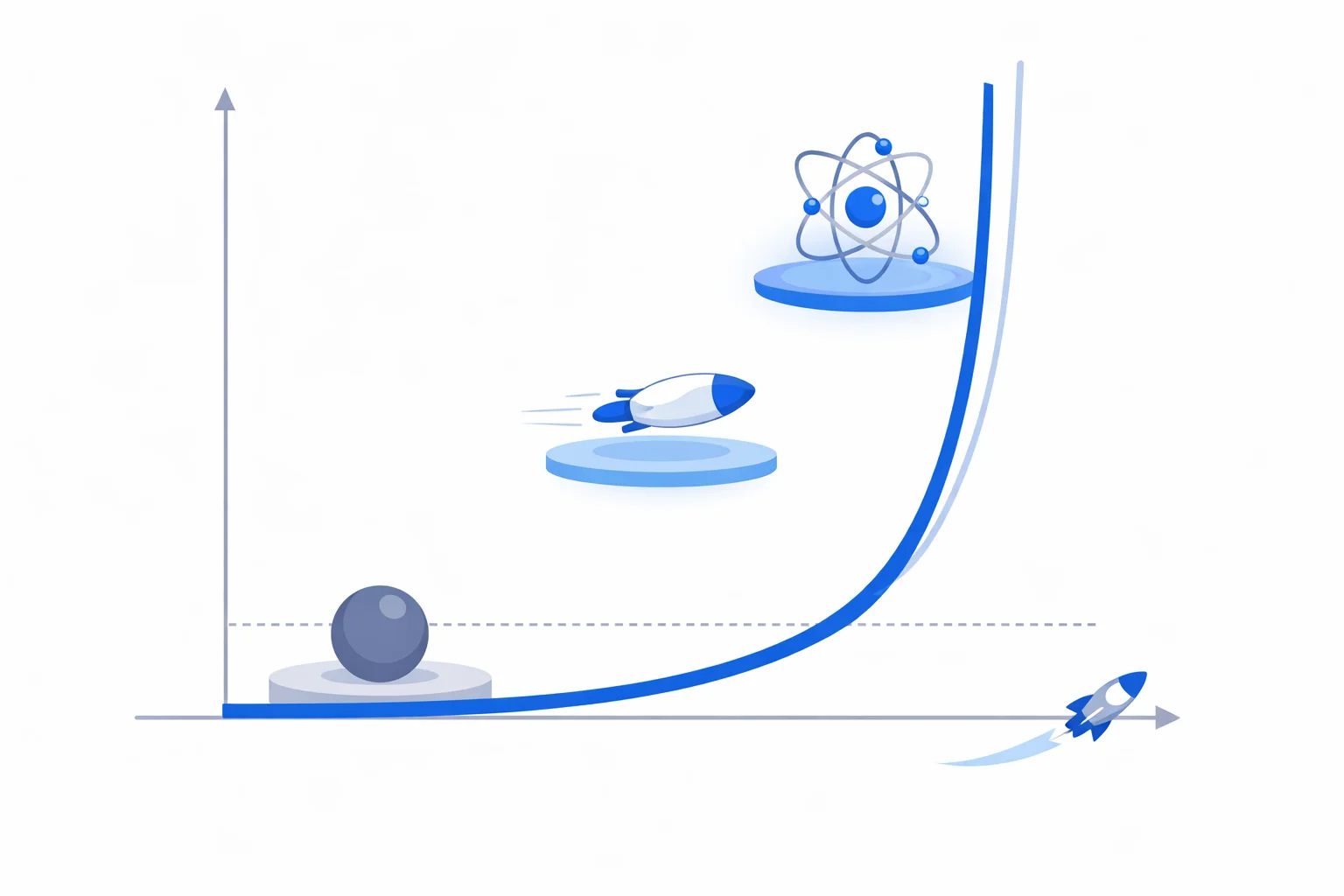
Three Energies Hiding in One Equation: Rest, Kinetic, Total
Relativity bundles three different energies into one compact relation. The headline is E = γmc², the total energy, where γ (the Lorentz factor) is 1/√(1 − v²/c²). Set the speed to zero and γ becomes 1, leaving the rest energy E₀ = mc²— the energy an object carries simply for having mass. Whatever's left when you subtract the rest energy from the total is the relativistic kinetic energy: KE = (γ − 1)mc².
That last equation is the one that matters for problems involving motion. An electron has a rest energy of 0.511 MeV no matter what; accelerate it until γ = 3 and its total energy becomes 1.533 MeV, of which 1.022 MeV is kinetic. The split is always the same idea: total equals rest plus kinetic. The calculator above reports all three at once, so you never have to remember which formula gives which.
Where ½mv² Starts to Lie: Newton vs Einstein
Here's the comparison no textbook puts front and center. For the same object at the same speed, line up the Newtonian ½mv² you'd get from our kinetic energy calculator against the relativistic (γ − 1)mc², written as a multiple of the rest energy:
| Speed | ½mv² (Newton) | (γ−1)mc² (Einstein) | How wrong is Newton? |
|---|---|---|---|
| 10% c | 0.0050 mc² | 0.0050 mc² | 0.8% low |
| 50% c | 0.125 mc² | 0.155 mc² | 19% low |
| 86.6% c | 0.375 mc² | 1.000 mc² | 63% low |
| 99% c | 0.490 mc² | 6.089 mc² | 92% low |
| 99.9% c | 0.499 mc² | 21.37 mc² | 98% low |
The pattern is brutal. Newton's ½mv² tops out near 0.5 mc² because v can never exceed c, so the most kinetic energy it can ever predict is about half the rest energy. The real kinetic energy has no ceiling — it climbs without limit as γ grows. By 99% c the true value is more than twelve times what ½mv² claims. This single divergence is why particle accelerators are designed around relativistic energy and never the Newtonian formula.
The Lorentz Factor γ Is the Whole Story
Strip away the symbols and relativistic energy is really just one number doing all the work: γ = 1/√(1 − v²/c²). At a walking pace γ is 1.0000000000001 — so close to 1 that the rest energy is essentially all you have. At 86.6% of light speed γ equals exactly 2, the tidy point where total energy is double the rest energy and the kinetic energy finally equals mc². Push to 99% c and γ is about 7; at 99.9% c it's 22; at 99.99% c it's 71.
Because γ sits as a multiplier in front of both energy and momentum, every relativistic quantity inherits that runaway behavior. The relativistic momentum p = γmv is what later sets a fast particle's wavelength in our de Broglie wavelength calculator, which is why electron microscopes need the relativistic correction once their electrons pass a few tens of keV. Watch the γ readout in the calculator as you drag the slider toward c — the way it accelerates upward is the entire physics of the situation.
Worked Example: An Electron at 99% the Speed of Light
Take an electron (rest energy mc² = 0.511 MeV) moving at v = 0.99c — the kind of speed reached inside a hospital's radiotherapy linac. First the Lorentz factor:
γ = 1/√(1 − 0.99²) = 1/√(1 − 0.9801) = 1/√0.0199 = 7.089
Now the three energies follow directly:
- Total energy: E = γmc² = 7.089 × 0.511 MeV = 3.62 MeV
- Kinetic energy:KE = (γ − 1)mc² = 6.089 × 0.511 MeV = 3.11 MeV
- Rest energy: unchanged at 0.511 MeV
Now do it the Newtonian way for contrast. ½mv² = ½(9.109 × 10⁻³¹ kg)(0.99 × 2.998 × 10⁸ m/s)² = 4.01 × 10⁻¹⁴ J, which is just 0.250 MeV. The simple formula undershoots the real 3.11 MeV by 92%. If you were calibrating that linac with ½mv², you'd be off by more than a factor of twelve — the difference between a working treatment beam and a useless one.
What E = mc² Really Says: The Energy in a Paperclip
Set the speed to zero and the calculator shows nothing but rest energy — and that's where E = mc² turns genuinely shocking. A 1-gram paperclip sitting on your desk has a rest energy of E₀ = (0.001 kg)(2.998 × 10⁸ m/s)² ≈ 9 × 10¹³ joules. That's about 21 kilotons of TNT, roughly the yield of the Hiroshima bomb — which, fittingly, released its energy by converting under a gram of matter into energy. The c² factor (9 × 10¹⁶ in SI units) is the exchange rate, and it is astronomically large.
So why doesn't a paperclip explode? Because there's no easy way to unlock that energy. Chemical reactions barely touch the mass — burning fuel converts maybe a billionth of it. Even nuclear fission liberates only about 0.1% of the mass as energy, and fusion around 0.7%; the steady radioactive decay of an unstable nucleus converts a similarly tiny sliver. The mass–energy equivalence is always there in the bookkeeping; what changes between a campfire and a reactor is merely how large a fraction of the rest energy you can pry loose. That's the same idea behind the radiation our photon energy calculator handles, where for a massless photon E = mc² collapses to E = pc.
Why You Can't Just Floor It to Light Speed
The total energy E = γmc² contains a built-in speed limit. As v approaches c, the term √(1 − v²/c²) heads to zero, so γ — and with it the energy — heads to infinity. Getting a single electron to exactly c would require infinite energy, which is the universe's polite way of saying it's impossible for anything with mass.
This is also why accelerators show diminishing returns. The Large Hadron Collider pushes protons to 99.9999991% of c, yet doubling a proton's already-enormous energy barely nudges its speed closer to c — nearly all the added energy pours into momentum and γ, not into velocity. Try typing 100% c into the calculator and it refuses, because the math genuinely diverges there. Only massless particles like photons, which have no rest energy to multiply, are allowed to travel at c.
When You Can Safely Ignore Relativity
Relativistic energy isn't something you reach for on every problem — most of the time ½mv² is the right tool, and pulling in γ is overkill. Expand the Lorentz factor for small speeds and you get γ ≈ 1 + ½(v/c)², which means the relativistic kinetic energy (γ − 1)mc² reduces neatly to ½mv². Einstein's formula contains Newton's as its low-speed limit; that's why the two columns above agree to four decimals at 10% c.
A practical rule: if an object moves below about 10% of the speed of light (30,000 km/s), the relativistic correction is under 1% and you should just use ½mv². Cars, bullets, satellites, even most chemistry — all comfortably Newtonian. Save the relativistic energy calculator for the cases that actually need it: electrons in accelerators and CRTs, cosmic-ray muons, particles in reactors, and any problem that hands you a speed quoted as a fraction of c. Knowing when not to use a formula is half of using it well.
Common Mistakes With Relativistic Energy
- Using ½mv² for fast particles.Past 10% c it's noticeably low; by 99% c it's off by 92%. The moment a speed is given as a fraction of c, switch to (γ − 1)mc².
- Confusing total energy with kinetic energy. E = γmc² is the total; the kinetic part is (γ − 1)mc². Forgetting to subtract the rest energy overstates the kinetic energy by exactly mc².
- Applying E = mc² to a moving object.That equation gives rest energy only. For motion you need E = γmc² or E² = (pc)² + (mc²)².
- Treating mass as if it grows.Modern relativity keeps mass invariant and puts the γ into energy and momentum. "Relativistic mass" is a retired concept — the momentum p = γmv already captures the effect.
- Mixing up the γ algebra.It's 1/√(1 − v²/c²), not 1/√(1 − v/c). Square the velocity ratio first, or you'll badly underestimate γ at high speed.
Where This Calculator Fits With Your Other Tools
Reach for relativistic energy whenever a problem quotes a speed near c or asks about accelerators, nuclear reactions, or mass–energy equivalence — common ground for AP Physics 2, AP Physics C, and introductory modern-physics courses. Start from the speed and read off all three energies, or work backward from a kinetic energy using γ = 1 + KE/(mc²). If your problem instead stays well below light speed, the plain kinetic energy calculator is faster and perfectly accurate. For the light side of the same physics — energy and momentum without any rest mass — pair this with the photon energy calculator. For the exact value of the speed of light and particle rest energies used here, see NIST's reference data, and for how relativistic energy plays out in practice, CERN's accelerator overview shows where these numbers come alive.