De Broglie Wavelength: How Every Moving Particle Hides a Wave
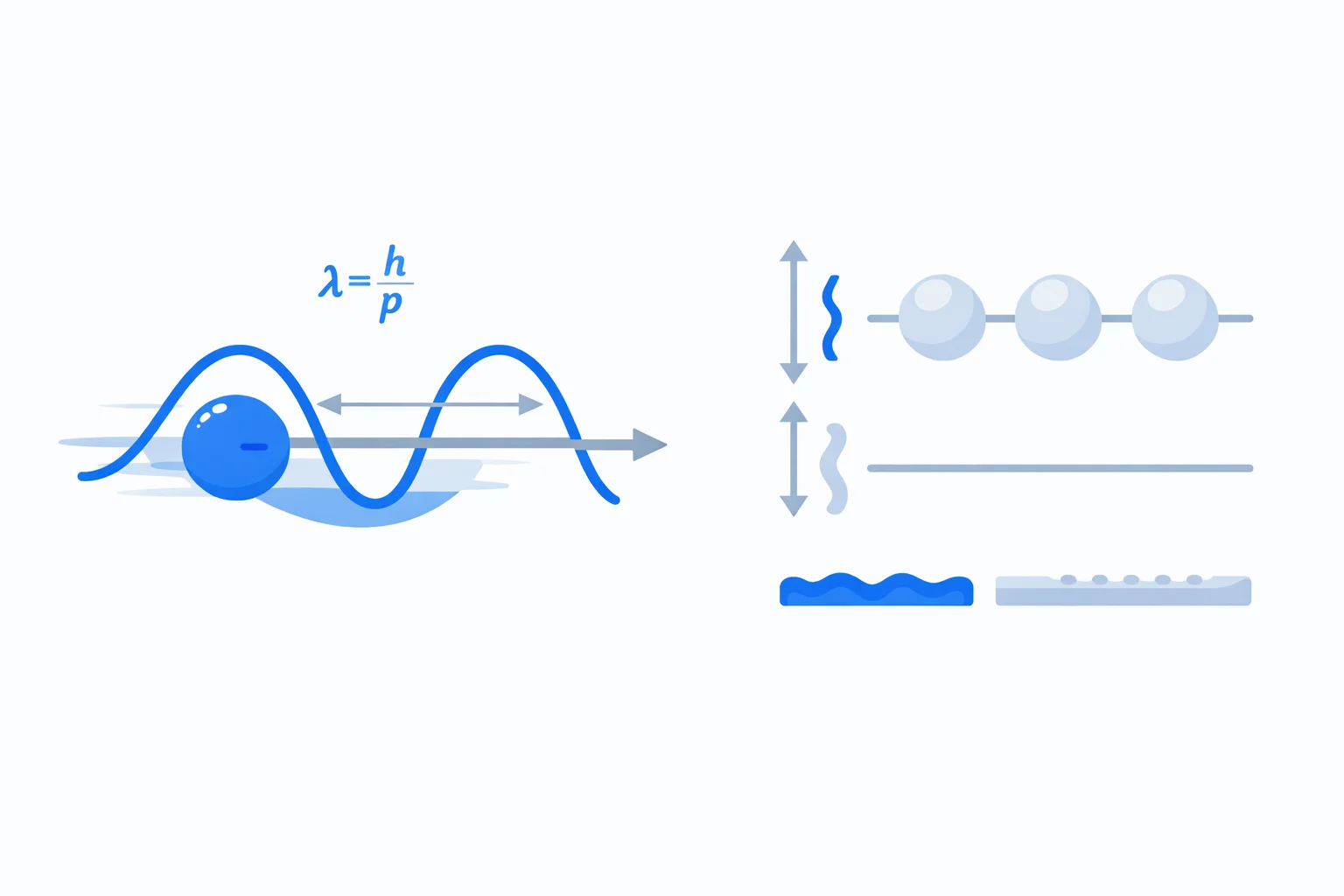
λ = h/p.Three symbols, and they say something genuinely strange: every moving particle — an electron, a proton, a thrown baseball — has a wavelength. Louis de Broglie wrote this in his 1924 PhD thesis. He took the photon's momentum relationship and ran it backward, proposing that matter waves too. The wavelength is Planck's constant divided by momentum, so a heavier or faster particle has a shorterwave. This calculator computes that wavelength for any particle from its velocity, kinetic energy, or the voltage that accelerated it — and tells you whether the wave is big enough to ever matter.
From Light Waves to Matter Waves: Where λ = h/p Comes From
Start with light. A photon carries momentum p = E/c, and since its energy is E = hc/λ, a little algebra gives p = h/λ — the same relationship our photon energy calculator uses from the light side. De Broglie's leap was to insist this isn't special to light. Solve p = h/λ for wavelength and you get λ = h/p, and de Broglie claimed it applies to anything with momentum. For a slow (non-relativistic) particle of mass m moving at speed v, momentum is simply p = mv, so the working formula becomes λ = h/(mv). Planck's constant, h = 6.626 × 10⁻³⁴ J·s, is the conversion factor between the everyday world of momentum and the quantum world of wavelength.
That tiny constant is the whole story. Because h is so small, you need an equally tiny momentum to get a wavelength large enough to notice. An electron qualifies. A grain of sand does not. The entire boundary between "quantum" and "classical" is set by whether mv is small enough for h/(mv) to reach atomic dimensions.
Solving λ = h/p Step by Step for an Electron
Take an electron accelerated from rest through a 100-volt potential difference — a standard setup in a cathode-ray demonstration. First find its kinetic energy. Crossing 100 V, the electron gains K = qV = (1.602 × 10⁻¹⁹ C)(100 V) = 1.602 × 10⁻¹⁷ J, which is just 100 eV by definition. The energy comes from electrostatic work, the same quantity our electric potential calculator handles.
Now turn energy into momentum. For a non-relativistic particle, K = p²/2m, so p = √(2mK):
p = √(2 × 9.109 × 10⁻³¹ kg × 1.602 × 10⁻¹⁷ J) = √(2.919 × 10⁻⁴⁷) = 5.40 × 10⁻²⁴ kg·m/s
Finally, divide Planck's constant by that momentum:
λ = h/p = (6.626 × 10⁻³⁴) / (5.40 × 10⁻²⁴) = 1.23 × 10⁻¹⁰ m = 0.123 nm
That's the punchline: 0.123 nm is almost exactly the spacing between atoms in a metal crystal. Fire these electrons at a nickel crystal and they diffract like X-rays — which is precisely what Clinton Davisson and Lester Germer saw in 1927 (using 54 V electrons, λ = 0.167 nm), turning de Broglie's thesis from speculation into Nobel Prize physics.
Why You'll Never See a Baseball Diffract
Run the same formula on something you can hold. A 145 g baseball leaving a pitcher's hand at 40 m/s has momentum p = mv = 0.145 × 40 = 5.8 kg·m/s. Its de Broglie wavelength:
λ = h/p = (6.626 × 10⁻³⁴) / 5.8 = 1.1 × 10⁻³⁴ m
To feel how absurd that is: a proton is about 10⁻¹⁵ m across, so the baseball's wavelength is roughly 10¹⁹ times smaller than a proton. There is no slit, grating, or crystal in the universe narrow enough to make it diffract. The matter wave is mathematically real, but its scale is so far below anything physical that the baseball obeys plain Newtonian mechanics. This single contrast — 0.123 nm for the electron, 10⁻³⁴ m for the baseball — is the cleanest answer to "why is the everyday world not quantum?" The mass term in the denominator crushes the wavelength into oblivion.
The Electron Microscope: De Broglie's Most Useful Consequence
De Broglie's equation isn't just exam fodder — it built a multi-billion-dollar industry. Any microscope's finest resolvable detail is limited by the wavelength it uses. Visible light tops out around 500 nm, so an optical microscope can't resolve anything much smaller than half a micron — no matter how perfectly its glass lenses obey the thin lens equation. Swap photons for electrons and the wavelength collapses. A 100 keV electron in a transmission electron microscope has λ ≈ 3.7 pm (using the relativistic formula), about 130,000 times shorter than green light.
That's why electron microscopes resolve individual columns of atoms while light microscopes can't even see a virus clearly. The trade-off: getting a short wavelength means giving the electron lots of momentum, which means high voltage. Crank the accelerating voltage up and λ = h/p drops, sharpening the image. The whole design philosophy of an electron microscope is one equation read in reverse.
The Accelerating-Voltage Shortcut for Electrons
Because electrons are so often accelerated through a known voltage, it's worth memorizing a shortcut. Combine λ = h/√(2mK) with K = eV and plug in the electron's mass and charge, and all the constants collapse into a single number:
λ ≈ 1.226 / √V nanometers (with V in volts)
So 100 V gives 1.226/√100 = 0.1226 nm, matching our worked example. A 150 V tube gives 1.226/√150 = 0.100 nm. This non-relativistic shortcut stays accurate to about 1% up to roughly 10 kV; above that you need the relativistic correction λ = 1.226 / √(V(1 + 0.978 × 10⁻⁶ V)) nm. Keep that 1.226 constant in your back pocket and you can estimate any electron wavelength on an exam without touching Planck's constant.
When the Simple Formula Breaks: Fast Electrons
The clean λ = h/√(2mK) formula quietly assumes p = mv with constant mass — fine for slow particles, wrong for fast ones. The threshold comes faster than students expect. A 100 keV electron is already moving at 55% of light speed, where its kinetic energy is a noticeable fraction of its 0.511 MeV rest energy — our relativistic energy calculator shows how fast the total energy E = γmc² climbs once you pass that threshold. Use the non-relativistic formula there and your wavelength comes out about 5% too large; at 1 MeV the error balloons.
The fix is the full energy–momentum relation, p = √(K² + 2Kmc²)/c, which the calculator applies when you tick the relativistic box. For a proton or neutron the correction kicks in at much higher energies because their rest energy (938 MeV) dwarfs typical lab energies, so a 1 MeV proton is still safely non-relativistic. Rule of thumb: if a particle's kinetic energy exceeds about 1% of its rest energy mc², switch to the relativistic mode.
De Broglie Wavelengths Across the Mass Scale
The reference table in the calculator above spans 30 orders of magnitude, and the pattern in it is the real lesson. A thermal neutron drifting at room temperature (0.025 eV) has λ = 0.18 nm — perfect for neutron diffraction, which is how scientists map where hydrogen atoms sit in a crystal that X-rays can't see. Even a 60-carbon buckyball, a molecule of 720 atomic mass units, was sent through a diffraction grating in 1999 with λ ≈ 2.8 pm, proving objects you could almost imagine seeing still obey λ = h/p. Then the scale runs off a cliff: a walking person clocks in around 10⁻³⁶ m. The wavelength shrinks in lockstep with momentum, exactly as the equation demands — there's no sudden "quantum switch," just a smooth slide into invisibility.
Common Mistakes With the de Broglie Equation
- Confusing energy with momentum.λ = h/p needs momentum, not energy. You can't write λ = h/K. Convert kinetic energy to momentum first with p = √(2mK), then divide.
- Forgetting the square root in the energy form. Doubling the kinetic energy does nothalve the wavelength — because p = √(2mK), you have to quadruple the energy to halve λ. The square root trips up a lot of students.
- Using mv when the particle is relativistic.A 100 keV electron's real momentum is bigger than mv predicts, so its wavelength is shorter than the simple formula gives. Past ~10 keV for electrons, switch to p = √(K² + 2Kmc²)/c.
- Leaving energy in electron volts.Plugging 100 (eV) straight into p = √(2mK) instead of 1.602 × 10⁻¹⁷ J wrecks the answer. Convert eV to joules first, or use the 1.226/√V shortcut that's built for volts.
- Expecting a stationary particle to have a wavelength.If v = 0 then p = 0 and λ = h/0 is infinite — the formula is telling you a truly motionless particle has no defined matter wave.
Where This Calculator Fits in Your Problem Set
Reach for this whenever a problem connects a particle's motion to a wavelength — AP Physics 2 modern-physics questions, electron-diffraction labs, neutron-scattering homework, or any "find the wavelength of an electron at X eV" prompt. Start in whichever mode matches your given information: velocity, kinetic energy, or accelerating voltage. If your problem instead hands you a speed and asks for the energy behind it, our kinetic energy calculator gets you the K that feeds straight into λ = h/√(2mK). For the photon half of wave–particle duality — light's energy and momentum — the photon energy calculator is the companion tool. For the exact CODATA value of Planck's constant used throughout, see NIST's reference data.