Photon Energy Explained: How E = hf Turns Color Into Energy
Stand next to a 50,000-watt FM radio tower all day and nothing happens to your skin. Spend twenty minutes in midday sun and you burn. The sunlight carries far less total power, so why does it win? The answer is the single idea this photon energy calculator is built around: light comes in packets called photons, and the energy of each packet depends on its frequency, not on how many packets arrive. A radio photon is feeble. An ultraviolet photon is a tiny wrecking ball. Stacking up trillions of weak photons never turns them into strong ones.
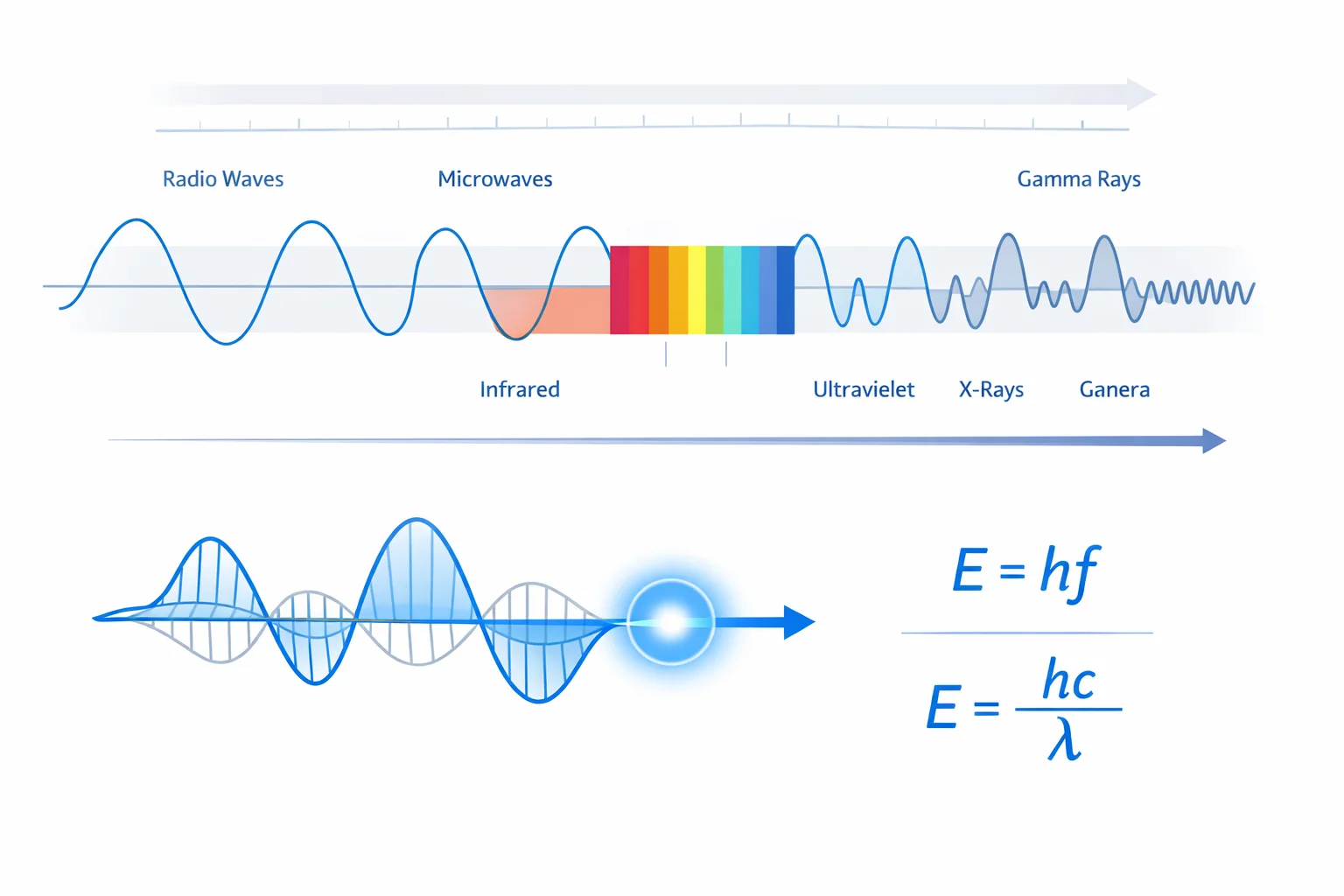
Why a Sunburn Comes From Frequency, Not Brightness
Breaking a chemical bond in your skin takes a photon carrying roughly 3.9 electron volts or more — that's ultraviolet territory. A visible red photon at 650 nm carries only 1.9 eV. An FM radio photon at 100 MHz carries about 0.0000004 eV. You could absorb a quadrillion radio photons and not a single one would have enough individual energy to damage a molecule, because energy from separate photons doesn't pool together to ionize an atom. This "one photon, one interaction" rule is the whole reason your microwave oven heats food without giving you radiation burns, while a sunlamp tans you with far less power.
Two Formulas, One Photon: E = hf and E = hc/λ
Photon energy starts with Planck's relation, E = hf, where E is the energy in joules, his Planck's constant (6.62607015 × 10⁻³⁴ J·s, an exact value since the 2019 SI redefinition), and fis the frequency in hertz. Because every electromagnetic wave travels at the speed of light, frequency and wavelength are locked together by c = fλ. Substitute that in and you get the second form, E = hc/λ, which is handier when you know the wavelength instead of the frequency.
These two equations are the same physics wearing different clothes. Use E = hf when a source is specified by frequency (a 2.45 GHz microwave, a 100 MHz FM station). Use E = hc/λ when you know the color or wavelength (a 532 nm green laser, a 0.03 nm medical X-ray). The calculator above accepts whichever you have and fills in the rest, including the photon's momentum p = E/c — yes, massless photons still carry momentum, which is how solar sails and radiation pressure work. Run that logic in reverse and a massive particle with momentum picks up a wavelength too, which our de Broglie wavelength calculator computes.
Worked Example: The Energy of One Green Photon
Take a 532 nm green laser pointer, the bright kind used in lecture halls. What energy does one of its photons carry? Start with E = hc/λ and convert the wavelength to meters: 532 nm = 532 × 10⁻⁹ m.
E = (6.626 × 10⁻³⁴ J·s)(2.998 × 10⁸ m/s) / (5.32 × 10⁻⁷ m)
E = (1.986 × 10⁻²⁵ J·m) / (5.32 × 10⁻⁷ m) = 3.73 × 10⁻¹⁹ J
That number is true but unfriendly. Divide by 1.602 × 10⁻¹⁹ J/eV and it becomes a clean 2.33 eV. Even faster: skip Planck's constant entirely and use the shortcut E (eV) = 1239.84 / λ (nm). So 1239.84 ÷ 532 = 2.33 eV in one step. Memorize that 1240 eV·nm constant and you can convert any visible wavelength to photon energy in your head on an exam.
Why Photon Energy Lives in Electron Volts
Joules are built for everyday energy — lifting boxes, braking cars. For light, they're hopelessly oversized: one green photon is 0.00000000000000000037 J. The electron volt fixes this. One eV is the energy an electron gains crossing a one-volt potential difference, which is exactly where it connects to our electric potential calculator. That definition makes 1 eV = 1.602 × 10⁻¹⁹ J, and suddenly the optical world fits on a readable scale: visible photons run 1.65–3.1 eV, X-rays sit in the keV range, and gamma rays reach MeV — the very photons an unstable nucleus flings out during radioactive decay. The whole reason chemists quote bond energies in eV (or kJ/mol) is that those numbers line up with the photons capable of breaking them.
Photon Energies of Everyday Light Sources
Plug a few familiar sources into E = hc/λ and the spread is staggering — nearly twelve orders of magnitude from radio to gamma. These aren't rounded guesses; they're what the formula returns for each real wavelength:
| Source | Wavelength | Photon Energy |
|---|---|---|
| FM radio (100 MHz) | 3 m | 0.41 µeV |
| Microwave oven (2.45 GHz) | 12.2 cm | 10.1 µeV |
| Infrared TV remote | 950 nm | 1.31 eV |
| Red laser pointer | 650 nm | 1.91 eV |
| Green laser pointer | 532 nm | 2.33 eV |
| Blue LED | 450 nm | 2.76 eV |
| UV-B (sunburn band) | 300 nm | 4.13 eV |
| Medical X-ray | 0.03 nm | 41 keV |
| Cobalt-60 gamma ray | 1.06 pm | 1.17 MeV |
Notice how the UV-B photon at 4.13 eV clears the ~3.9 eV bond-breaking threshold while the red pointer at 1.91 eV doesn't come close. That single comparison explains why ultraviolet causes sunburn and skin damage but red and infrared light don't, no matter how intense.
The Photoelectric Effect: Photon Energy You Can Measure
Photon energy isn't just bookkeeping — you can watch it eject electrons. Shine light on a metal and electrons fly off, but only if each photon's energy beats the metal's work function φ (the binding energy holding electrons in). Below that threshold, cranking up the brightness does nothing; above it, even dim light works instantly. The energy that's left over after escaping becomes the electron's kinetic energy: KE = hf − φ.
Say you hit sodium (φ ≈ 2.28 eV) with that 2.33 eV green photon. The ejected electron leaves with just 2.33 − 2.28 = 0.05 eV of kinetic energy — barely escaping. Switch to a 4.13 eV UV photon and the electron rockets out with 1.85 eV. You can verify that ejected-electron energy with our kinetic energy calculator. Einstein explained this in 1905, and it's the experiment that forced physics to accept light as particles. NASA's overview of the electromagnetic spectrum shows where each photon-energy band sits.
How Many Photons Does a Laser Pointer Fire?
Here's where photon energy collides with intuition. A 5 mW green laser sounds weak, and each photon truly is — 3.73 × 10⁻¹⁹ J. But power is energy per second, so divide: 0.005 W ÷ 3.73 × 10⁻¹⁹ J = about 1.3 × 10¹⁶ photons every second. That's thirteen quadrillion green photons leaving the pointer each second, which is why the beam looks perfectly smooth even though it's a hail of discrete particles. Type a beam power into the calculator and it runs this division for you — useful for estimating detector count rates or how many photons a single camera pixel collects.
Mistakes That Wreck Photon Energy Calculations
- Leaving wavelength in nanometers.Plugging 532 into E = hc/λ instead of 532 × 10⁻⁹ m makes your answer 10⁹ times too small. Either convert to meters or use the 1239.84 eV·nm shortcut that expects nanometers.
- Mixing the two formulas.E = hf needs frequency; E = hc/λ needs wavelength. Don't drop a wavelength into E = hf — the units (J·s × m) won't even give you energy.
- Confusing photon energy with beam energy.One photon's energy is tiny; the beam's total energy is that figure times the photon count. A problem asking for "the energy of the light" usually wants per-photon energy, but read carefully.
- Using the wrong h.Planck's constant is 6.626 × 10⁻³⁴ J·s or 4.136 × 10⁻¹⁵ eV·s. Pick the version that matches the energy unit you want, and never blend the two in one calculation.
- Assuming brighter means higher energy per photon. Intensity changes photon count, never individual photon energy. Only frequency (color) changes that.
When to Reach for This Photon Energy Calculator
Use it whenever you need to move between a light's color, frequency, and energy — AP Physics 2 and AP Physics C problems, chemistry photochemistry questions, spectroscopy lab work, or just settling whether a given laser can break a particular bond. The electron-volt output is built for atomic-scale comparisons, and the spectrum classifier tells you instantly whether you're in visible, UV, or X-ray territory. If your problem then asks what an ejected electron does, hand the leftover energy to the kinetic energy calculator. And if you're working through how photons ionize atoms by overcoming the electrostatic pull on electrons, our Coulomb's Law calculator handles that binding force. And once that light reaches a camera or your eye, a lens focuses it into an image — our lens equation calculator finds exactly where. For the exact CODATA value of Planck's constant, see NIST's reference data.