Radioactive Decay: How a Half-Life Tells You What's Left — and How Old It Is
A lump of charcoal from an old campfire comes back from the lab holding 22% of the carbon-14 you'd find in a living tree. How old is it? That single question — turn a leftover fraction into an age, or an age into a leftover fraction — is what a radioactive decay calculator is built to answer. Carbon-14 halves every 5,730 years, so 22% remaining works out to about 2.18 half-lives, which puts the fire at roughly 12,500 years ago. Below, we'll solve that live, then turn it into the formula that handles every isotope from a six-hour medical tracer to uranium that outlasts the Earth.
Start With a Real Sample: Dating a Piece of Charcoal
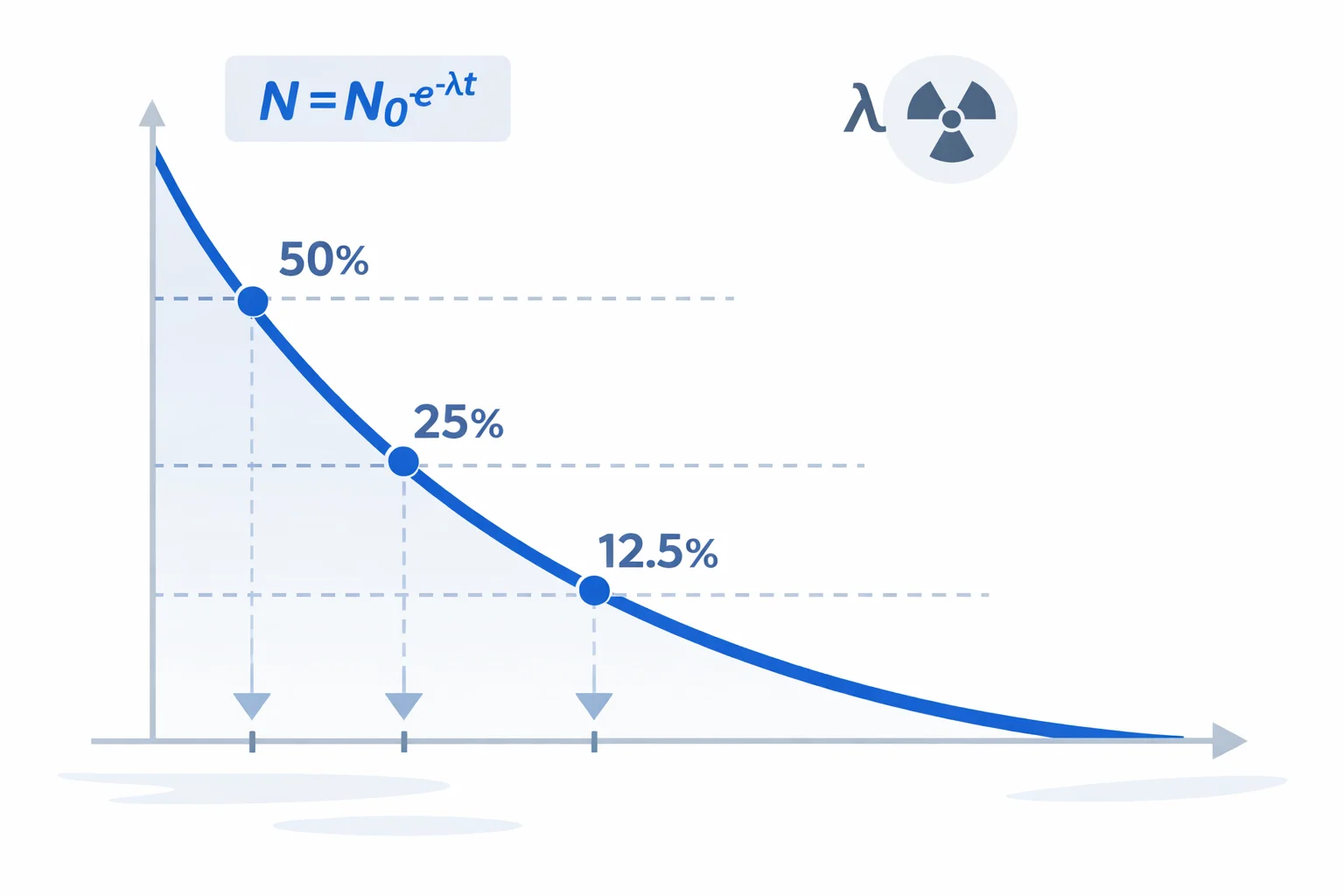
Here's everything the problem hands you and what it hides. Known: the half-life of carbon-14 (5,730 years) and the fraction still present (N/N₀ = 0.22). Unknown:the elapsed time t. The trick is to count half-lives. After one half-life you're at 50%, after two you're at 25%, after three at 12.5%. Our 22% sits just past two half-lives, and you find exactly where with a base-2 logarithm:
n = log₂(N₀/N) = log₂(1 / 0.22) = log₂(4.545) = 2.184 half-lives
Multiply by the half-life and the age falls out: t = 2.184 × 5,730 ≈ 12,510 years. Notice the age isn't a tidy multiple of the half-life — real samples almost never land on a clean 25% or 12.5%, which is exactly why you need the log instead of just counting on your fingers. Flip the calculator above to "Find age / time," type 22, and you'll get the same number without touching a log table.
From Counting Half-Lives to N = N₀e^(−λt)
Counting half-lives is really the equation N = N₀ × (½)^(t/T½) in disguise. Physicists usually write the same thing with base e instead: N = N₀e^(−λt), where λ (the decay constant) is the probability per second that any single nucleus lets go. The two forms are identical because λ and the half-life are locked together by λ = ln(2) / T½ ≈ 0.693 / T½. That 0.693 is the whole bridge between them — drop it and every activity number you calculate comes out about 44% too high.
Run it forward with a medical example. A thyroid patient swallows a 555 MBq dose of iodine-131, which has a half-life of 8.02 days. After 24 days — almost exactly three half-lives — how hot is it still? Three half-lives means (½)³ = 1/8 remains, so the activity has dropped to 555 × 0.125 ≈ 69 MBq. The forward mode does this in one step: enter the starting amount, the elapsed time, and read the survivor off the top. The energy each of those decays releases, incidentally, comes from a tiny mass difference in the nucleus — the same mass-to-energy conversion behind our relativistic energy calculator.
Half-Life, Decay Constant, and Mean Lifetime Aren't the Same Number
Students mix these three up constantly, and the differences are worth pinning down because each answers a different question. The half-life is when half the sample is gone. The decay constant λ is a per-second probability. The mean lifetime τ is the average time an individual nucleus survives — and it's longer than the half-life, not shorter, because the atoms that hang on for ages drag the average up.
| Quantity | Symbol | Relation to T½ | What it tells you |
|---|---|---|---|
| Half-life | T½ | — | Time for the sample to drop to 50% |
| Decay constant | λ | 0.693 / T½ | Chance per second each nucleus decays |
| Mean lifetime | τ | 1.443 × T½ | Average survival time of one nucleus (falls to 1/e ≈ 37%) |
| Half-lives elapsed | n | t / T½ | How many doublings-down have happened |
For iodine-131 those come out as T½ = 8.02 days, λ ≈ 1.0 × 10⁻⁶ per second, and τ ≈ 11.6 days. The calculator prints all three so you never have to remember which one the problem secretly wants — a question that asks "after how long does activity fall to 37%?" is quietly asking for τ, not the half-life.
Half-Lives of Isotopes You'll Actually Meet
Half-lives span an absurd range — from fractions of a second to billions of years — and the number alone tells you how an isotope behaves. Short half-life means intense but fleeting; long half-life means faint but permanent. These are the ones that show up in hospitals, physics exams, and news headlines:
| Isotope | Half-life | Decay mode | Where you meet it |
|---|---|---|---|
| Technetium-99m | 6.01 hours | Gamma (isomeric) | SPECT medical imaging |
| Radon-222 | 3.82 days | Alpha | Basement air hazard |
| Iodine-131 | 8.02 days | Beta⁻, gamma | Thyroid therapy |
| Cobalt-60 | 5.27 years | Beta⁻, gamma | Cancer radiotherapy, sterilization |
| Cesium-137 | 30.17 years | Beta⁻, gamma | Reactor fallout, density gauges |
| Carbon-14 | 5,730 years | Beta⁻ | Radiocarbon dating |
| Uranium-238 | 4.47 billion years | Alpha | Uranium–lead rock dating |
The gamma rays listed for several of these are photons in their own right — when cobalt-60 decays it emits two gamma photons at 1.17 and 1.33 MeV, energies you can check with the photon energy calculator. Load any of these presets and the decay curve reshapes instantly, but its shape never changes: it's always the same halving, just stretched across a different time axis.
Why a Speck of Technetium Outshines a Chunk of Uranium
Activity — decays per second, measured in becquerels — is where half-life gets counterintuitive. Activity is A = λN, so it depends on both how many atoms you have and how twitchy each one is. Take one microgram of each: technetium-99m (6-hour half-life) fires off roughly 2 × 10¹¹ decays every second, about 200 GBq. The same microgram of uranium-238 manages about 0.012 decays per second. Same mass, yet the technetium is around sixteen trillion times more active, purely because its λ is enormous.
That's the resolution to a classic confusion: a long half-life does not mean "more radioactive." It means the opposite for a fixed amount of material. It also explains why hospitals love short-lived tracers — technetium-99m gives a bright scan then vanishes within a day, so the patient's dose ends almost as fast as it began. The activity readout in the calculator lets you watch A shrink in lockstep with the remaining atoms; the becquerels always fall by the same fraction as the mass.
Where the Simple Half-Life Model Breaks Down
The clean N₀e^(−λt) curve rests on assumptions, and it's worth knowing where they crack:
- It's a statistical law, not a promise.Decay is random per nucleus. The formula only works because a gram of material holds ~10²² atoms; for a handful of atoms the curve is a probability, and you genuinely can't say when any single one will go.
- It assumes a closed sample.Radiocarbon dating fails if the object swapped carbon with its surroundings — a contaminated bone or a shellfish that ate "old" ocean carbon will date wrong by thousands of years.
- It tracks only one isotope.When the daughter is itself radioactive (uranium-238 decays through a long chain to lead), a single λ doesn't capture the whole picture — you need the full decay chain and secular equilibrium.
- Carbon-14 has a ceiling.Past about 10 half-lives (~57,000 years) so little C-14 is left that background noise swamps the signal, which is why radiocarbon can't date dinosaur bones — you switch to longer-lived isotopes like uranium-238 for that.
Common Mistakes in Decay Problems
- Mixing time units.If the half-life is in days but the elapsed time is in hours, convert first. A radon problem with T½ = 3.82 days and t = 48 "hours" entered as 48 days is off by a factor of 24 — the calculator's unit dropdowns exist to stop exactly this.
- Using λ = 1/T½ instead of λ = ln(2)/T½. Forgetting the 0.693 is the single most common error, and it inflates every activity by about 44%.
- Thinking two half-lives means nothing's left.½ + ½ does not equal the whole sample. Two half-lives leaves ¼, not 0 — each step halves what remains, it doesn't subtract a fixed chunk.
- Confusing fraction remaining with fraction decayed.After one half-life, 50% remains and 50% has decayed — but after two, it's 25% remaining versus 75% decayed. Read the question carefully; the calculator shows both numbers side by side.
Practice Problems (With Answers)
Work these by hand, then check them in the calculator above.
- 1.A cobalt-60 source (T½ = 5.27 years) is used in a clinic. What fraction is left after 21.08 years? — That's 21.08 / 5.27 = 4 half-lives, so (½)⁴ = 6.25%.
- 2.A sample falls to 12.5% of its original activity in exactly 30 years. What's its half-life? — 12.5% is (½)³, so 3 half-lives = 30 years and T½ = 10 years.
- 3.A sealed basement reads 800 Bq of radon-222 (T½ = 3.82 days). With no new radon seeping in, what's the activity after 11.46 days? — That's 3 half-lives, so 800 × (½)³ = 100 Bq.
Where This Calculator Fits With Your Other Tools
Reach for radioactive decay whenever a problem quotes a half-life, a fraction remaining, or an activity — common ground for AP Physics 2, AP Chemistry, and any intro modern-physics course. Use forward mode for "how much is left" and dosing questions; use age mode for radiocarbon and rock dating. The particles a nucleus throws off carry the story further: a fast alpha or beta particle has a matter wavelength you can find with the de Broglie wavelength calculator. For the half-lives, decay modes, and molar masses behind the presets here, the National Nuclear Data Center is the standard reference, and the IAEA documents how these isotopes are used in the field.