Hooke's Law F = kx: Spring Force, Spring Energy, and Where They Differ
Stretch a spring twice as far and it pulls back twice as hard — never three times, never the same. That strict proportionality is what a spring force calculator captures with Hooke's Law, F = kx, and it's also where the most common confusion begins. People mix up the spring's force, which grows in a straight line with stretch, and the energy it stores, which grows with the square of the stretch. Those are two different numbers, and treating them as one is how a homework answer ends up off by a whole factor of the displacement. This page sorts out the force from the energy, shows where the famous minus sign comes from, and walks through what k really tells you.
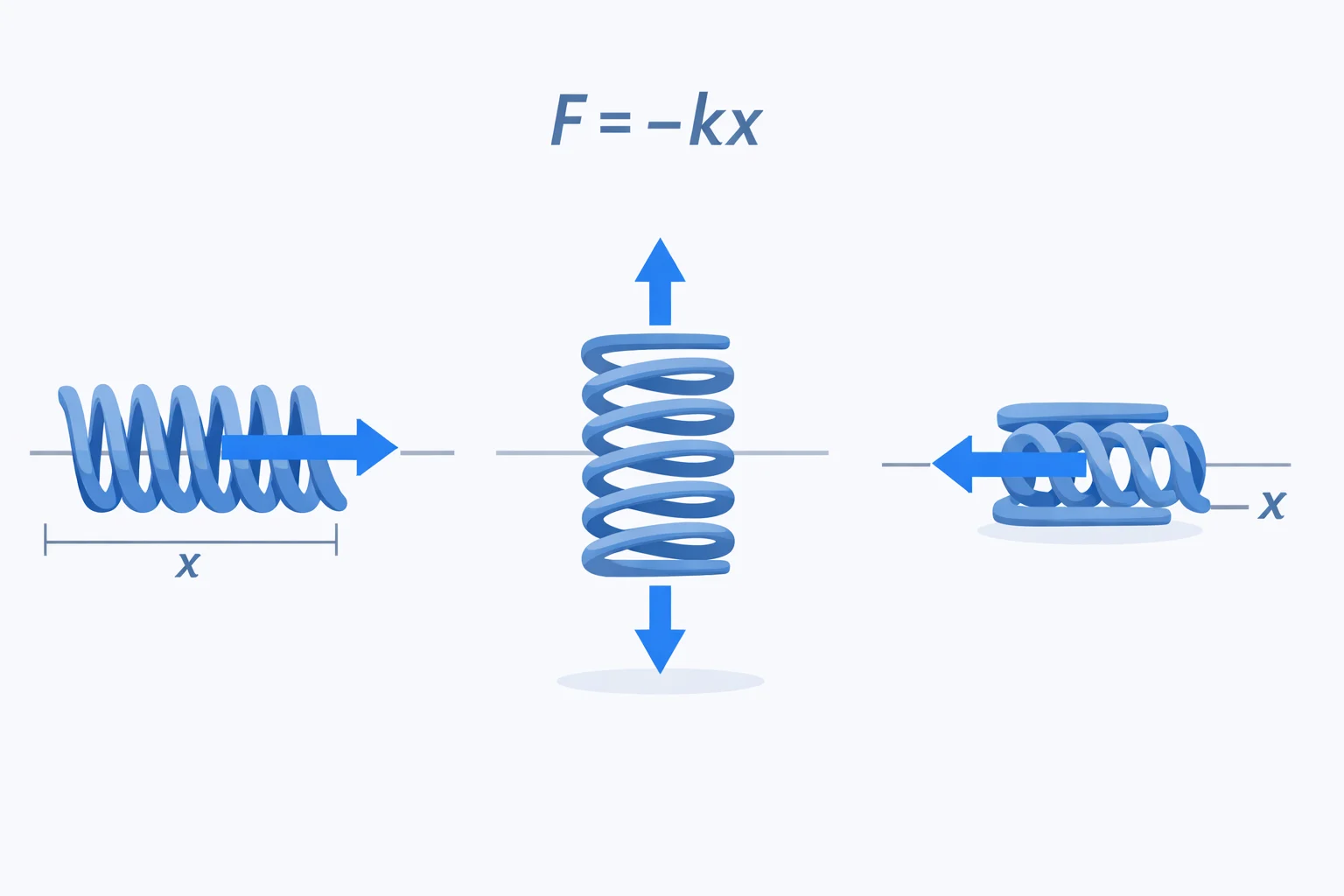
The Minus Sign in F = −kx Is the Whole Point
Write Hooke's Law honestly and it reads F = −kx, not F = kx. That minus sign isn't decoration — it's the entire personality of a spring. It says the force always points opposite to the displacement, back toward the spring's natural rest length. Pull a spring to the right and it tugs left. Compress it left and it pushes right. The spring is a relentless restorer, forever trying to undo whatever you did to it.
So why does the calculator show a positive 20 N and not −20 N? Because for the size of the force, the sign just encodes direction. A 250 N/m spring stretched 8 cm (0.08 m) gives F = 250 × 0.08 = 20 N of restoring force. The magnitude is 20 N; the “−” tells you it's aimed inward. In a one-dimensional problem you only need the minus sign when you're tracking which way the force points — for instance, when this restoring force becomes the net force that accelerates a mass back and forth. That's the seed of oscillation, and once it's the only force acting, you can hand it straight to the force calculator to turn it into an acceleration with F = ma.
What the Spring Constant k Actually Measures
The spring constant k is the stiffness of the spring, measured in newtons per metre (N/m). Read the units out loud and the meaning falls out: it's the number of newtons of force you get for every metre of stretch. A k of 300 N/m means every metre of stretch costs 300 N — or, more usefully, every centimetre costs 3 N. Bigger k means a stiffer spring that fights back harder for the same displacement.
Here's a fact that surprises people: k is a property of the whole spring, not the material alone. Take a spring and cut it in half, and its spring constant roughly doubles. Each coil stretches a little under load, and with half as many coils sharing the same displacement, each one has to work twice as hard. That's why a short, stubby spring feels so much stiffer than a long, loose one of identical wire. To find k from a measurement, flip the formula to k = F / x — hang a known weight, measure the stretch, divide. A 5 N weight that stretches a spring 2 cm gives k = 5 / 0.02 = 250 N/m.
Worked Example: Sizing a Spring for a Screen Door
You want a screen-door closer spring that pulls the door shut with at least 30 N of force when the door is open 0.6 m (the spring stretches that far). What spring constant do you need, and how much energy does the door store in the spring when it's wide open?
Start with the stiffness. You need F = 30 N at x = 0.6 m, so k = F / x = 30 / 0.6 = 50 N/m. Pick a spring rated at 50 N/m or a touch higher and the door will pull itself shut with the force you wanted. Now the stored energy: PE = ½kx² = 0.5 × 50 × 0.6² = 0.5 × 50 × 0.36 = 9 J. That 9 joules is what gets released as the door swings closed — it becomes the door's kinetic energy plus whatever the damper bleeds off, which you can trace with the conservation of energy calculator.
Notice the asymmetry hiding in those two numbers. To double the closing force to 60 N you'd double k to 100 N/m. But the stored energy at full stretch would then be 0.5 × 100 × 0.36 = 18 J — the force doubled and the energy doubled too, because k doubled while x stayed fixed. Change x instead of k and the story flips, which is the next section.
Force Grows Linearly, Energy Grows Squared
This is the distinction that trips up most students, so it's worth slowing down. For a fixed spring, the forceis F = kx — double the stretch, double the force. The energystored is PE = ½kx² — double the stretch, and the energy goes up by a factor of four. They come apart because one is linear in x and the other is quadratic. The energy is literally the triangular area under the F-versus-x line, which is why the ½ shows up and why it grows faster than the force.
An archer feels this directly. Drawing a bow from 30 cm to 60 cm of pull doubles the force on the fingers, but quadruples the energy stored in the limbs — which is why the last few centimetres of draw matter so much for arrow speed. The same ½kx² is the elastic potential energy a spring stores, and it's also why the work you do to stretch a spring isn't simply force times distance. The force keeps growing as you pull, so the work done is the average force times distance — exactly the ½kx² area, not the full kx times x.
| Stretch x | Force F = kx | Energy ½kx² |
|---|---|---|
| 5 cm | 10 N | 0.25 J |
| 10 cm | 20 N | 1.0 J |
| 20 cm | 40 N | 4.0 J |
| 40 cm | 80 N | 16.0 J |
The table uses k = 200 N/m. Watch the columns: every time the stretch doubles, the force column doubles but the energy column quadruples. By 40 cm the force has grown 8× from the 5 cm row, while the energy has grown 64×. That gap is the whole reason a slightly over-stretched spring can store a startling amount of energy.
Why Springs Flip the Resistor Rules
Combine springs and the arithmetic feels backward if you learned circuits first. Springs in parallel(side by side, sharing the load) add their constants: k = k₁ + k₂. Two 100 N/m springs side by side behave like one 200 N/m spring — stiffer, because two springs split the displacement and each contributes its full force. Springs in series(end to end) add like reciprocals: 1/k = 1/k₁ + 1/k₂. Two 100 N/m springs in a chain give 50 N/m — softer, because the same force stretches both, so the total stretch doubles.
Resistors do the exact opposite: they add in series and combine reciprocally in parallel. The reason is which quantity gets shared. Series springs share the same force and add up their stretches; parallel springs share the same stretch and add up their forces. Once you know the combined k, drop it back into F = kx and the rest of the problem is ordinary.
| Arrangement | Springs Combine As | Two 100 N/m Springs | Resistors (for contrast) |
|---|---|---|---|
| Parallel (side by side) | k = k₁ + k₂ (stiffer) | 200 N/m | Add reciprocally (softer) |
| Series (end to end) | 1/k = 1/k₁ + 1/k₂ (softer) | 50 N/m | Add directly (larger) |
| Quantity shared | Parallel shares stretch; series shares force | — | Opposite of springs |
Typical Spring Constants, Slinky to Suspension
Spring constants span an enormous range, and seeing real values builds intuition for what a given k means. These are representative figures — real springs vary with wire diameter, coil count, and material — but they show the orders of magnitude you'll meet. A Slinky is so soft it stretches under its own weight; a car suspension spring barely budges under a person.
| Spring | Typical k (N/m) | Force at 5 cm Stretch |
|---|---|---|
| Slinky toy | ~1 | 0.05 N |
| Ballpoint pen click spring | ~125 | 6.3 N |
| Kitchen spring scale | ~350 | 17.5 N |
| Trampoline spring | ~2,000 | 100 N |
| Diving board (effective) | ~10,000 | 500 N |
| Car suspension coil | ~30,000 | 1,500 N |
When Hooke's Law Quietly Stops Working
F = kx is a model, and like every model it has a fence around it. Hooke's Law only holds inside the elastic limit— the range where the spring snaps back to its original length. Push past it and you reach the yield point, where the metal deforms permanently. The force stops climbing in a straight line and the line bends over; stretch further and the spring stays stretched even after you let go. This is exactly why a force-extension experiment plots a straight line only up to a point — within that linear region the slope of the force-extension graph gives you k, but past the elastic limit the slope loses its meaning. You've seen this with a cheap pen spring that never quite springs back after being yanked too hard.
There are quieter failures too. Rubber bandsonly loosely obey Hooke's Law — their force-versus-stretch curve is S-shaped, not a straight line, so a single k doesn't describe them well. And no real spring is perfectly elastic: a small amount of internal friction means a slowly cycled spring loses a little energy to heat each cycle. For the everyday range of a metal spring, though, F = kx is accurate to a few percent, which is why it's the workhorse of every intro physics course.
Common Hooke's Law Mistakes
- Leaving x in centimetres.The spring constant is in N/m, so x must be in metres. A 12 cm stretch is 0.12 m, not 12. Plug in 12 and your force comes out 100× too large.
- Confusing force with energy.F = kx and PE = ½kx² are not interchangeable. If a question asks for the force, don't hand back the energy — they differ by a factor of x/2.
- Measuring x from the wrong point.The displacement is measured from the spring's natural, unloaded length, not from the floor or from a stretched starting position. A spring already hanging with a weight on it has a new equilibrium, and x is measured from there for any extra stretch.
- Assuming k is fixed by the material.Cutting, stacking, or combining springs changes k. The same steel wire can give you 50 N/m or 5,000 N/m depending on how it's coiled and connected.