Ohm’s Law Calculator: Solving V = IR for Voltage, Current, and Resistance
An Ohm's Law calculatoris the fastest way to solve V = IR for voltage, current, or resistance in any DC circuit. Whether you're sizing a resistor for an LED, checking the current draw of an appliance, or studying for your AP Physics exam, Ohm's Law is the single most important equation in electronics. This calculator solves all three rearrangements instantly, displays power dissipation using three equivalent formulas, and includes preset circuit examples so you can explore real-world scenarios without doing any math by hand.
What Is Ohm's Law?
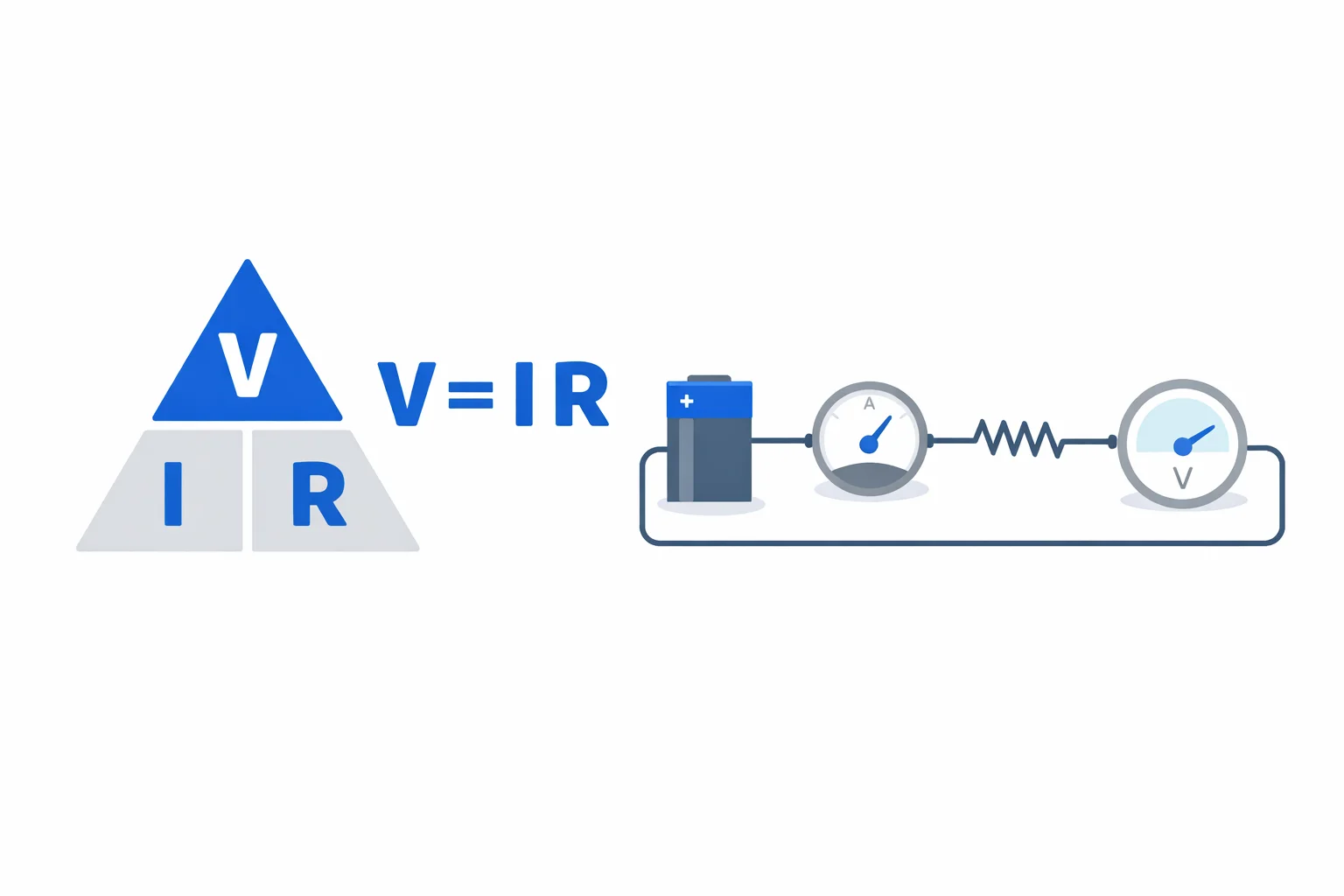
Ohm's Law is a fundamental principle of electrical physics discovered by German physicist Georg Simon Ohm in 1827. It describes the linear relationship between voltage (V), current (I), and resistance (R) in an electrical conductor: V = I × R.
In plain language, voltage is the "electrical pressure" that pushes charged particles through a conductor. Resistance is how much the conductor opposes that flow. Current is the resulting rate of charge movement — how many coulombs of charge pass a point each second. The three are locked together: increase voltage while keeping resistance constant and current rises proportionally. Increase resistance while keeping voltage constant and current drops.
This law applies to ohmic materials— conductors where resistance stays constant regardless of voltage. Metals and standard carbon or metal-film resistors are ohmic under normal conditions. Non-ohmic components like diodes, LEDs, and thermistors have resistance that varies with temperature or applied voltage, so simple V = IR does not apply directly to them.
The Three Ohm's Law Formulas
The single equation V = IR can be rearranged into three forms depending on which variable you need to find:
- V = I × R— find voltage when you know current and resistance. A 2 A current through a 6 Ω resistor produces 12 V across it.
- I = V / R— find current when you know voltage and resistance. A 9 V battery across 150 Ω drives 0.06 A (60 mA).
- R = V / I— find resistance when you know voltage and current. If 5 V produces 0.023 A, the resistance is approximately 217 Ω.
The Ohm's Law triangle is a popular memory aid: draw a triangle with V at the top, I at the bottom-left, and R at the bottom-right. Cover the variable you want to find, and the remaining two show the formula. The calculator above includes an interactive triangle that highlights which variable you're solving for.
Key Variables: V, I, and R Explained
Understanding the physical meaning and typical ranges of each variable helps you use the calculator effectively and spot errors:
- Voltage (V)— measured in volts. A single AA cell produces 1.5 V, a car battery 12 V, a US wall outlet 120 V AC, and European mains 230 V AC. High-voltage transmission lines carry 110,000–765,000 V.
- Current (I)— measured in amperes (A). A typical LED draws 20 mA (0.02 A), a phone charger 1–3 A, a microwave 10 A, and an electric vehicle charger up to 200 A. As little as 100 mA through the heart can be fatal.
- Resistance (R)— measured in ohms (Ω). A short length of copper wire has about 0.01 Ω, a standard resistor ranges from 1 Ω to 10 MΩ, and dry human skin is roughly 100,000 Ω. Insulators like rubber can exceed 1014 Ω.
For deeper analysis of current specifically — including wire gauge tables and safety thresholds — see our current calculator.
Worked Example: LED Current Limiting
You want to power a standard red LED (forward voltage 2.0 V, desired current 20 mA) from a 5 V USB supply. What resistor value do you need?
Step 1: Find the voltage across the resistor. The resistor drops the difference between the supply and the LED: VR = 5 − 2 = 3 V.
Step 2:Apply Ohm's Law to find resistance. R = V / I = 3 / 0.020 = 150 Ω.
Step 3:Choose the nearest standard value. The E24 series includes 150 Ω exactly, so that's your resistor. If you used a 220 Ω resistor instead, the LED current would drop to 3 / 220 = 13.6 mA — still bright enough for an indicator.
Step 4:Calculate power dissipated by the resistor. P = I² × R = 0.020² × 150 = 0.06 W. A standard 1/4 W (0.25 W) resistor handles this with plenty of margin.
You can verify this in the calculator by selecting "Solve for Resistance," entering V = 3 and I = 0.02.
Ohm's Law and Power: The Complete Wheel
Ohm's Law (V = IR) and the power equation (P = VI) combine into a set of 12 formulas known as the Ohm's Law wheel. Given any two of the four quantities — V, I, R, P — you can find the other two:
- P = V × I— the direct power formula. A 120 V outlet delivering 10 A supplies 1,200 W.
- P = I² × R— shows that power loss scales with the square of current. Doubling the current quadruples resistive heating, which is why transmission lines use high voltage to minimize current.
- P = V² / R— useful for calculating heater or bulb wattage from the mains voltage and the device's resistance.
The calculator above shows all three power formulas simultaneously so you can cross-check your work. For dedicated power analysis, try our energy, work, and power calculators.
Common Mistakes With Ohm's Law
These are the errors that physics students and hobbyists make most frequently — each one can produce results off by orders of magnitude:
- Forgetting to convert units:Entering 4.7 kΩ as 4.7 instead of 4,700 in the formula gives an answer 1,000 times too large. Always convert kΩ to Ω and mA to A before calculating.
- Applying V = IR across a non-ohmic device:An LED does not have a fixed resistance. You cannot divide 5 V by the LED's "resistance" to find current. Instead, subtract the LED's forward voltage from the supply voltage and use Ohm's Law across the series resistor only.
- Using total voltage for a single component:In a series circuit with multiple resistors, V = IR applies to each resistor individually, not the whole circuit. Each resistor drops only a fraction of the total voltage, proportional to its share of the total resistance.
- Ignoring internal resistance:A 9 V battery with 1 Ω internal resistance connected to a 9 Ω load delivers only 8.1 V to the load, not 9 V. The missing 0.9 V is dropped across the battery's own internal resistance.
- Mixing up series and parallel rules: In series, resistances add (Rtotal = R1 + R2). In parallel, the reciprocals add (1/Rtotal = 1/R1 + 1/R2). Mixing these up can double or halve your expected current.
Ohm's Law in Series and Parallel Circuits
Ohm's Law applies to individual components and to entire circuits. How you use it depends on whether components are wired in series or parallel:
- Series circuit:Current is the same everywhere. Voltages divide proportionally to resistance. Three resistors of 100 Ω, 220 Ω, and 330 Ω in series total 650 Ω. On a 12 V supply, the current is 12 / 650 = 18.5 mA. The 330 Ω resistor drops 330 × 0.0185 = 6.1 V.
- Parallel circuit:Voltage is the same across every branch. Current divides inversely with resistance. Two parallel resistors of 100 Ω and 200 Ω on 10 V carry 100 mA and 50 mA respectively, for a total of 150 mA. The equivalent resistance is 66.7 Ω.
For complex resistor networks, our resistance calculator handles series, parallel, and mixed combinations step by step.
Real-World Applications of Ohm's Law
Ohm's Law is not just a classroom formula — it underpins every electrical system from household wiring to spacecraft power buses:
- Sizing fuses and breakers:A 20 A breaker on a 120 V circuit protects up to 2,400 W of load. Plugging in a 1,500 W microwave (12.5 A) plus a 1,000 W toaster (8.3 A) draws 20.8 A total, tripping the breaker.
- Designing voltage dividers:Two resistors in series split voltage proportionally. A 10 kΩ and 5 kΩ divider on a 3.3 V supply outputs 1.1 V — common for level-shifting microcontroller signals.
- Estimating battery life:A 2,000 mAh battery powering a circuit that draws 250 mA lasts approximately 8 hours (2,000 / 250). Ohm's Law lets you calculate the current from the battery voltage and circuit resistance.
- Troubleshooting circuits:If a measured voltage across a resistor disagrees with V = IR, either the resistor has drifted in value, there is a bad solder joint adding unwanted resistance, or the meter is loading the circuit.
When to Use This Ohm's Law Calculator
This Ohm's Law calculator is the right tool whenever you need to:
- Quickly solve V = IR for any one of voltage, current, or resistance in homework, lab work, or exams
- Choose the correct resistor value for an LED, sensor pull-up, or voltage divider circuit
- Determine the current draw of an appliance to select the right fuse, breaker, or wire gauge
- Calculate power dissipation in a resistor to choose the correct wattage rating and avoid overheating
- Explore preset real-world circuits like USB devices, car headlights, and household outlets
- Reference all 12 Ohm's Law wheel formulas for voltage, current, resistance, and power in one place