Mirror Equation Calculator: Image Distance and Magnification for Concave and Convex Mirrors
Look into the back of a shiny spoon and you're tiny and right-side up. Flip it over and lean in close, and suddenly you're huge — then pull back and you flip upside down. Same spoon, three different reflections, and one relationship predicts every one of them. This mirror equation calculatorsolves 1/f = 1/dₒ + 1/dᵢ for concave and convex mirrors, then tells you whether the image is real or virtual, upright or inverted, and how much it grows or shrinks. The catch that trips people up isn't the algebra — it's that a mirror's signs mean something different from a lens's, and that difference is where we'll start.
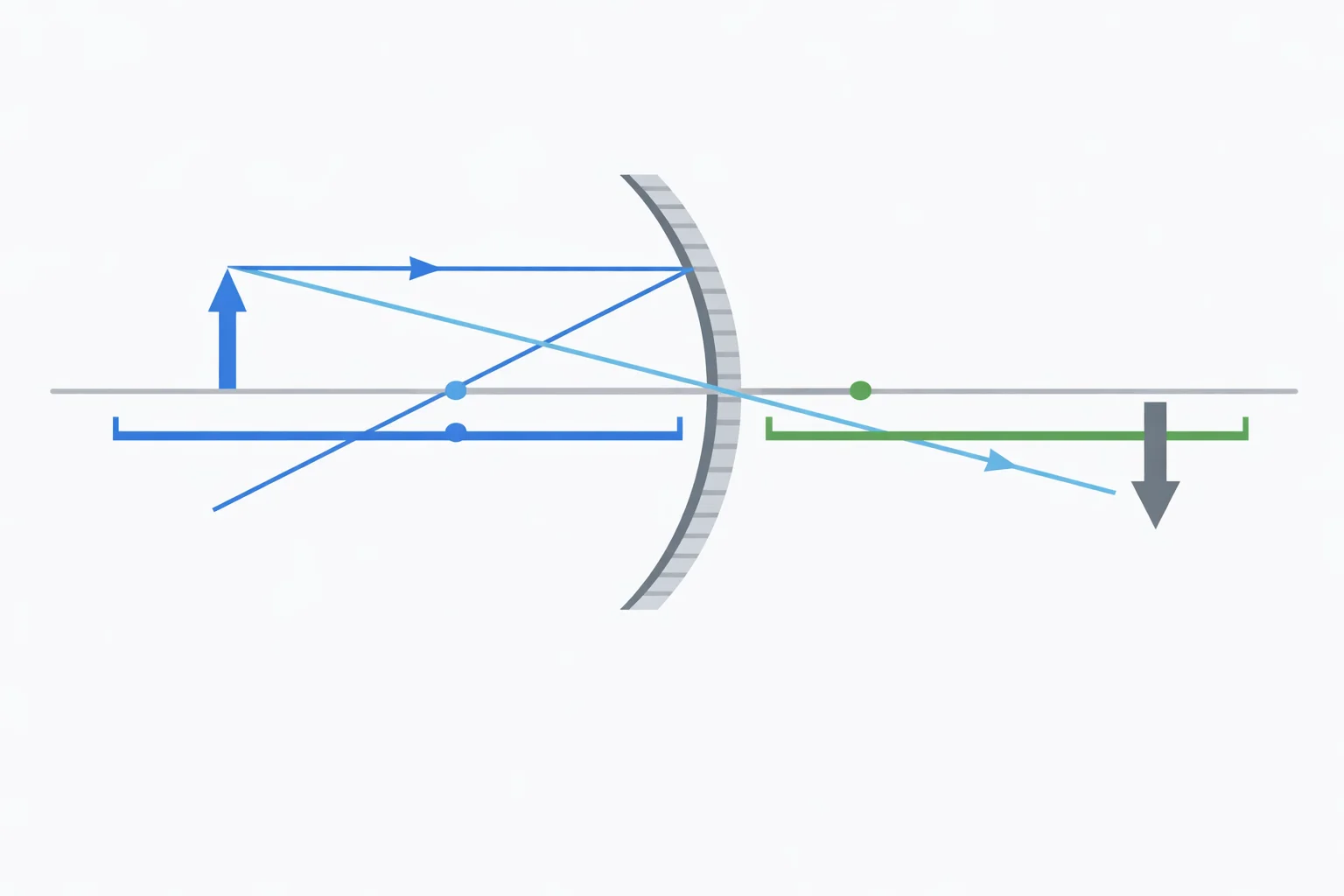
Concave vs Convex: One Bowl Faces You, One Bulges Out
Every curved mirror is one of two kinds, and the split decides almost everything. A concave mirror caves inward like the inside of a bowl facing you — it collects parallel light and converges it to a focal point, so its focal length is positive. A convexmirror bulges toward you like the back of that spoon — it spreads parallel light apart, so its focal length is negative. Feed a convex mirror into the equation and you can't get a real image out of it no matter what you try; the math simply won't produce one. Here's the head-to-head:
| Property | Concave mirror | Convex mirror |
|---|---|---|
| Focal length sign | Positive (+f) | Negative (−f) |
| What it does to parallel light | Converges it to F | Spreads it apart |
| Image type possible | Real or virtual, depends on dₒ | Always virtual |
| Image size | Bigger or smaller, depends on dₒ | Always smaller |
| Field of view | Narrow | Very wide |
| Everyday example | Makeup mirror, telescope, headlight | Car side mirror, shop security dome |
Why a Mirror's Real Image Lands in Front, Not Behind
If you already know the lens equation, the mirror version looks identical — same 1/f = 1/dₒ + 1/dᵢ, same magnification m = −dᵢ/dₒ. But there's one physical difference that flips the meaning of the answer. Light passes through a lens, bending by Snell's law at each surface, so a lens's real image forms on the far side, away from you. A mirror bounces light straight back, so a mirror's real image forms in front, on the same side as the object — right in the space between you and the glass. That's why a concave shaving mirror can throw a real, floating image you can wave your hand through, something a lens can never do on the viewer's side. When dᵢ comes out positive here, the image is in front and real; when it's negative, the image hides behind the mirror and is virtual.
The f = R/2 Shortcut Every Mirror Problem Leans On
A spherical mirror is just a slice of a sphere, and that sphere has a radius — the radius of curvature, R. The focal length is exactly half of it: f = R/2. Grind a concave mirror to a 40 cm radius and it focuses light at 20 cm, full stop. This is a mirror-only convenience; a thin lens doesn't collapse to one tidy radius the way a mirror does. The center of that sphere, called the center of curvature C, sits at a distance R = 2f from the mirror, which is why the "object at 2f" case is special: put an object right at C and its real image comes back the same size, inverted, at C. The calculator above lets you type either f or R and instantly shows you the other, so you never have to remember which one a textbook problem handed you.
One quick consequence worth internalizing: because f = R/2, doubling how sharply you curve a mirror halves its focal length. A gently curved security dome with R = 2 m has f = −1 m and barely bends light; a tightly curved dental mirror with R = 6 cm has f = 3 cm and magnifies aggressively. The curvature is the knob; the focal length just follows.
The Mirror Sign Convention (and When dᵢ Flips Meaning)
Nearly every wrong mirror answer traces back to a sign. Here is the convention this calculator uses, the standard intro-physics one where "in front is positive":
- Focal length f: positive for a concave mirror, negative for a convex mirror. (And R = 2f carries the same sign.)
- Object distance dₒ: positive for a real object sitting in front of the mirror — the everyday case.
- Image distance dᵢ: positive when the image forms in front of the mirror (real, projectable) and negative when it forms behind (virtual).
Get those three straight and the equation never misleads you. A concave mirror with the object beyond its focal length returns a positive dᵢ — a real, inverted image. Slide the object inside the focal length and dᵢ goes negative, signaling the virtual, magnified reflection you use to shave or apply makeup. A convex mirror returns a negative dᵢ for every object distance, which is the mathematical reason it can never project a picture.
Working a Shaving-Mirror Problem Step by Step
Take a concave shaving mirror with a 25 cm focal length (so R = 50 cm) and a face 15 cm away. Because 15 cm is inside the 25 cm focal length, we should expect the enlarged, upright reflection — let's prove it. Rearrange to 1/dᵢ = 1/f − 1/dₒ = 1/25 − 1/15 = 0.04 − 0.0667 = −0.0267 cm⁻¹. Flip that and dᵢ = −37.5 cm. The negative sign says the image is virtual, sitting 37.5 cm behind the mirror. Magnification is m = −dᵢ/dₒ = −(−37.5)/15 = +2.5, so the reflection is upright and two and a half times life-size. That's exactly why you lean in close to a magnifying mirror — step back past 25 cm and the image would flip upside down and shrink.
Now move the same face out to 60 cm, past the center of curvature at 50 cm. Then 1/dᵢ = 1/25 − 1/60 = 0.04 − 0.01667 = 0.02333, giving dᵢ = +42.9 cm and m = −0.71. The positive distance means a real image now floats 42.9 cm in front of the mirror, inverted and about 71% of life-size. One mirror, two object positions, and the sign of dᵢ told the whole story. Load the "Shaving / makeup mirror" preset above to watch the first case draw itself.
"Objects Are Closer Than They Appear": The Convex Math
That etched warning on your passenger mirror is a physics disclaimer. Passenger-side mirrors are convex — typically a radius of curvature around 2 m, so f = −1 m. Put a car 15 m back into the equation: 1/dᵢ = 1/(−100 cm) − 1/(1500 cm) = −0.01 − 0.000667 = −0.010667, so dᵢ = −93.75 cm and m = −(−93.75)/1500 = +0.0625. The trailing car renders upright but only about 6% of its real angular size. Your brain equates "smaller" with "farther," so the shrunken image reads as more distant than the car actually is — hence the warning.
The payoff for that distortion is field of view. Because a convex mirror spreads light outward, it packs a much wider slice of the road into the same piece of glass, shrinking the blind spot. Shop-ceiling security domes push this further: a dome with f = −30 cm can fit an entire aisle into a reflection the size of a dinner plate. You trade faithful size for sweeping coverage, and the magnification calculator quantifies exactly how much size you gave up.
Focal Lengths and Radii of the Mirrors Around You
The mirror equation isn't just a homework tool — it's the design spec behind the reflective surfaces you pass every day. These are representative values (real products vary), with concave taken as positive and convex as negative:
| Mirror | Type | Typical focal length (f) | Radius R = 2f |
|---|---|---|---|
| Makeup / shaving mirror | Concave | +20 to +40 cm | +40 to +80 cm |
| Dental inspection mirror | Concave | +2 to +4 cm | +4 to +8 cm |
| Car passenger-side mirror | Convex | −0.9 to −1.8 m | −1.8 to −3.6 m |
| Store security dome | Convex | −0.25 to −0.6 m | −0.5 to −1.2 m |
| 8-inch reflecting telescope | Concave | +1200 mm | +2400 mm |
| Flashlight / headlight reflector | Concave | +1 to +3 cm | +2 to +6 cm |
The telescope row hints at a limit these numbers ignore. A big concave primary mirror gathers light and forms a real image, but it can never focus that light tighter than roughly the wavelength doing the imaging — the diffraction limit. And the light itself is a stream of individual photons, each carrying energy E = hf, whether they bounce off a telescope mirror or your bathroom one.
Where the Mirror Equation Stops Being Accurate
The formula 1/f = 1/dₒ + 1/dᵢ quietly assumes paraxial rays — light staying close to the axis and hitting the mirror at shallow angles. Push past that and it starts to lie in predictable ways:
- Wide, deeply curved mirrors: rays striking far from the axis focus at a slightly different point than central rays (spherical aberration), so a big concave mirror blurs where the equation promises a sharp point. Telescope makers dodge this by grinding a parabolic surface instead of a spherical one.
- Off-axis objects:something well off the central axis images with coma and astigmatism, distortions the single-number focal length doesn't capture at all.
- The f = R/2 rule itself:it's an approximation that holds for shallow spherical mirrors. For a hemisphere or a mirror curved almost into a full cup, the effective focal point drifts.
For an ordinary concave or convex mirror and objects near the axis, though, the equation is accurate to a fraction of a percent. Treat it as an excellent first answer, and reach for ray-tracing software only when the mirror is huge, steeply curved, or the object is far off to the side.
The Sign Slip That Puts a Real Image Behind the Glass
The mistake I see most often in the classroom isn't the reciprocal algebra — it's entering a convex mirror with a positive focal length. A student writes f = +30 cm for a convex mirror, gets a tidy positive dᵢ, and reports a real image floating in front of a mirror that physically cannot make one. Convex mirrors only ever produce virtual, upright, shrunken images. Feed the correct f = −30 cm and the sign flips to reveal the virtual image behind the glass. The habit that saves you: decide concave or convex first, write the focal length with its sign before anything else, and let the equation carry that sign to the end. For a full derivation and a gallery of ray diagrams, HyperPhysics keeps a clear spherical-mirror reference. Nail the sign convention and every "where does the image form?" problem becomes a plug-and-flip.