Magnification Calculator: Linear vs. Angular, and How Instruments Multiply It
Two microscopes both stamped "400×" can hand you wildly different views — one a crisp cell wall, the other a bloated smudge. Same number, different result, because magnification isn't a single quantity. This magnification calculatorhandles both flavors: the linear magnification m = hᵢ/hₒ = −dᵢ/dₒ that tells you how tall an image is, and the angular magnification behind every magnifier, telescope, and microscope. Learning how to calculate magnification really means learning which of the two a problem is actually asking for.
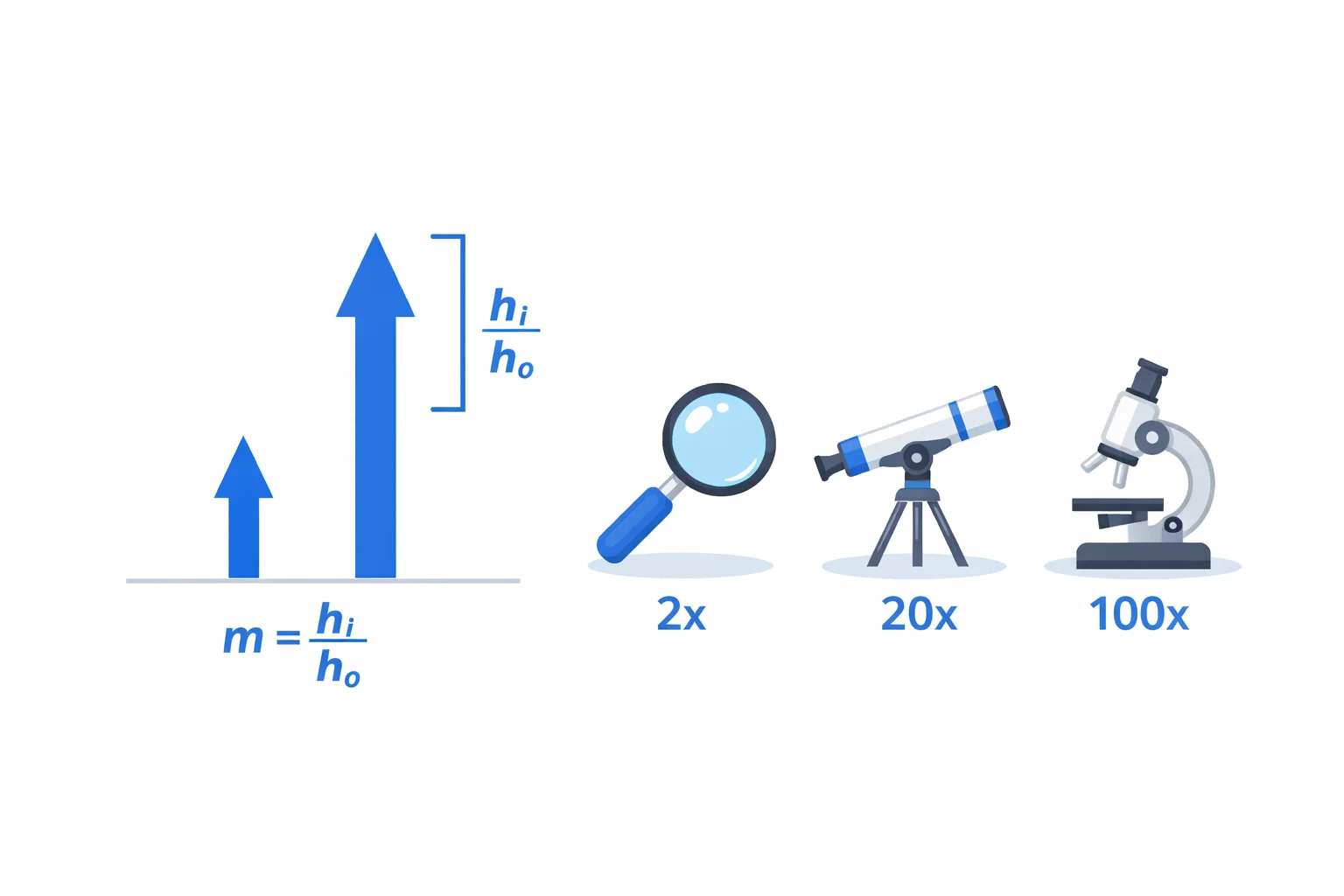
Two Different Numbers Both Called "Magnification"
The word hides two separate ideas. Linear magnification(also called transverse magnification) is a pure size ratio: how many times taller the image is than the object. Put a 6 mm ant under a lens that forms a 24 mm image and the linear magnification is 4. That's the number the lens and mirror equations produce, and it's the one you use for anything projected onto a screen or sensor.
Angular magnification is different. It compares the angle an object subtends through the instrument to the angle it subtends with your naked eye at the standard 25 cm near point. This is what matters for anything you look throughrather than project — because a star has no meaningful "image height," but it absolutely has an apparent angular size. A telescope can't make Jupiter physically bigger; it makes Jupiter fill 50 times the angle in your field of view. Confusing these two is the single most common conceptual error in optics.
| Feature | Linear magnification | Angular magnification |
|---|---|---|
| What it compares | Image height ÷ object height | Apparent angle with tool ÷ angle with naked eye |
| Formula | m = hᵢ/hₒ = −dᵢ/dₒ | M = N/f (magnifier), fₒ/fₑ (telescope) |
| Carries a sign? | Yes — negative means inverted | Usually quoted as a positive magnitude |
| Used for | Cameras, projectors, a single lens on a bench | Magnifiers, microscopes, telescopes, binoculars |
| Meaning of "10×" | Image is 10 times as tall | Object looks 10 times bigger to your eye |
Linear Magnification: One Ratio, Two Ways to Measure It
Linear magnification gives you two equivalent formulas, and which one you reach for depends on what you've measured. If you have the heights, m = hᵢ/hₒ. If you have the distances from a lens or mirror, m = −dᵢ/dₒ. They always agree, which is exactly why you can pin down the image size without ever holding a ruler up to the image — just track the two distances.
Work a concrete one. A security camera sits 3.0 m from a doorway and forms its image on a sensor 25 mm behind the lens. Put both in the same unit: dₒ = 3000 mm, dᵢ = 25 mm. Then m = −25/3000 = −0.0083. A 1.8 m person shrinks to hᵢ = m × hₒ = −0.0083 × 1800 mm = −15 mm on the sensor, inverted. That tiny 15 mm image is why a single sensor can hold a whole hallway. Notice the magnification sits far below 1 — "magnification" routinely means shrinking. Reproduce this in the calculator's Linear mode with the Distances option, or if you already know both physical heights, switch to Heights and read the same m straight off the ratio. When you only know the focal length and one distance, get dᵢ from the lens equation calculator first, then bring it back here.
What the Minus Sign Is Telling You
That minus sign in m = −dᵢ/dₒ isn't decoration — it's the orientation bit. A negative magnification means the image is inverted; a positive one means it stands upright. So m = −0.5 and m = +0.5 both describe a half-height image, but the first is flipped (a real image on a camera sensor) and the second is upright (the virtual image in a magnifying glass). Strip the sign and you lose half the information. The same rule governs curved mirrors, where a concave mirror flips your face at arm's length while a convex mirror keeps it upright and shrunken — the mirror equation calculator carries that sign through the reflection.
Why a Microscope's 400× Isn't a Height Ratio
Here's where students get burned. A simple magnifier doesn't work by forming a bigger image somewhere you can measure — it works by letting you bring an object much closer than your eye could normally focus, so it fills a wider angle. The angular magnification of a magnifier with your eye relaxed is M = N/f, where N is the 25 cm near point and f is the lens's focal length. A 5 cm loupe therefore gives M = 25/5 = 5×. Strain your eye to hold the image at the near point instead and you get M = 1 + N/f = 6× — one extra unit of magnification in exchange for eye fatigue.
That near point is a real, personal number. Textbooks use 25 cm, but a typical 50-year-old's near point has receded past 40 cm, which quietly changes their angular magnification. Enter 40 for N in the magnifier mode and watch the same lens deliver a bigger number — the physics literally depends on whose eye is looking. Linear magnification never does that, because a height ratio doesn't care about the observer.
How Magnifications Multiply in Telescopes and Microscopes
Compound instruments stack two lenses, and their magnifications multiply. A microscope's objective forms a real, enlarged image inside the tube; the eyepiece then acts as a magnifier on that image. Total magnification is the product: M = Mobjective× Meyepiece. With a 40× objective and a 10× eyepiece you get 40 × 10 = 400×, not 50×. Add them and you'd be off by a factor of eight.
A telescope multiplies too, but its angular magnification collapses to a clean ratio of focal lengths: M = fₒ/fₑ, objective over eyepiece. A 1000 mm objective with a 25 mm eyepiece gives 40×; drop in a 10 mm eyepiece and you jump to 100× without touching the front of the scope. This is exactly why observers own a box of eyepieces instead of a box of telescopes — the cheap part of the system sets the power. Binoculars run the same fₒ/fₑ math, just with the tube folded by prisms that bounce light losslessly past the critical angle — that's how a 7×50 fits in your hands. The Multi-stage mode lets you chain any such factors, whether it's a two-lens relay, a scope with a Barlow lens, or a microscope feeding a camera.
Magnification of the Instruments Around You
These aren't made-up round numbers — they're the real specs printed on everyday optics. Watch how the kind of magnification shifts as you move down the list.
| Instrument | Typical magnification | Kind |
|---|---|---|
| Reading magnifier (loupe) | 2×–10× | Angular (N/f) |
| Jeweler's loupe | 10× | Angular |
| 7×50 binoculars | 7× | Angular (fₒ/fₑ) |
| Student microscope, low power | 40× (4× obj × 10× eye) | Angular product |
| Student microscope, oil immersion | 1000× (100× × 10×) | Angular product |
| Beginner telescope | 30×–120× | Angular |
| Camera photographing a face | ~0.02× (reduced) | Linear |
| Scanning electron microscope | up to ~500,000× | Effective |
When More Magnification Stops Helping
There's a ceiling, and past it magnification turns useless. A light microscope can't resolve detail finer than roughly half the wavelength of the light it uses — about 0.2 micrometers for visible light near 550 nm. Push magnification beyond what that resolution supports (past around 1000× for visible light) and you get empty magnification: the blur just gets bigger, never sharper. It's the optical version of zooming into a low-resolution photo.
So the 1000× ceiling on student microscopes isn't a cost-cutting limit — it's physics. Beating it means using a shorter wavelength, which is the whole reason electron microscopes exist: an electron's de Broglie wavelength can be tens of thousands of times shorter than visible light, so it resolves detail that no amount of glass and lamplight ever could. Magnification without matching resolution is empty, and no formula on this page changes that.
The Three Mistakes That Wreck Magnification Problems
Almost every wrong answer traces back to one of three slips. First, adding factors instead of multiplying them: a 40× objective and a 10× eyepiece give 400×, and treating it as 50× isn't a rounding error — it's an eightfold miss. Second, confusing linear with angular magnification: quoting a microscope's 400× as a height ratio, or expecting a telescope to make a star's image physically taller, mixes two incompatible definitions.
Third, and sneakiest, dropping the sign in the linear formula. Report m = 0.5 when the real answer is −0.5 and you've quietly claimed an upright image where the physics demands an inverted one. For the underlying refraction that bends the light in the first place — and sets a lens's focal length — the Snell's law calculator shows where those angles come from. Decide which magnification you need, multiply the stages, and keep the sign, and the arithmetic stops fighting you. For a fuller treatment of the magnifier and microscope equations, HyperPhysics keeps a clear reference on angular magnification.