Critical Angle Calculator: The Exact Angle Where Light Stops Escaping
Hang three meters below the surface of a calm sea, look straight up, and something strange happens: the entire sky, horizon to horizon, is compressed into a bright circle about 6.8 meters across. Outside that circle the underside of the surface is a perfect mirror, showing you the seafloor. Divers call it Snell's window, and the number that draws its edge is exactly what this critical angle calculatorcomputes: θc = arcsin(n₂/n₁), the one angle where light stops escaping a dense medium and starts bouncing back inside. Let's solve the diver's problem by hand first, then push the same formula into fiber-optic cables and gem labs.
From Two Indices to One Angle: Solving the Diver's Problem
What do we know? Light is trying to leave water (n₁ = 1.333) and enter air (n₂ = 1.0003). What do we want? The steepest angle, measured from the vertical normal, at which it can still get out. Plug in: θc = arcsin(1.0003/1.333) = arcsin(0.7504) = 48.6°. Every ray from below that meets the surface at more than 48.6° is turned back — total internal reflection. Every ray from the whole hemisphere of sky above, meanwhile, gets funneled into that same cone on the way down.
That's where the 6.8-meter circle comes from. The escape cone has a half-angle of 48.6°, so at a depth d the window's radius is d × tan 48.6° = d × 1.134. Three meters down: radius 3.4 m, diameter 6.8 m. Underwater photographers exploit this constantly — shoot inside the window and you capture the world above the water; shoot outside it and you get mirror reflections of the reef. The calculator's "escape cone" readout is this window measured from inside: 2 × 48.6° ≈ 97.3° of apparent sky.
Why TIR Is a One-Way Street (and When No Critical Angle Exists)
The formula falls straight out of Snell's law. Refraction obeys n₁ sin θ₁ = n₂ sin θ₂, and the escaping ray bends awayfrom the normal when it enters a rarer medium. Push θ₁ up until θ₂ hits its ceiling of 90° — the refracted ray lying flat on the surface — and you get n₁ sin θc = n₂ × 1, so sin θc = n₂/n₁. That's the whole derivation. The Snell's law calculator handles the general bending problem; this page lives at that 90° limit.
Notice what the formula demands: sin θc can't exceed 1, so a critical angle exists only when n₂ < n₁. Try it the other way — air into water — and you'd need arcsin(1.333), which doesn't exist. Physically that's right: light entering a denser medium bends towardthe normal, so it always gets in, at any angle up to a grazing 90°. Total internal reflection is strictly a dense-to-rare phenomenon. If this calculator warns you there's no critical angle, you haven't broken physics — you've just pointed the light the wrong way.
Fiber Optics Runs on an 85° Critical Angle, Not the 42° You'd Guess
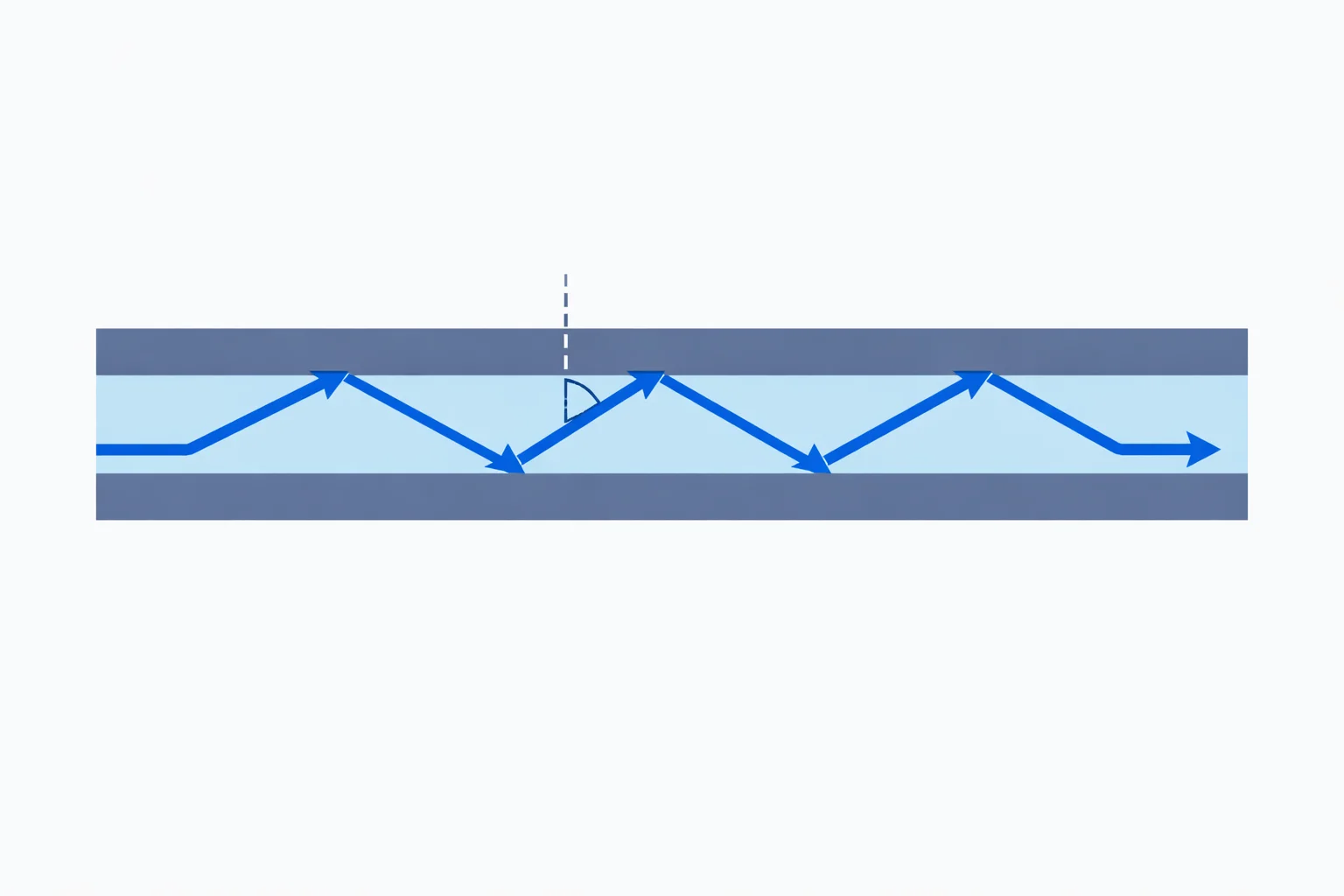
Ask most students for the critical angle inside a fiber-optic cable and they'll reach for glass-to-air: about 41–43°. Real telecom fiber doesn't work that way — the glass core is wrapped in a glass cladding, and the two are deliberately almost identical. Corning's SMF-28, the workhorse fiber of the internet, pairs a core index of 1.4682 with a cladding of 1.4629 — a contrast of just 0.36%. That puts the critical angle at arcsin(1.4629/1.4682) = 85.1°. Only rays skimming within about 5° of the fiber's axis survive.
Why engineer the trap to be so shallow? Pulse sharpness. A ray bouncing at 85° travels barely longer than one going straight down the axis, so a data pulse arrives compact. If steep 45° rays were allowed too, their zigzag path would be dramatically longer and the pulse would smear out over kilometers — modal dispersion, the effect that caps how fast you can blink data down a multimode line. The small contrast also sets the numerical aperture, NA = √(n²core − n²cladding) = √(1.4682² − 1.4629²) ≈ 0.125, which means light launched from air must arrive within arcsin(0.125) ≈ 7.2° of the axis to be guided at all. (Corning's datasheet quotes NA 0.14 — they measure it from the beam's 1% power width rather than the ray-optics limit, a good reminder that spec sheets and textbook formulas define things differently.) Cheap plastic fiber flips every one of those choices: a PMMA core (n = 1.492) against fluoropolymer cladding (n = 1.402) gives θc = 70°, NA ≈ 0.51, and a fat 61° acceptance cone — sloppy enough to couple with a bare LED, which is why TOSLINK audio cables cost pocket change. RP Photonics has a rigorous treatment of total internal reflection if you want the wave-optics picture behind these ray-level numbers.
Critical Angles for Real Boundary Pairs — Air Isn't Always on Top
Most tables only list critical angles "into air." But the rare medium matters just as much as the dense one, and swapping air for water or grease changes the physics you observe:
| Boundary (dense → rare) | n₁ / n₂ | Critical angle θc | Where you meet it |
|---|---|---|---|
| Water → air | 1.333 / 1.0003 | 48.6° | Snell's window, glowing pool lights |
| Acrylic → air | 1.49 / 1.0003 | 42.2° | Edge-lit signs, light pipes, endoscopes |
| Crown glass → air | 1.52 / 1.0003 | 41.1° | Binocular and periscope prisms |
| Crown glass → water | 1.52 / 1.333 | 61.3° | Why 45° prisms fail if flooded |
| Diamond → air | 2.417 / 1.0003 | 24.4° | The brilliance of a round cut |
| Diamond → water | 2.417 / 1.333 | 33.5° | Wet stones visibly lose fire |
| Diamond → skin grease | 2.417 / ~1.5 | ≈ 38.4° | Why dirty rings stop sparkling |
| Fiber core → cladding | 1.4682 / 1.4629 | 85.1° | SMF-28 telecom fiber |
Read the middle column and a rule emerges: the closer the two indices, the larger the critical angle. Diamond against air traps rays across a huge 24.4°–90° range; fiber core against cladding traps almost nothing — on purpose. Both are "total internal reflection devices," tuned to opposite ends of the same arcsin.
How Gemologists Turn θc Into a Stone-ID Test
The standard gemological refractometer is a critical-angle instrument, even though its dial reads refractive index. The stone sits on a high-index glass hemicylinder with a drop of contact fluid (n = 1.81) between them. Light entering the glass beyond the stone's critical angle reflects totally and lights up the eyepiece scale; light below it leaks into the stone and leaves a shadow. The position of that sharp shadow edge is arcsin(n_stone/n_glass) — the instrument just relabels the angle axis in index units. Sapphire (n = 1.77) reads cleanly; diamond, cubic zirconia, and moissanite all sit above the 1.81 fluid and show "over the limit," which is itself diagnostic.
The cut of a diamond is critical-angle engineering too. Its pavilion facets slope at roughly 40.75° — well beyond the stone's 24.4° θc — so light entering the crown strikes the first pavilion facet above the critical angle, reflects totally, crosses to the second facet, reflects again, and exits back through the top into your eye. Two lossless bounces, by design. Cut the pavilion too shallow or too deep and rays meet the facets belowθc, leak out the bottom, and the stone goes glassy — jewelers call it a fish-eye or a nail-head. Cubic zirconia's higher critical angle (27.6°) and different dispersion mean even a well-cut CZ returns light differently, one of several tells under a loupe.
Prisms Beat Mirrors: TIR Never Pays the Silver Tax
A household mirror reflects 90–95% of the light that hits it; aluminum coatings run closer to 90%. Bounce a beam four times and a silvered path keeps as little as 0.9⁴ ≈ 66% of the light. Total internal reflection, by contrast, is genuinely lossless — 100.000%, not a rounded-up marketing number — because past θc there is simply no transmitted wave to carry energy away. That's why binoculars fold their long light path with bare glass porro prisms instead of tiny silvered mirrors: light inside the prism meets each internal face at 45°, comfortably past crown glass's 41.1° critical angle, and bounces for free. Fold the path twice per barrel and a 7×50 binocular's 7× magnification fits in your hands instead of needing a half-meter tube.
The 45°-versus-41.1° margin is thinner than it looks, though. Flood the prism's outer face with water and the critical angle jumps to 61.3° — the 45° geometry stops working entirely, which is why waterproofing matters more to binocular optics than to the housing. Even fused quartz (n = 1.458, θc = 43.3° in air) keeps only a 1.7° margin at 45°. It's a nice design lesson: TIR is binary. You don't get 99% reflection just below the critical angle — you get ordinary partial reflection, most of the light gone.
The Upside-Down Ratio and Other Ways This Goes Wrong
Three slips account for nearly every wrong critical-angle answer I've graded. First, the inverted ratio: computing arcsin(n₁/n₂) instead of arcsin(n₂/n₁). For glass to air that's arcsin(1.52) — your calculator throws a domain error, which is actually the friendly outcome because it forces you to notice. The dangerous version is a boundary like glass-to-water, where the inverted ratio 1.52/1.333 = 1.14 still errors, but water-to-glass 0.877 quietly returns 61.3° for a boundary that has no critical angle in that direction. The number looks plausible and is completely meaningless.
Second, the direction error: expecting TIR when light enters a denser medium. It never happens — bending toward the normal can't flatten a ray onto the surface. Third, measuring from the surface instead of the normal. A ray meeting the water's underside at 50° from the surfaceis at 40° from the normal — below the 48.6° critical angle, so it escapes. Plug in the 50° figure and you'd predict total internal reflection for a ray that actually leaves the water. One wrong reference line flips the physical outcome, not just the decimal places. (A fourth, sneakier one: if your arcsin(0.7504) comes out as 0.848, your calculator is in radians — that's 48.6° wearing a disguise.)
Three Practice Problems (Answers Included)
Work these with the calculator or by hand — each one is a setup that actually comes up.
- 1. The bar-top glow.Light trapped in a puddle of spilled ethanol (n = 1.361) on a lit bar top — what's the critical angle into air? Answer:θc = arcsin(1.0003/1.361) = arcsin(0.735) = 47.3°. Slightly wider escape cone than water, because ethanol's index is a bit higher — wait, check that instinct: higher n₁ means a smallerratio and a smaller θc. 47.3° < 48.6°. The formula catches what intuition fumbles.
- 2. The prism-design threshold.What's the minimum refractive index a material needs so a 45° prism totally reflects in air? Answer:you need θc ≤ 45°, so n₁ ≥ n₂/sin 45° = 1.0003/0.7071 = 1.414. Crown glass (1.52) clears it easily, fused quartz (1.458) barely, and water (1.333) fails — a water-filled "prism" leaks at 45° no matter how cleanly it's built.
- 3. The snorkeler's window. Floating 2 m above the sand, how wide is the circle of sky a snorkeler sees on the surface? Answer: radius = 2 × tan 48.6° = 2 × 1.134 = 2.27 m, so the window is about 4.5 m across. Descend to 4 m and it doubles to 9.1 m — the window scales linearly with depth while its 97.3° angular size never changes.