Thin Lens Calculator: From Surface Curvature to Focal Length with the Lensmaker's Equation
An optician's order slip reads SPH −2.50. Twenty minutes later a machine has ground a curve with a radius of exactly 11.1 cm into the back of a plastic blank, and someone's distance vision is fixed. How did "−2.50" become "11.1 cm"? That conversion — from optical power to physical surface curvature — is the lensmaker's side of thin lens physics, and it's what this thin lens calculatorworks out: enter a lens's two surface radii and its glass, get its focal length and power in diopters, combine two lenses into one system, or run the math backwards to identify an unlabeled lens from bench measurements.
What −2.50 D on a Prescription Actually Specifies
A diopter is nothing exotic: it's one over the focal length in meters, P = 1/f. So "−2.50 D" specifies a diverging lens with f = 1/(−2.50) = −0.40 m — it takes light from far away and makes it appear to come from a virtual point 40 cm in front of the lens, exactly where a nearsighted eye that can't focus past 40 cm needs it. The reason eye care runs on diopters rather than focal lengths is practical: powers of stacked lenses add, focal lengths don't. Your eye itself is roughly a +60 D system (about two-thirds of it from the cornea alone), and a −2.50 D correction just subtracts from that total.
But a prescription says nothing about shape. A −2.50 D lens could be biconcave, plano-concave, or the gently curved meniscus form that actually sits in your frames — the equation below is what lets the lab pick.
The Lensmaker's Equation: Curvature and Glass Set the Power
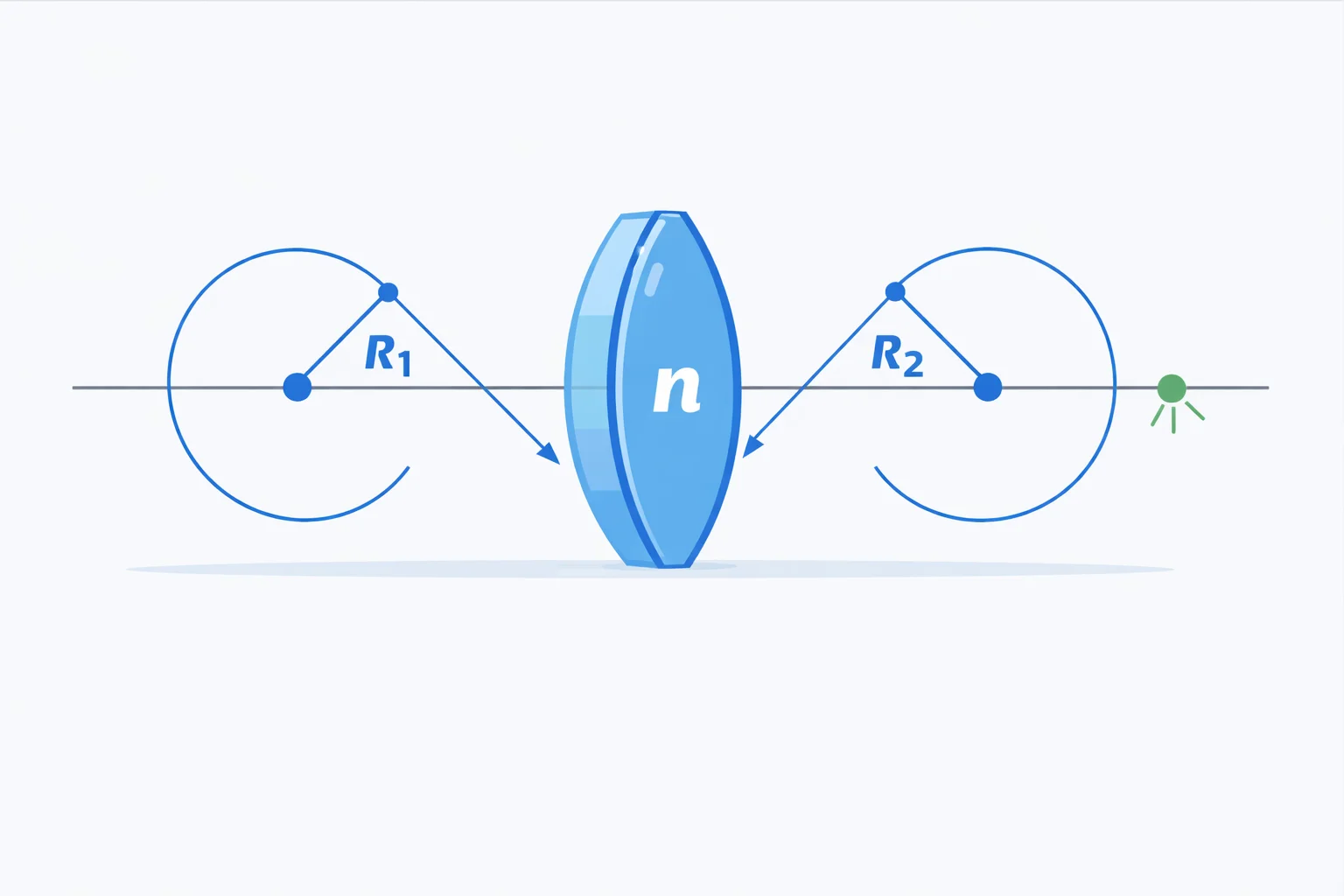
For a thin lens in air, the focal length follows from just three numbers — the refractive index n of the material and the radii of curvature of its two surfaces:
1/f = (n − 1)(1/R₁ − 1/R₂)
Each surface refracts the light according to Snell's law, and the equation is simply both surface contributions added up. Take a symmetric biconvex magnifier in BK7 crown glass (n = 1.517) with both radii at 10 cm. With the sign convention applied (R₁ = +10 cm, R₂ = −10 cm), the curvature term is 1/0.10 − 1/(−0.10) = 20 m⁻¹, so P = 0.517 × 20 = 10.3 D and f = 9.7 cm. Notice the two knobs: sharper curves (smaller R) raise the power, and so does a higher index, through that (n − 1) factor. Double the bending ability of the glass and you need only half the curvature — a trade-off the eyeglass industry is built on, as the materials table below shows.
Two Thin-Lens Equations, Two Different Jobs
Physics courses use "thin lens equation" for two related but different formulas, and mixing them up wastes exam time. Both assume the same idealized thin lens; they just answer different questions:
| Lensmaker's equation | Thin-lens imaging equation | |
|---|---|---|
| The formula | 1/f = (n − 1)(1/R₁ − 1/R₂) | 1/f = 1/dₒ + 1/dᵢ |
| Question it answers | What focal length does this piece of glass have? | Where does the image of this object form? |
| Inputs | Index n, surface radii R₁ and R₂ | Focal length f, object distance dₒ |
| Who reaches for it | Lens designers, optical labs, opticians | Students, photographers, anyone locating an image |
| Where the signs live | In the radii (convex vs concave surfaces) | In the distances (real vs virtual images) |
They chain together naturally: the lensmaker's equation manufactures the f that the imaging equation consumes. This page handles the design side; for the imaging side — image distance, magnification, and ray diagrams — use the lens equation calculator.
Convex, Concave, Flat: Reading R₁ and R₂ Correctly
The radii carry signs, and the convention is the part everyone fumbles. Measured along the direction light travels, a radius is positive when the surface's center of curvature lies on the outgoing side. For a biconvex lens that means R₁ > 0 but R₂ < 0 — the two surfaces curve opposite ways even though both look "convex" from outside. A flat surface has R = ∞, so its 1/R term is just zero, which is why a plano-convex lens gets all its power from one face: a BK7 surface ground to R = 5.2 cm and paired with a flat back gives P = 0.517/0.052 ≈ 9.9 D, essentially the same 10 cm focal length as the biconvex magnifier above using only half the grinding work. The calculator sidesteps the sign bookkeeping entirely — you declare each surface convex, flat, or concave, and it assigns the signs.
Same Prescription, Five Materials: Why High-Index Lenses Are Flatter
Here's the worked design problem from the opening. The lab wants −2.50 D in the common meniscus form, with the front surface fixed at a gentle +2.00 D curve (standard practice, so the lens follows the face). The back surface must then contribute −4.50 D, and its required radius is R = (n − 1)/4.50. Run that across real eyeglass materials:
| Material | Index n | Back radius for −4.50 D | Practical note |
|---|---|---|---|
| CR-39 plastic | 1.498 | 11.1 cm | The default budget lens since 1947 |
| Trivex | 1.53 | 11.8 cm | Impact-resistant and very light |
| Polycarbonate | 1.586 | 13.0 cm | Shatterproof — standard for kids' and sports frames |
| High-index 1.67 | 1.67 | 14.9 cm | Noticeably thinner edges on strong prescriptions |
| High-index 1.74 | 1.74 | 16.4 cm | The flattest curve — premium thin lenses |
Same −2.50 D in every row, yet the 1.74 material needs a radius nearly 50% larger than CR-39. A flatter curve removes less material, so the finished lens is thinner and lighter at the edge — that's the entire pitch behind "high-index" upgrades at the optician, compressed into one (n − 1) factor. Load the eyeglass preset in the calculator and swap materials to watch the power shift while the shape stays put.
Why Optometrists Add Diopters, Not Focal Lengths
Put two thin lenses in contact and the combined power is just P = P₁ + P₂. That's why an optometrist refines your prescription by dropping trial lenses into a frame: +2.00 D plus +0.50 D reads +2.50 D, no algebra required. Try the same trick with focal lengths (50 cm and 200 cm) and you're stuck adding reciprocals — the diopter exists precisely to make lens stacking arithmetic.
Separate the lenses by a distance d and a correction term appears: P = P₁ + P₂ − d·P₁·P₂. That subtracted term isn't a nuisance — it's a design tool. Space a +2.5 D objective and a +20 D eyepiece exactly 45 cm apart and the combined power hits 2.5 + 20 − 0.45 × 50 = 0 D: an afocal system that takes parallel rays in and sends parallel rays out. You've built a Keplerian telescope, and its usefulness comes not from net power but from angular magnification — the fₒ/fₑ ratio the magnification calculator handles. The two-lens mode above traces the image through both stages, including the odd-but-correct case where lens 1's image lands behind lens 2 and acts as a virtual object.
Drop a Lens in Water and It Loses Three-Quarters of Its Power
The full lensmaker's equation replaces (n − 1) with (n/n₍medium₎ − 1), and that small edit has dramatic consequences. In air, BK7 glass works with 1.517/1.000 − 1 = 0.517. Submerge the same lens in water (n = 1.333) and the factor collapses to 1.517/1.333 − 1 = 0.138 — the 10.3 D magnifier from earlier drops to 2.8 D, a 73% power loss, without changing shape at all. A lens has no power of its own; it only has power relative to what surrounds it.
You've felt this. Open your eyes underwater and the world smears, because your cornea's +43 D of refracting power depends on the air-to-tissue index step of 1.376 − 1.000. Water shrinks that step to 1.376 − 1.333 and the cornea delivers only about +5 D — goggles fix your vision by restoring a pocket of air, not by bending any light themselves. Fish solved the same problem differently: their eyes carry nearly spherical lenses with a graded index reaching about 1.55 at the core, packing in extra curvature and index because the water steals so much of both.
Measuring an Unlabeled Lens with Sunlight and a Wall
Every physics lab drawer has anonymous lenses, and the fastest way to identify one needs no equipment. The Sun sits 1.5 × 10¹¹ m away, so 1/dₒ is as close to zero as you'll ever get and the imaging equation collapses to dᵢ = f: focus the solar image to its smallest, brightest point on pavement and the lens-to-spot distance isthe focal length. For a 10 cm lens the error from the Sun's finite distance is about one part in 10¹², comfortably beyond any ruler.
Indoors, the bench version does the same job: place a lamp at a measured dₒ, find the sharp image on a screen at dᵢ, and the calculator's measure mode returns f — a lamp 30 cm out with a sharp image at 20 cm pins the lens at f = 12 cm, or +8.3 D. Diverging lenses dodge both tricks, since their images are virtual and land on no screen. The workaround uses the previous section: press the mystery lens against a known converging lens, measure the combined power, and subtract. A −4 D unknown stacked on a +10 D reference focuses sunlight at 1/(6 D) ≈ 16.7 cm, and the subtraction hands you the −4.
Where "Thin" Stops Being True
The whole framework assumes the lens's center thickness t is negligible next to its radii. Real glass eventually objects. The thick-lens correction adds a term to the curvature bracket: (n − 1)t/(nR₁R₂). For a chunky little biconvex lens with R₁ = 20 mm, R₂ = −20 mm, and t = 8 mm in BK7, the thin approximation predicts f = 19.3 mm while the thick formula gives 20.8 mm — a 7% miss, enough to visibly defocus a camera. As a rule of thumb, once t exceeds about a tenth of the smaller radius, stop trusting the thin version.
Two more assumptions hide in the fine print. The equation is paraxial — valid for rays near the axis at shallow angles — so wide apertures pick up spherical aberration the formula can't see. And n is quoted for one wavelength, usually yellow-green; blue light refracts more strongly than red, focusing about 1.5% closer in crown glass, which is the chromatic fringing that forces camera designers to pair crown and flint elements. For a single lens used near its axis, though, the thin-lens numbers land within a percent or two of reality — which is why the approximation has survived 300 years of better math.
The Sign Slip That Turns a Lens Into a Window
The classic lensmaker's blunder: entering both radii of a biconvex lens as positive. Do that with the symmetric 10 cm magnifier and the bracket reads 1/10 − 1/10 = 0 — the math announces your lens has no power at all, a flat window in disguise. With unequal radii the error is sneakier: R₁ = 10 cm, R₂ = 15 cm entered both-positive gives a curvature term of 0.033 cm⁻¹ instead of the correct 0.167 cm⁻¹, a lens five times weaker than the one in your hand, and nothing about the answer looks obviously wrong. If a lensmaker's result seems feeble, check the sign of R₂ before anything else — or let the calculator's convex/concave buttons carry the convention for you. For the full derivation from Snell's law at each surface, HyperPhysics keeps a compact lensmaker's equation reference. Both surfaces bulging outward must add power; any sign choice that makes them cancel is telling you the convention slipped.