The Magnetic Force Equation: Why Moving Charges Curve and Wires Jump
Here's a fact that trips up even strong physics students: a magnetic field can't speed up a charged particle. Not even a little. It can fling an electron into a tight spiral, bend a proton's path into a perfect circle, or yank a current-carrying wire sideways hard enough to rattle a lab bench — but it will never add a single joule of kinetic energy. A magnetic force calculatormakes this strange behavior concrete by turning F = qvB sin(θ) and F = BIL sin(θ) into numbers you can actually see and compare.
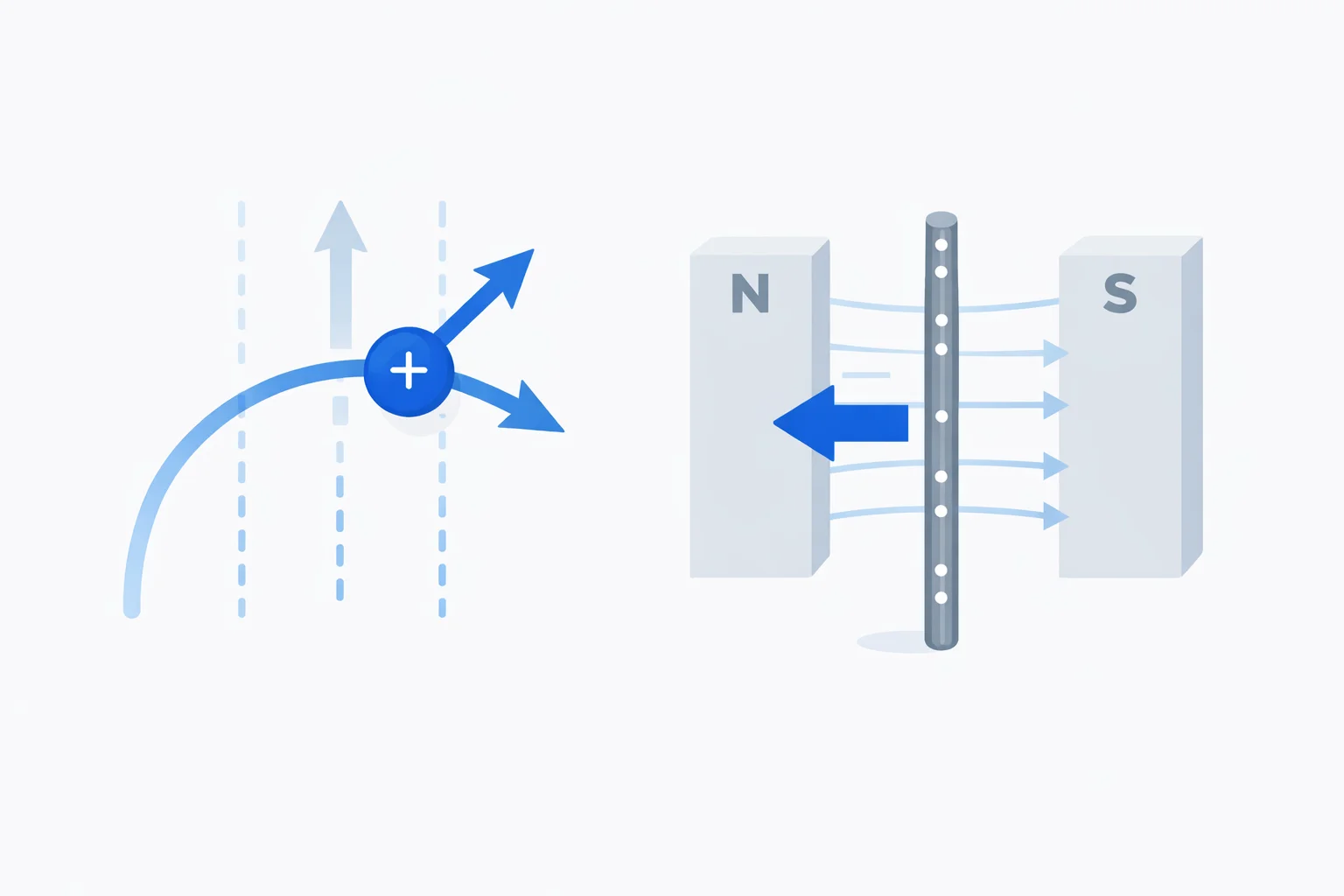
Two Formulas, One Magnetic Force
The magnetic force shows up in two common forms depending on what's moving through the field:
- Single charge: F = |q|vB sin(θ), where q is the charge in coulombs, v is the speed in m/s, B is the magnetic field in tesla, and θ is the angle between the velocity vector and the field vector.
- Straight wire: F = BIL sin(θ), where I is the current in amps and L is the length of wire inside the field. This is really the same formula — current is just a stream of moving charges, so I·L replaces q·v.
The sin(θ) factor is the part most people underestimate. At 90° it equals 1 and you get maximum force. At 45° you lose about 29% of that force. At 30° you're down to half. And at 0° — when the charge moves parallel to the field — the force vanishes entirely. This isn't a minor detail; it's the entire reason particle accelerators need carefully oriented magnets.
The Right-Hand Rule Decoded
The magnetic force doesn't push in the direction of B, and it doesn't push in the direction of v. It pushes perpendicular to both simultaneously. That's a genuinely weird three-dimensional relationship, and the right-hand rule is how physicists keep it straight.
For a positive charge: point your right-hand fingers in the direction of v, curl them toward B, and your thumb shows the force direction. For a negative charge (like an electron), the force flips — it goes opposite to what your thumb says. For a wire, point your fingers along the conventional current direction instead of velocity.
A practical trick for exams: write "v," "B," and "F" on your fingers as a quick reference. If the problem gives you two of the three directions, the third is fixed. Over half the AP E&M free-response questions on magnetic force are really just testing whether you can apply this rule under pressure.
Worked Example: Proton in a Cyclotron
A proton enters a cyclotron's magnetic field of 1.2 T moving at 5.0 × 10⁶ m/s perpendicular to the field. Let's find the magnetic force and the radius of its circular orbit.
Step 1 — Force:F = qvB sin(90°) = (1.602 × 10⁻¹⁹)(5.0 × 10⁶)(1.2)(1) = 9.61 × 10⁻¹³ N. That seems tiny, but the proton's mass is only 1.673 × 10⁻²⁷ kg, so the acceleration is F/m ≈ 5.75 × 10¹⁴ m/s² — roughly 59 billion times the acceleration due to gravity.
Step 2 — Radius:Since the magnetic force provides centripetal force, qvB = mv²/r, giving r = mv/(qB) = (1.673 × 10⁻²⁷)(5.0 × 10⁶) / ((1.602 × 10⁻¹⁹)(1.2)) = 0.0435 m, or about 4.4 cm. Notice the radius doesn't depend on the angle because we're already perpendicular.
One subtle but important point: the cyclotron period T = 2πm/(qB) is independent of velocity. Double the proton's speed and it traces a bigger circle but completes it in exactly the same time. That velocity-independence is what makes cyclotrons work — the oscillating electric field can stay at a fixed frequency while the proton spirals outward.
When θ ≠ 90°: Helical Motion
Most textbooks work at θ = 90° and call it a day. But in reality, charged particles rarely enter a field perfectly perpendicular. When the angle is something else — say 60° — you split the velocity into two components:
- v⊥ = v sin(θ) — the perpendicular piece that gets bent into circular motion
- v∥ = v cos(θ) — the parallel piece that the magnetic field can't touch
The result is a helix: the particle spirals around the field lines while drifting along them. The pitch of the helix (distance traveled per revolution) is p = v∥ × T. This isn't just academic — it's how Earth's magnetic field traps charged particles from the solar wind into the Van Allen radiation belts. The particles spiral along field lines, bouncing between the magnetic poles, and the ones that reach the atmosphere produce the aurora.
Force on a Current-Carrying Wire
Switch from a single particle to a wire carrying conventional current, and the physics stays the same but the bookkeeping changes. F = BIL sin(θ) gives you the total force on a straight wire of length L. This is the operating principle behind every electric motor ever built.
Consider the voice coil in a speaker. A thin wire loop sits in a permanent magnet's field of about 1–1.5 T. When audio current flows through the coil, the force pushes the cone forward or backward, moving air and creating sound. Change the current direction and the cone reverses. The current calculatorcan help you figure out the actual amperage flowing through the coil from the amplifier's voltage and the coil's resistance.
For a rectangular current loop with N turns, area A, in a uniform field, the torque is τ = NBIA sin(φ), where φ is the angle between the field and the normal to the loop. This torque is maximum when the loop plane is parallel to B and zero when it's perpendicular — which is precisely the equilibrium position a compass needle snaps to.
Worked Example: Will the Speaker Cone Move?
A speaker voice coil has 50 turns of wire, each 3 cm long, sitting in a 1.2 T permanent magnet field. The amplifier pushes 0.3 A through the coil. The wire is perpendicular to the field. What force drives the cone?
Each turn contributes: F₁ = BIL sin(90°) = (1.2)(0.3)(0.03)(1) = 0.0108 N. With 50 turns: F_total = 50 × 0.0108 = 0.54 N. That's enough to accelerate a 5-gram speaker cone at 108 m/s² — far more than gravity. You'll definitely hear it.
If you want to explore how the electric field between the magnet's poles relates to the magnetic field, remember: magnetic fields exert forces on moving charges, while electric fields exert forces on stationary ones too. The two fields together form the full Lorentz force: F = qE + qv × B.
From Mass Spectrometers to Maglev Trains
The magnetic force's ability to sort particles by mass-to-charge ratio is the foundation of mass spectrometry. Ionized molecules enter a uniform magnetic field, and since r = mv/(qB), heavier ions curve less. A detector at different radial positions identifies each species. Modern mass specs resolve masses to parts per million — all from one equation.
Other applications that rely directly on F = qvB or F = BIL:
- Cyclotrons and synchrotrons — accelerate protons and ions for cancer radiation therapy and particle physics research
- Hall effect sensors — measure magnetic fields by detecting the tiny voltage that builds up when electrons in a current-carrying conductor get pushed sideways by B
- Maglev trains — superconducting magnets and current-carrying rail coils produce forces strong enough to levitate a 50-ton train car
- Electromagnetic braking — eddy currents induced in a spinning metal disk create opposing forces that slow rotation without friction or wear
- Cathode ray tubes — deflection coils steer electron beams across the screen using precisely controlled magnetic fields
The Coulomb's law calculator handles the electrostatic side of charged particle interactions. For a complete picture of how particles behave in electromagnetic devices, you need both the electric force (which can do work and change speed) and the magnetic force (which changes direction only).
AP Exam Traps and How to Dodge Them
After grading hundreds of AP Physics responses, certain mistakes show up over and over:
- Forgetting sin(θ).Students memorize F = qvB and drop the angle. If the problem says "at 30° to the field," that factor of 0.5 changes the answer by a factor of 2. Always check whether v and B are perpendicular before assuming sin(θ) = 1.
- Confusing speed with velocity.Magnetic force depends on the speed and the angle — it doesn't change the speed, only the direction. If a question asks "what happens to the kinetic energy," the answer is always "nothing."
- Flipping the sign for electrons. F = qvB sin(θ) gives a positive magnitude when you use |q|. But the direction for electrons is opposite to what the right-hand rule gives for positive charges. The exam loves asking for the deflection direction of an electron beam.
- Using the wrong formula for wires. The force on a wire is F = BIL sin(θ), NOT F = BIv sin(θ). Students who memorize only the charge formula sometimes substitute I for q and get nonsense units.
- Forgetting that r = mv/(qB) is independent of angle. Well, almost. The radius depends on v⊥, so at non-perpendicular angles you should use v sin(θ) in the radius formula, not the full v.
A strong AP score in E&M hinges on these force problems. If you're preparing for the exam, work through at least a dozen practice problems with different angles, charges, and field orientations until the right-hand rule becomes muscle memory.