Electric Potential Explained: Why Voltage Is a Scalar and How V = kQ/r Connects Charge, Distance, and Energy
Most students learn electric field first, then hit electric potential and assume it's just the same idea with different units. It's not. An electric potential calculator reveals something that surprises many people: calculating potential is actually easierthan calculating electric field, because you don't need vectors. The potential at a point is a plain number — positive, negative, or zero — and when multiple charges are involved, you just add those numbers together. No sine, no cosine, no breaking into components. That single fact makes V = kQ/r one of the most underestimated tools in electrostatics.
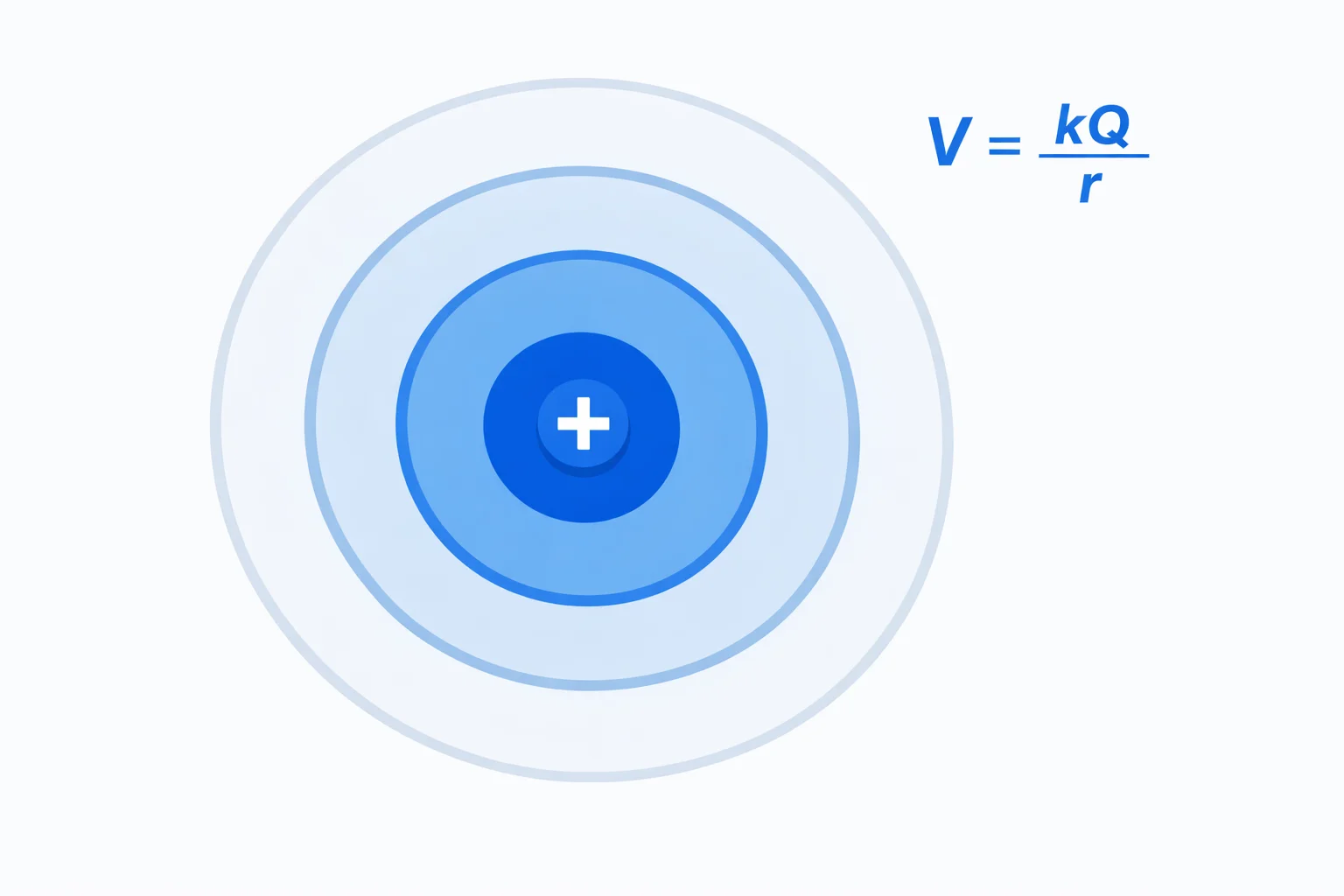
The Scalar Advantage: Why Potential Beats Field for Calculation
Electric field is a vector. To find the net field from three charges, you need to calculate each field's magnitude, determine its direction, decompose into x and y components, add those components separately, then recombine with the Pythagorean theorem. That's a lot of trig.
Electric potential? Add the numbers. Done. If charge Q1 creates +500 V at a point and Q2 creates −300 V at the same point, the net potential is +200 V. This scalar nature isn't a simplification or an approximation — it's fundamental to what potential means physically. Potential measures energy per unit charge, and energy is a scalar quantity. There's no “direction” to energy.
This is precisely why physics professors assign superposition problems using potential first. Once you're comfortable with scalar addition, the jump to vector addition for electric field calculations feels less intimidating.
The V = kQ/r Formula, Step by Step
The electric potential at a distance r from a point charge Q is:
V = kQ / r
where k = 8.99 × 10&sup9; N·m²/C² (Coulomb's constant) and ris in meters. Unlike the electric field formula E = kQ/r², potential falls off as 1/r rather than 1/r². Double the distance and the potential halves — it doesn't drop to a quarter.
Worked example: A proton sits at the origin. What's the potential 0.53 × 10&sup-10 m away (the Bohr radius of hydrogen)?
- Q = +1.602 × 10&sup-19 C
- r = 5.3 × 10&sup-11 m
- V = (8.99 × 10&sup9;)(1.602 × 10&sup-19) / (5.3 × 10&sup-11)
- V ≈ 27.2 V
That's the potential the electron “sees” in a hydrogen atom. Multiply by the electron's charge and you get roughly 13.6 eV — the ionization energy of hydrogen. Not a coincidence. The connection between potential and energy is direct.
Superposition: Adding Potentials from Multiple Charges
When multiple charges contribute to the potential at a single point, you simply add them:
V_total = V&sub1; + V&sub2; + V&sub3; + … = k Σ(Q_i / r_i)
Suppose you have a +3 μC charge 0.2 m away and a −2 μC charge 0.4 m away from point P:
- V&sub1; = (8.99 × 10&sup9;)(3 × 10&sup-6) / 0.2 = 134,850 V
- V&sub2; = (8.99 × 10&sup9;)(−2 × 10&sup-6) / 0.4 = −44,950 V
- V_net = 134,850 + (−44,950) = 89,900 V
Try that same problem for electric field and you'd need to worry about whether the fields point in the same or opposite directions, break them into components if the geometry isn't linear, and then combine. With potential, it's pure arithmetic. The Coulomb's Law calculator can help you find the forces involved, but for energy-related questions, potential is the cleaner path.
Electric Potential vs. Electric Field — Connected but Different
They're related by a derivative: E = −dV/dr. The electric field points in the direction of steepest potential decrease. Think of it like a topographic map: potential is altitude, and the electric field is slope. A ball rolls downhill (from high to low potential), and the steeper the hill, the stronger the “field.”
Key differences that matter in problem-solving:
| Property | Electric Potential (V) | Electric Field (E) |
|---|---|---|
| Type | Scalar (just a number) | Vector (magnitude + direction) |
| Units | Volts (V) = J/C | N/C = V/m |
| Distance dependence | 1/r (point charge) | 1/r² (point charge) |
| Sign | Positive or negative | Always positive magnitude |
| Superposition | Add numbers | Add vectors |
| Zero potential | Doesn't mean zero field | Zero field doesn't mean zero potential |
That last row is the source of endless exam mistakes. More on that below.
Potential Difference, Voltage, and the Work-Energy Link
In circuits, we say “voltage” but really mean potential difference: ΔV = V_A − V_B. A 9V battery maintains 9 joules of potential difference per coulomb of charge that flows through it. The work done by the electric field when a charge q moves from point B to point A is:
W = q · ΔV = q(V_A − V_B)
If ΔV is positive and qis positive, the work is positive — meaning you had to push the charge “uphill” against the field. That's exactly what a battery does: it uses chemical energy to push positive charges from low potential to high potential.
This work-energy connection is why electric potential shows up everywhere in circuit analysis. The voltage across a resistor tells you how much energy each coulomb of charge loses as it passes through. Our Ohm's Law calculator builds on this same principle — V = IR is really a statement about potential difference driving current. For the general mechanical version of work (W = Fd cosθ, where force and displacement aren't necessarily aligned), our work calculator handles any angle between force and motion.
Equipotential Surfaces and What They Tell You
An equipotential surface connects all points at the same electric potential. For a single point charge, these are concentric spheres. Two key facts about them:
- No work is done moving a charge along an equipotential surface. Since ΔV = 0 along the surface, W = qΔV = 0. This is like walking along a contour line on a topographic map — you're not gaining or losing altitude.
- Electric field lines are always perpendicular to equipotential surfaces. If they weren't, there'd be a component of E along the surface, which would mean a potential difference — contradicting the definition of “equipotential.”
Equipotential lines in a lab usually show up in electrode mapping experiments, where students use a voltmeter to trace lines of constant voltage on conducting paper. If you've done one of these labs, you've literally drawn the potential landscape of the field.
Worked Example: Finding Where Net Potential Is Zero
This problem type shows up on nearly every AP Physics E&M exam: two point charges on the x-axis, find the point where V = 0.
Setup:A +6 μC charge sits at x = 0 and a −2 μC charge sits at x = 0.4 m. Find the point on the x-axis (between the charges) where V = 0.
At a point x meters from the +6 μC charge:
- V&sub1; = k(6 × 10&sup-6) / x
- V&sub2; = k(−2 × 10&sup-6) / (0.4 − x)
- V_net = 0 → 6/x = 2/(0.4 − x)
- 6(0.4 − x) = 2x → 2.4 − 6x = 2x → x = 0.3 m
So the potential is zero at x = 0.3 m. But here's the twist that catches students: the electric field at x = 0.3 m is NOT zero.Both charges create fields pointing in the same direction there (toward the negative charge), so the fields add rather than cancel. Zero potential and zero field are different conditions — the first is a scalar equation, the second is a vector equation.
There's also a second point where V = 0, located outside the charges on the negative-charge side (at x = 0.6 m). That's because the relationship 6/x = 2/(x − 0.4) also has a solution beyond the −2 μC charge.
AP Physics Pitfalls with Electric Potential
After grading hundreds of practice exams, certain mistakes come up again and again:
- Confusing V = 0 with E = 0. Between a positive and negative charge, there's a point where potential is zero but the field is strong. Between two identical positive charges, there's a point where the field is zero but the potential is large. These are fundamentally different conditions.
- Forgetting the sign of Q in V = kQ/r. Electric field magnitude uses |Q|, but potential keeps the sign. A −5 μC charge creates negative potential everywhere around it. If you drop the sign, your superposition answer will be wrong.
- Using 1/r² instead of 1/r. This happens when students confuse the potential formula with the field formula. If your answer seems way too small at large distances, check your exponent on r.
- Thinking a grounded conductor has zero field. Grounding sets V = 0, not E = 0. A grounded sphere near a positive charge still has an induced surface charge and a nonzero field — it just has zero potential.
The pattern behind most of these mistakes is treating potential like a vector or treating vectors like scalars. Keep the distinction clear and you'll avoid the majority of errors. If you want to practice superposition with forces instead, the capacitance calculator uses similar energy concepts but in a circuit context, which can help build intuition for how potential translates to stored energy.