W = Fd cos(θ): Understanding Work in Physics from Textbook to Real Life
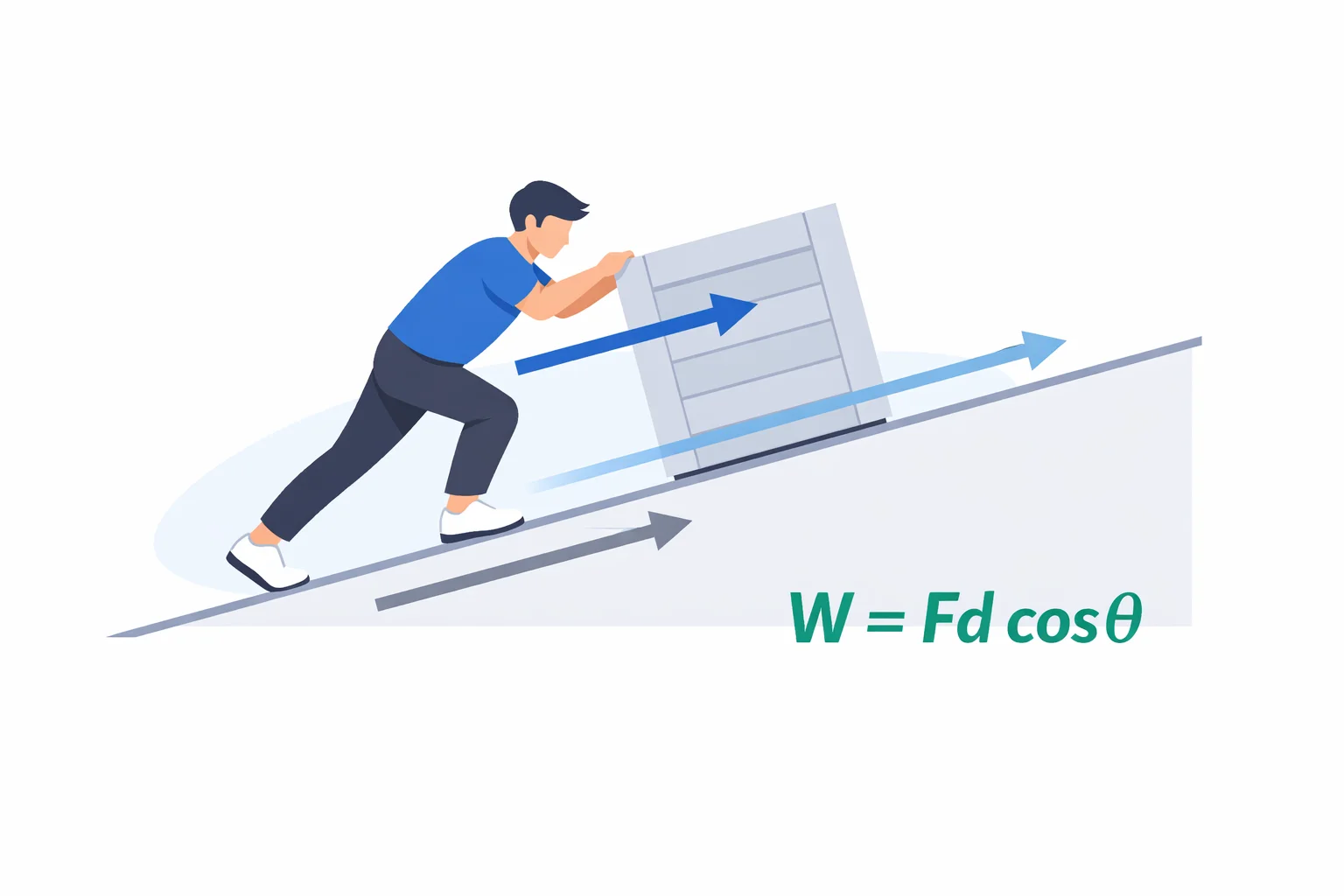
A work calculator in physics does something deceptively simple: it multiplies force by distance and then adjusts for direction. That's the whole formula \u2014 W = Fd cos(\u03B8) \u2014 and yet it trips up more students than almost any other equation in mechanics. The problem isn't the math. It's the word "work" itself. In everyday English, holding a heavy backpack for twenty minutes feels like work. In physics, the work done on that backpack is exactly zero joules if it doesn't move. Getting comfortable with that disconnect is the first real hurdle.
The Work Equation \u2014 Three Variables, One Dot Product
The equation W = Fd cos(\u03B8) packs three things into one compact expression:
- F \u2014 the magnitude of the applied force in newtons (N)
- d \u2014 the displacement (not total distance traveled) in meters (m)
- \u03B8 \u2014 the angle between the force vector and the displacement vector
The result comes out in joules (J), where 1 J = 1 N\u00B7m. Mathematically, W = Fd cos(\u03B8) is the scalar (dot) product of the force and displacement vectors: W = F \u00B7 d. That single dot product eliminates the need to break forces into components manually \u2014 the cosine handles projection for you.
One subtle point: dis displacement, not distance. If you push a box 5 meters east and then 5 meters back west to the starting point, the total displacement is zero, and the net work from your push is zero. The box ends up with no change in kinetic energy. Distance traveled was 10 m, but physics doesn't care about the scenic route.
Why Cosine? The Angle That Changes Everything
Imagine pulling a sled with a rope. If you pull perfectly horizontally, every newton of force goes into moving the sled forward. But most people naturally hold the rope at an angle. At 30\u00B0 above horizontal, only the horizontal component F cos(30\u00B0) \u2248 0.87F does work. The vertical component F sin(30\u00B0) = 0.5F just partially lifts the sled off the snow without advancing it.
By 60\u00B0, you're down to half the force actually doing work. At 90\u00B0 \u2014 pulling straight up \u2014 the work is exactly zero because cos(90\u00B0) = 0. You're lifting, not moving forward. And past 90\u00B0, the cosine goes negative, meaning the force component along the displacement opposes the motion. That's friction in a nutshell: it always acts at 180\u00B0 to displacement, so cos(180\u00B0) = \u22121 and friction always does negative work.
Worked Example: Pushing a Crate Up a Loading Ramp
A warehouse worker pushes a 40 kg crate up a 6-meter ramp inclined at 20\u00B0 to the horizontal. She pushes parallel to the ramp surface with a constant 250 N force. Kinetic friction provides 80 N opposing the motion. What's the net work done on the crate?
Step 1 \u2014 Work by the applied push. The push is parallel to displacement (along the ramp), so \u03B8 = 0\u00B0:
W_push = 250 N \u00D7 6 m \u00D7 cos(0\u00B0) = 250 \u00D7 6 \u00D7 1 = 1,500 J
Step 2 \u2014 Work by friction. Friction acts at 180\u00B0 to displacement:
W_friction = 80 N \u00D7 6 m \u00D7 cos(180\u00B0) = 80 \u00D7 6 \u00D7 (\u22121) = \u2212480 J
Step 3 \u2014 Work by gravity. Gravity pulls straight down while the crate moves along the ramp. The angle between the gravitational force (pointing down) and the displacement (along the ramp upward) is 90\u00B0 + 20\u00B0 = 110\u00B0:
W_gravity = (40 \u00D7 9.81) N \u00D7 6 m \u00D7 cos(110\u00B0) = 392.4 \u00D7 6 \u00D7 (\u22120.342) = \u2212805.3 J
Step 4 \u2014 Net work. The normal force is perpendicular to displacement (\u03B8 = 90\u00B0), contributing zero work. Adding everything up:
W_net = 1,500 + (\u2212480) + (\u2212805.3) + 0 = 214.7 J
That 214.7 J of net work goes directly into the crate's kinetic energy. If the crate started from rest, you can find its speed at the top: v = \u221A(2 \u00D7 214.7 / 40) \u2248 3.28 m/s. Notice how much of the worker's effort (1,500 J) gets eaten by friction and gravity \u2014 only about 14% goes into actual speed.
Negative and Zero Work \u2014 When Forces Fight or Ignore Motion
Negative work isn't "bad" work. It means a force is taking energy out of the system rather than adding it. Your car's brakes do negative work every time you slow down \u2014 they convert kinetic energy into heat. Air resistance does negative work on every baseball ever thrown. Without negative work, nothing would ever decelerate.
Zero work is equally important and often misunderstood. Three scenarios where work is exactly zero:
- No displacement (d = 0): Pushing against a wall, holding a weight stationary. Your muscles burn ATP, but no physics work occurs.
- Force perpendicular to motion (\u03B8 = 90\u00B0): The normal force on a book sliding across a table. Gravity on a satellite in circular orbit. The centripetal force on a car turning a corner. These forces change direction, not speed, so they transfer no energy.
- No force (F = 0): An object coasting frictionlessly through space. No force, no work, no change in energy \u2014 pure inertia.
The Work-Energy Theorem: Connecting W to Speed
Here's the payoff of understanding work: the net work done on an object equals its change in kinetic energy. That's the work-energy theorem:
W_net = \u0394KE = \u00BDmv\u00B2_final \u2212 \u00BDmv\u00B2_initial
This is incredibly powerful for solving problems. Instead of tracking accelerations and time intervals with kinematics, you can often jump straight from forces and distances to final speed. If you know the net work is 200 J and the object's mass is 5 kg starting from rest, the final speed is \u221A(2 \u00D7 200 / 5) = \u221A80 \u2248 8.94 m/s. No kinematics equations needed. You can explore the connection further with our electric potential calculator, where work per unit charge defines voltage.
Work Done by Variable Forces
W = Fd cos(\u03B8) assumes constant force. What about a spring, where force increases the more you stretch it? You need calculus:
W = \u222B F(x) dx
For a spring following Hooke's law (F = kx), integrating from 0 to x gives W = \u00BDkx\u00B2. Stretch a spring with k = 200 N/m by 0.3 meters, and you've done \u00BD(200)(0.09) = 9 joules of work. That energy is now stored as elastic potential energy, ready to launch a projectile or absorb a shock.
Graphically, work equals the area under a force-vs-displacement curve. For constant force, it's a rectangle. For a spring, it's a triangle. For complicated forces, you might need numerical integration \u2014 but the principle is always the same: area under the curve equals energy transferred.
Five Places You Calculate Work Outside a Textbook
- Structural engineering: When a crane lifts a 2,000 kg I-beam 30 meters, the work against gravity is 2,000 \u00D7 9.81 \u00D7 30 = 588,600 J. The crane motor needs to supply at least this much energy, plus losses to friction and efficiency. That number drives motor selection and energy cost estimates.
- Automotive braking:Stopping a 1,500 kg car from 100 km/h requires removing \u00BD(1,500)(27.8)\u00B2 \u2248 578,700 J of kinetic energy. The brakes do this much negative work, converting it all to heat. That's why brake discs glow orange after aggressive track driving \u2014 half a megajoule has to go somewhere.
- Exercise science:When a 75 kg person climbs a 4-meter staircase, they do at least 75 \u00D7 9.81 \u00D7 4 = 2,943 J of work against gravity. At a metabolic efficiency of about 25%, their body actually burns around 11,770 J (\u2248 2.8 kcal). That's one flight of stairs.
- Electrical work: When a charge moves through an electric field, the work done on it equals qEd cos(\u03B8) \u2014 the same formula with charge replacing mass. Voltage itself is defined as work per unit charge: V = W/q.
- Spacecraft maneuvers: A thruster producing 500 N over a 120-second burn on a spacecraft moving at 3,000 m/s does roughly 500 \u00D7 (3,000 \u00D7 120) = 180 MJ of work. But that number depends on the reference frame \u2014 one reason orbital mechanics gets complicated fast.
AP Exam Pitfalls with Work Problems
After grading hundreds of practice exams, these are the mistakes that show up over and over:
- Confusing distance and displacement. A ball thrown straight up and caught at the same height has zero net displacement. Gravity does zero net work over the full trip. Students who use the total distance traveled (2h) instead get the wrong answer.
- Forgetting the angle.If a problem says "a force of 40 N is applied at 30\u00B0 above the horizontal," you must include cos(30\u00B0). Writing W = 40 \u00D7 d without the cosine is one of the most common errors on AP Physics 1.
- Mixing up the sign of gravitational work.When an object moves upward, gravity does negative work (opposing motion). When it falls, gravity does positive work (assisting motion). Students often assign the wrong sign because they think "up is positive" applies to work too.
- Claiming the normal force does work on a flat surface.The normal force is perpendicular to the surface, and on a flat surface that's perpendicular to motion. cos(90\u00B0) = 0. The normal force does zero work. On an inclined surface this still holds \u2014 normal force and displacement along the incline remain perpendicular.
- Applying W = Fd cos(\u03B8) to non-constant forces. If the problem involves a spring or a force that changes with position, you need integration (or the area-under-the-curve approach). Plugging the average force into W = Fd works for linear force functions but not in general. The Coulomb's law calculator shows a case where force varies with distance squared \u2014 you can't just multiply a single force value by total distance.