SAT Physics Score Calculator: Scoring 75 Questions With a Quarter-Point Penalty
You've just finished a practice test out of a secondhand prep book: 52 right, 15 wrong, 8 left blank. The answer key doesn't tell you what that means, because the SAT Physics Subject Test never scored the way your school tests do. It clawed back a quarter point for every wrong answer, then pushed the result through a conversion table onto the 200-800 scale. Work it through and 52 out of 75 — a number that looks like a 69% — lands near 690, which sounds excellent right up until you learn this test's average was 667. This SAT physics score calculator runs that whole pipeline, plus the piece almost no scorer bothers with: what those 8 blanks were actually worth.
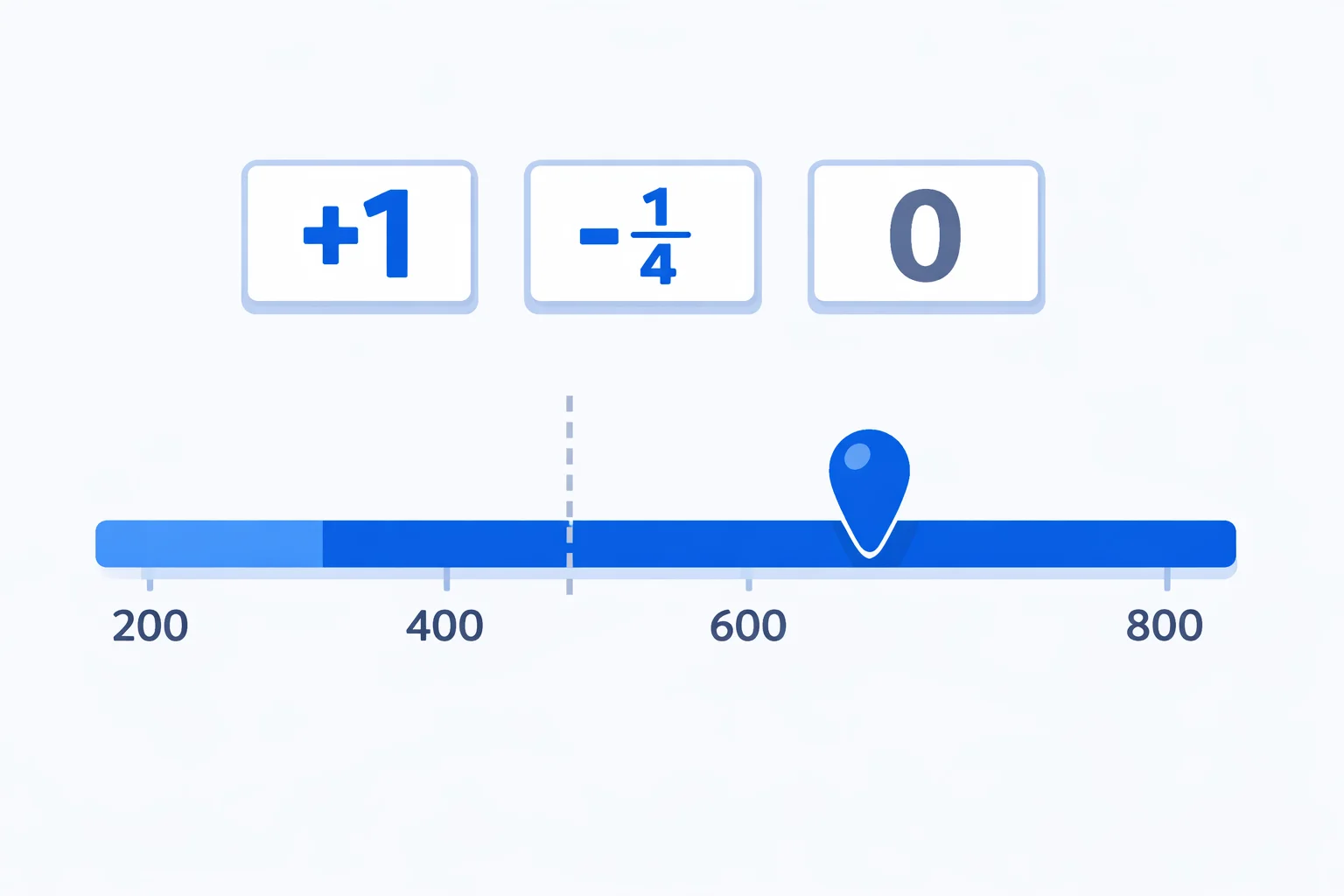
52 Right, 15 Wrong, 8 Blank: Scoring It by Hand
Three numbers go in, and they always sum to 75. Start with the rights-minus-wrongs formula College Board applied to every Subject Test:
Raw score = (number correct) − 0.25 × (number wrong)
So: 52 − 0.25 × 15 = 52 − 3.75 = 48.25. Those 15 wrong answers didn't merely fail to earn points — they handed back the equivalent of nearly four correct ones. College Board rounded that to the nearest whole number, giving a raw 48, then looked it up on the conversion table printed for that specific form. A raw 48 sat around 690.
Notice what the blanks did: nothing at all. Eight unanswered questions cost zero and earned zero, which is why they never appear in the formula. They matter only as an opportunity you either took or didn't — and whether skipping them was the right call has an exact answer.
The Quarter-Point Penalty Was Tuned to Make Blind Guessing Worth Exactly Zero
Every question offered five choices, A through E. Guess at random and you're right one time in five. Compute the expected value of that gamble:
E = (1/5)(+1) + (4/5)(−0.25) = 0.20 − 0.20 = 0.00
That is not a coincidence. A quarter is precisely the penalty that makes the odds and the cost cancel on a five-choice question — the scoring was engineered so random bubbling gained nobody anything. Which means the folk wisdom students passed around ("there's a penalty, so don't guess") had the conclusion backwards. Blind guessing cost nothing on average; all it added was variance. And the instant you could rule out even one choice, the arithmetic tipped in your favour:
| Choices eliminated | Odds of a hit | Expected raw points per guess | Value across 8 blanks |
|---|---|---|---|
| 0 | 1 in 5 | 0.000 | 0 raw — a coin flip with no edge |
| 1 | 1 in 4 | +0.063 | +0.5 raw ≈ +3 scaled |
| 2 | 1 in 3 | +0.167 | +1.3 raw ≈ +8 scaled |
| 3 | 1 in 2 | +0.375 | +3.0 raw ≈ +18 scaled |
Eliminating two choices on all eight blanks was worth roughly 8 scaled points — the gap between a 690 and a 700. Eliminating three was worth about 18, which on this test moved you from the 59th percentile to the 66th. So the sensible strategy was never "answer everything" or "skip what you don't know," but something narrower: cross out what's physically impossible, then commit. No current physics exam makes you do this math — neither the AP Physics 1 score calculator nor the IB Physics score calculator carries a penalty term, because both exams dropped rights-minus-wrongs scoring years ago. On those, a blank is strictly worse than a guess, every single time.
A 690 Here Was a Below-Average Score
The 200-800 scale was borrowed from the main SAT, where 500 is deliberately pinned near the middle of a national cohort of well over a million students. SAT Physics reused those same numbers on a completely different population. Across its final reported years the mean sat near 667 with a standard deviation around 103 — roughly 90,000 test-takers, nearly all of whom had already completed a physics course and were applying to science or engineering programs.
Model that as a normal distribution and the percentiles get uncomfortable:
| Scaled score | Standard deviations from the mean | Approximate percentile |
|---|---|---|
| 800 | +1.29 | ~90th |
| 750 | +0.81 | ~79th |
| 690 | +0.22 | ~59th |
| 667 | 0.00 | 50th |
| 600 | −0.65 | ~26th |
A 700 on the main SAT's math section put you comfortably inside the top 10%. A 700 on SAT Physics put you barely ahead of half the room. This is the most misread number in Subject Test scoring, and it's why admissions officers never treated the two 700s as equivalent — identical digits describing completely different achievements. The same selection effect runs through AP: the AP Physics C score calculator covers an exam where a far higher share of candidates earn a 5 than on AP Physics 1, not because it's easier but because only calculus-ready students sit it.
You Could Miss Nine Questions and Still Score 800
Conversion tables for this test flattened near the top. Once your raw score reached about 66, additional points bought you nothing, because 800 was the ceiling. Run the numbers on a strong performance: 68 correct, 7 wrong, 0 blank gives 68 − 1.75 = 66.25, rounding to a raw 66 — an 800 with nine questions missed outright.
That plateau changed how you should have played the clock. If you were chasing 800, the last few questions were insurance rather than a requirement, and pace mattered more than perfection — you had 48 seconds per question, and burning three minutes on a nasty rotational-dynamics item to protect a point that fell inside the plateau was a losing trade. Compare that with a system where the top has no slack at all: the Physics Regents score calculator maps a chart where each of the final 15 raw credits is worth roughly a full scaled point right up to 100, so there's no cushion anywhere near the ceiling.
The Full Range: −18.75 to 75 Raw Points
Answer all 75 questions wrong and your raw score is −18.75, which the tables floored at 200. The middle of the conversion ran close to linear at roughly 6 to 8 scaled points per raw point — so a single answer moved you by more than the 10-point reporting increment:
| Raw score | Approximate scaled score | What that answer sheet looked like |
|---|---|---|
| 66+ | 800 | 68 right, 7 wrong — the plateau |
| 60 | 765 | 64 right, 16 wrong — or 60 right with 15 left blank |
| 50 | 705 | 56 right, 24 wrong |
| 40 | 645 | 46 right, 24 wrong, 5 blank |
| 30 | 580 | 36 right, 24 wrong, 15 blank |
| 20 | 500 | 26 right — the scale's midpoint, far below this test's mean |
| 0 | 340 | 10 right, 40 wrong, 25 blank |
Every administration shipped its own table, and published forms spread about ±30 scaled points at the same raw score, which is why this calculator reports a band rather than a single confident number. Third-party prep books were looser still — generally more generous than the official tables — so read a Barron's 780 as a real 740 and you'll be closer to the truth.
75 Questions, 60 Minutes, No Calculator
One constraint shaped this exam more than any other: calculators were prohibited. Every number was engineered to fall out cleanly, which meant the test measured whether you recognised the physics, not whether you could grind the algebra. A projectile question would hand you g = 10 m/s² and an initial speed of 20 m/s precisely so the arithmetic stayed mental.
| Topic area | Share of the 75 questions | Roughly how many items |
|---|---|---|
| Mechanics | 36–42% | 27–32 |
| Electricity and magnetism | 18–24% | 14–18 |
| Waves and optics | 15–19% | 11–14 |
| Heat and thermodynamics | 6–11% | 5–8 |
| Modern physics | 6–11% | 5–8 |
| Miscellaneous — measurement, graphs, history | 4–9% | 3–7 |
Part A opened with classification questions: a single set of five answer choices reused across a small block of questions. They scored individually, which created a specific failure mode worth knowing about — a student who misread the shared answer bank could lose four or five answers in one block and hand more than a full raw point to the penalty in a single stroke.
The Test Ended in January 2021 — What the Prep Books Are Still Worth
College Board discontinued all SAT Subject Tests in January 2021, effective immediately in the United States and after the June 2021 sitting internationally. The SAT Suite now consists of the SAT alone — no physics component, and none planned. Two forces drove the decision: most universities had already dropped Subject Test requirements, and the expanded AP program covered the same ground with far more depth.
So what do you sit instead? For US applicants the answer is AP — AP Physics 1 on the algebra-based path, AP Physics C on the calculus-based one, both of which carry actual college credit that Subject Tests never did. Internationally, IB Physics HL fills the same slot. The contrast is worth making concrete:
| Dimension | SAT Physics (through 2021) | AP Physics 1 |
|---|---|---|
| Length | 60 minutes, 75 questions | 3 hours, MCQ plus free response |
| Wrong-answer penalty | −0.25 per wrong answer | None — always answer |
| Calculator | Prohibited | Permitted throughout |
| Score scale | 200–800, mean ≈ 667 | 1–5, with roughly half of candidates scoring 3 or higher |
| College credit | Never awarded | Commonly awarded for 4s and 5s |
The old practice tests keep one genuine use. Seventy-five conceptual questions in 60 minutes is the best pacing drill in physics prep, and the mechanics and circuits items map almost one-to-one onto AP Physics 1 content — you just have to ignore the scoring convention and put the calculator away.
How to Score an Old Practice Test Now
If you're working through a used prep book, score it honestly and the number still tells you something. Mark blanks separately from wrong answers — collapsing the two hides the guessing decision, which was the only strategic lever this format ever offered. Then read the accuracy figure this calculator reports next to the raw score: correct ÷ attempted. A student at 52 right and 15 wrong is running 78% accuracy on what they attempted, and that's a cleaner signal of content mastery than the scaled score, because it strips out how aggressive they were about bubbling.
Two cautions on reading the output. The conversion here is modeled on published College Board forms, and real forms varied by roughly ±30 points at the same raw score — a genuine spread, not a hedge, so any score within 30 points of a threshold you care about should be treated as unresolved. And the percentile comes from the reported mean and standard deviation rather than a real percentile table, so it's dependable in the middle and soft at the edges, where the actual distribution piles up against the 800 ceiling instead of tailing off the way a normal curve does. Neither caveat touches the raw score itself: correct minus a quarter of wrong is exact arithmetic, and it's the one part of this test's scoring that was never a matter of judgment.