Gravitational and Elastic Potential Energy: The Physics of Stored Energy
A potential energy calculator solves what might be the most counterintuitive idea in introductory physics: an object sitting perfectly still can have enormous energy. Not because it's doing anything visible, but because of where it is or how it's been deformed. A 500 kg roller coaster car at the top of a 50-meter hill stores 245,250 joules of gravitational potential energy — enough to accelerate it to 31.3 m/s (113 km/h) by the bottom of the drop, without any engine whatsoever.
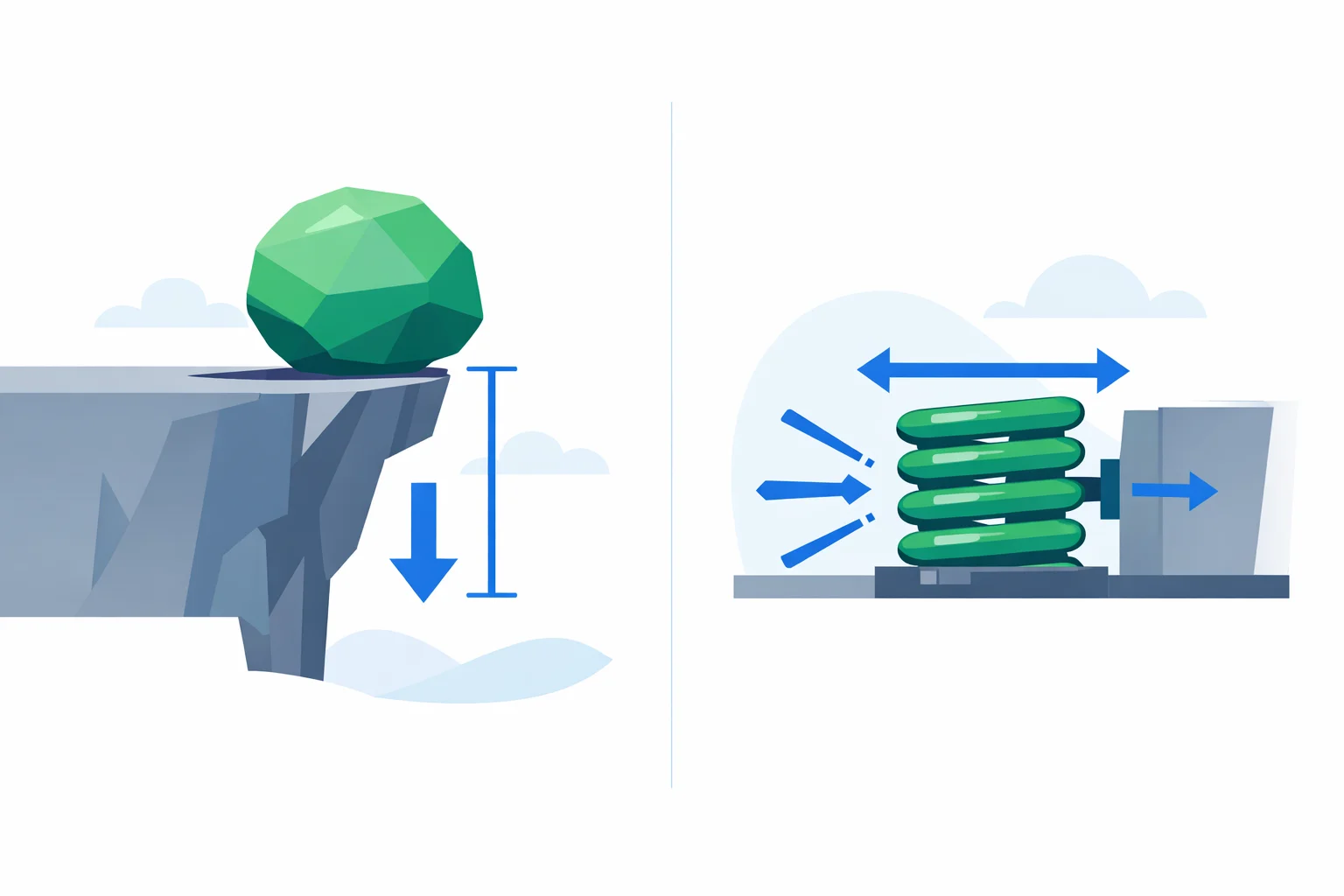
Two Forms of Stored Energy
Physics recognizes several types of potential energy, but two dominate introductory courses and engineering practice. Gravitational potential energy (PE = mgh) depends on mass, gravity, and height above a reference level. Elastic potential energy(PE = ½kx²) depends on a spring constant and how far a spring, bow, or elastic band has been stretched or compressed from its resting position.
Both share a key trait: they represent stored work that something did in the past. Lifting a barbell stores gravitational PE because your muscles did work against gravity. Pulling back a bowstring stores elastic PE because your arm did work against the spring force. Release either one, and that stored work converts to kinetic energy — a direct application of conservation of energy.
Gravitational PE: A Worked Example You Won't Forget
Forget the generic "ball on a shelf" problem. Here's one that shows up in real engineering: A hydroelectric dam holds back a reservoir where water can fall 100 meters to the turbines. How much gravitational PE does 1 cubic meter of water have?
One cubic meter of water has a mass of 1,000 kg. With g = 9.81 m/s²:
PE = mgh = 1,000 × 9.81 × 100 = 981,000 J = 981 kJ
That's nearly a megajoule from a single cubic meter of water. A large reservoir releases millions of cubic meters per year, which is why hydroelectric power works at scale. If that water fell freely (no turbine), it would hit the base at about 44.3 m/s — roughly 160 km/h. Instead, the turbine captures most of that energy and converts it to electrical power.
Notice what happens when you double the height to 200 m: PE doubles to 1,962 kJ. Height and PE are directly proportional — a linear relationship. This is different from how elastic PE behaves.
Elastic PE: Why Displacement Matters More Than You Think
Elastic PE follows PE = ½kx², and that squared term changes everything. A spring with k = 800 N/m compressed 0.08 m stores:
PE = ½ × 800 × 0.08² = 2.56 J
Compress it twice as far (0.16 m) and you get ½ × 800 × 0.16² = 10.24 J — four times the energy, not double. This is why archers draw their bows as far as possible: the last few centimeters of draw contribute disproportionately more energy than the first.
A compound bow with an effective spring constant of 350 N/m and a 0.7 m draw length stores about 85.75 J. That's enough to launch a 0.02 kg arrow at roughly 92.6 m/s (333 km/h). The same bow drawn only halfway (0.35 m) stores just 21.4 J — one quarter of the energy, producing half the arrow speed.
Choosing Your Reference Point (The Part Most Textbooks Rush)
Here's where many students lose marks: gravitational PE depends on which height you call "zero." There's no universal zero — you pick it. A 2 kg ball on a 10 m building has PE = 196.2 J relative to the ground. But if the building sits on a 50 m cliff, that same ball has PE = 1,177.2 J relative to the cliff base. Both answers are correct.
The trick: potential energy differencesare what matter physically. Drop the ball from the roof and it gains 196.2 J of kinetic energy by the time it hits ground level — regardless of the cliff below. When solving problems, pick the reference point that makes your math cleanest, usually the lowest point the object reaches.
Elastic PE dodges this complication entirely. The natural (unstretched) length of the spring is always x = 0, and PE = 0 there. No choice required.
PE to KE: The Conversion That Runs the Universe
Conservation of energy says the total mechanical energy (PE + KE) in an isolated system stays constant. As an object falls, PE decreases and kinetic energy increases by the same amount. At the bottom, KE = initial PE (minus any friction losses).
This gives you a powerful shortcut. Instead of tracking forces and accelerations along a curved roller coaster track, just set PE at the top equal to KE at the bottom:
mgh = ½mv² → v = √(2gh)
Mass cancels. A marble and a bowling ball dropped from the same height reach the same speed (in a vacuum). This result surprises students every time, and it's one of the most commonly tested relationships on the AP Physics 1 exam.
Three Mistakes That Cost Points on Physics Exams
Mistake 1: Forgetting to square the displacement in elastic PE.Students write PE = ½kx instead of PE = ½kx². The units don't even work out — ½kx gives you newtons, not joules. If your elastic PE has units of force instead of energy, you dropped the exponent.
Mistake 2: Using the wrong height in multi-step problems. If a ball rolls down a ramp and then up a loop, the height for PE is the verticalcomponent, not the distance along the ramp. A 30° ramp that's 10 m long has a vertical height of only 5 m (10 × sin 30°).
Mistake 3: Double-counting energy. In a spring-mass system on a vertical surface, students sometimes add gravitational PE and elastic PE incorrectly. Both are potential energies, but they have different reference points. Track each separately and add them for the total PE at any position.
Real-World Stored Energy: From Dams to DNA
Gravitational PE powers much of civilization's infrastructure. Pumped-storage hydroelectric plants pump water uphill at night (cheap electricity) and release it through turbines during peak demand, effectively using gravity as a battery. The Bath County Pumped Storage Station in Virginia stores about 24 GWh of energy — the equivalent of lifting 8.8 billion kilograms of water 100 meters.
Elastic PE operates everywhere at smaller scales. The tendon in your Achilles stores and releases elastic energy with every running step, returning about 35% of the energy that would otherwise be wasted. Kangaroos are even more efficient — their tendons return up to 70%, which is why they can bounce across Australia without exhausting themselves. At the molecular level, ATP synthase rotors in your cells use elastic strain energy to snap phosphate bonds into place, manufacturing the fuel your muscles burn.
When mgh and ½kx² Stop Working
The formula PE = mgh assumes g is constant, which works fine near Earth's surface where g barely changes across typical heights. But launch a satellite to orbit height (400 km) and g drops by about 12%. For those cases, you need the general gravitational PE formula: PE = -GMm/r, where r is the distance from the center of the attracting body.
Similarly, PE = ½kx² assumes an ideal (Hookean) spring where force is proportional to displacement. Real springs deviate at large deformations — a rubber band gets stiffer the more you stretch it, and a metal spring permanently deforms past its elastic limit. For non-linear springs, you'd integrate the actual F(x) curve to find the true stored energy.
For nearly all homework, lab, and AP exam problems, though, mgh and ½kx² are exactly what you need. The calculator above handles both, so plug in your values and let the math take care of itself.