KE = ½mv² Explained: Why Velocity Matters More Than Mass in the Energy of Motion
A loaded semitruck and a golf ball can carry the same kinetic energy — the truck just needs to creep forward while the ball needs to scream off the tee at 70 m/s. That single fact reveals everything you need to know about the kinetic energy formula KE = ½mv²: velocity dominates. This calculator lets you plug in mass and speed to get the energy of motion in joules, or work backwards to find the mass or velocity behind a known energy value.
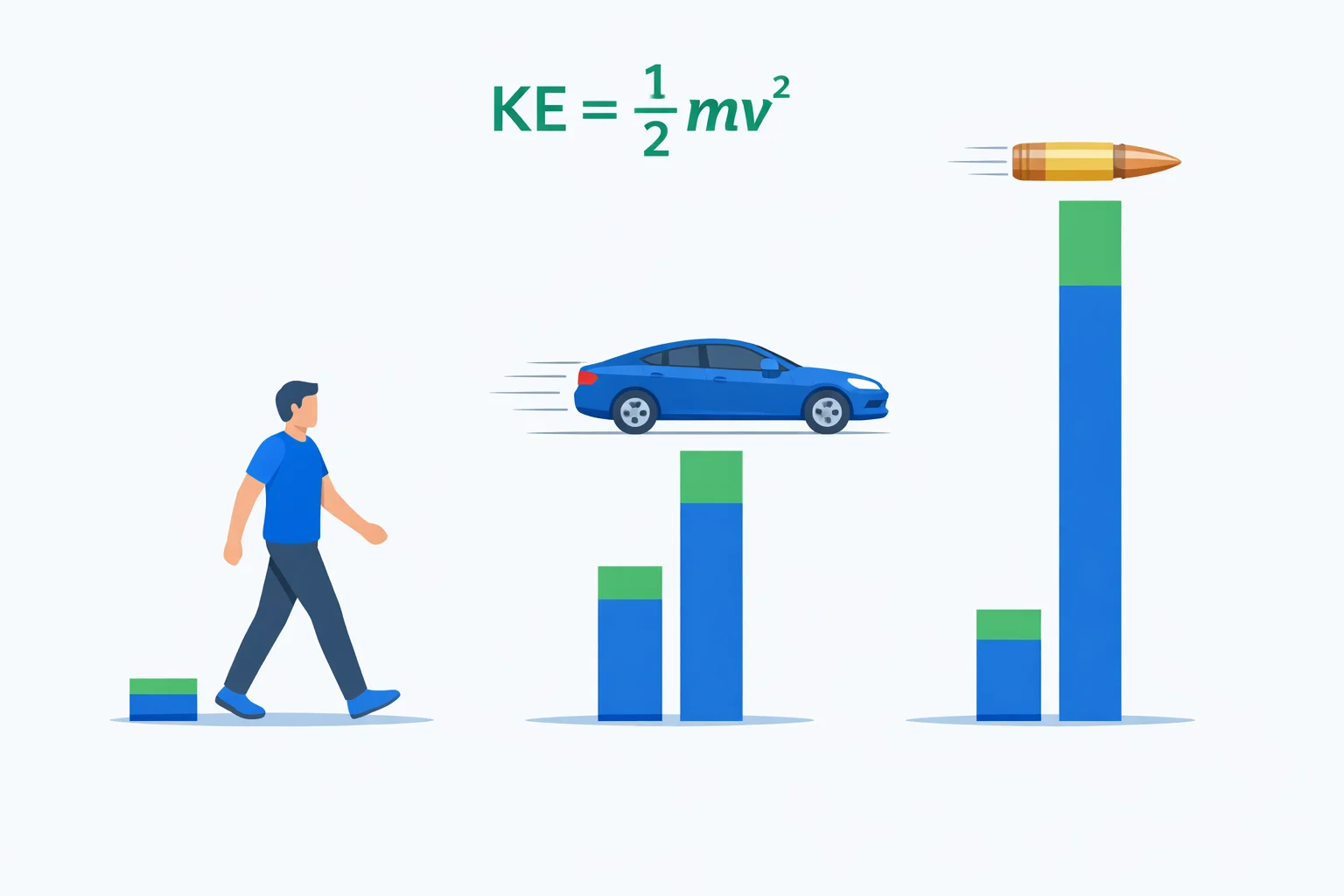
Half mv Squared — Where It Comes From
Kinetic energy didn't drop out of thin air. Start with Newton's second law, F = ma, and imagine pushing a box from rest. The work done by that force is W = Fd. Substitute a = F/m and use the kinematics relation v² = 2ad to eliminate distance, and you land on:
KE = ½mv²
The ½ isn't arbitrary decoration. It falls naturally out of integrating force over distance — the same way the area of a triangle is ½ × base × height. If you've ever wondered where the half comes from, that's the full story: calculus hands it to you automatically when you integrate mv dv from 0 to v.
Worked Example: Car vs. Bicycle
Let's compare two objects traveling at the same speed on the same road.
Car: mass = 1,400 kg, velocity = 13.4 m/s (about 30 mph)
KE = ½ × 1,400 × 13.4² = ½ × 1,400 × 179.56 = 125,692 J ≈ 125.7 kJ
Bicycle + rider: mass = 85 kg, velocity = 13.4 m/s (same 30 mph)
KE = ½ × 85 × 13.4² = ½ × 85 × 179.56 = 7,631 J ≈ 7.6 kJ
The car carries about 16.5 times more kinetic energy at the same speed — exactly the mass ratio. Now watch what happens when the car doubles its speed to 60 mph (26.8 m/s): KE jumps to ½ × 1,400 × 26.8² = 502,768 J ≈ 503 kJ. That's four times the 30-mph value, not double. The v² relationship is why highway crashes are so much more destructive than fender benders at parking-lot speeds.
Why Velocity Gets Squared
Students often ask why energy grows with the square of speed instead of linearly. Here's the intuition: to accelerate an object that's already moving fast, you cover more ground during the same acceleration. More distance at the same force means more work, which means more energy stored. Each incremental m/s of speed adds more energy than the last.
Practical consequence? A car going 100 km/h has four timesthe kinetic energy of the same car at 50 km/h. Braking distance scales the same way — which is why speed limits exist and why the stopping-distance chart in your driver's manual isn't a straight line. If you're studying for the AP exam, this is the kind of conceptual reasoning that shows up in free-response questions more often than raw computation.
Solving Backwards — Mass and Velocity from KE
The calculator above can reverse the formula in two directions:
- Find velocity: v = √(2KE / m). Useful when you know an object's energy — maybe from a net work calculation — and want the resulting speed.
- Find mass: m = 2KE / v². Less common, but relevant in ballistics or particle physics when you measure speed and energy independently.
Notice something odd: you can't recover direction from kinetic energy. Two objects moving in opposite directions at the same speed have identical KE. That's because KE is a scalar. If you need direction, you need momentum (p = mv), which is a vector.
Unit Conversions That Trip People Up
The formula KE = ½mv² gives joules only when mass is in kilograms and velocity in meters per second. Mixing units is the #1 source of wrong answers on homework and exams. Common pitfalls:
- Grams instead of kilograms: A 200 g ball is 0.2 kg. Using 200 gives an answer 1,000× too large.
- km/h instead of m/s: Divide by 3.6 to convert. 90 km/h = 25 m/s, not 90.
- mph to m/s: Multiply by 0.44704. 60 mph ≈ 26.8 m/s.
The calculator handles the math for you, but build the habit of converting first when working problems by hand. Write the conversion factor explicitly — it's faster than re-doing the whole problem after catching the error at the end.
Kinetic Energy and the Work-Energy Theorem
The work-energy theorem says the net work done on an object equals its change in kinetic energy: Wnet = ΔKE = KEfinal − KEinitial. This is arguably the single most powerful idea in introductory mechanics because it lets you skip free-body diagrams entirely for many problems. It also bridges the gap between KE and potential energy — when gravity or a spring does work on an object, the PE lost equals the KE gained. That's the conservation of energy principle in action.
Example: a 0.5 kg hockey puck sliding at 20 m/s is slowed to 12 m/s by friction. What work did friction do?
KEinitial = ½ × 0.5 × 20² = 100 J
KEfinal = ½ × 0.5 × 12² = 36 J
Wfriction = 36 − 100 = −64 J
The negative sign means friction removed energy from the puck — 64 out of 100 J lost, giving this surface an efficiency of just 36% at preserving the puck's kinetic energy. You never needed to know the friction coefficient, the distance, or the deceleration — just the before-and-after speeds. Use the power calculator if you also need to know how fast that energy transfer happened.
Real-World Numbers You Can Feel
Raw joule numbers are hard to internalize. Here are some benchmarks worth memorizing:
- 1 J — roughly the energy of dropping an apple 1 meter. Barely noticeable.
- 100 J — a fast tennis serve. Enough to sting your hand.
- 1,000 J (1 kJ) — a 90 kg person jogging at about 4.7 m/s.
- 500 kJ — a midsize car at highway speed. This is what crumple zones must absorb.
- 1 MJ — roughly the muzzle energy of a military anti-materiel rifle round. Also, roughly the energy in a small candy bar (but that's chemical, not kinetic).
- 7 GJ — a Boeing 747 at cruising speed. Equivalent to about 1.7 tons of TNT.
Where ½mv² Breaks Down
The classical kinetic energy formula is an approximation — an excellent one at everyday speeds, but it fails in three regimes:
- Relativistic speeds (above ~10% of c): Use KE = (γ − 1)mc² instead. At 0.1c, the classical formula underestimates KE by about 0.75%. At 0.5c, the error is 15%. Particle accelerators never use ½mv².
- Quantum scale: For electrons and photons, energy is quantized. A photon has energy E = hf but zero rest mass, so ½mv² doesn't apply at all.
- Rotating objects: A spinning wheel has rotational kinetic energy KErot = ½Iω² where I is moment of inertia and ω is angular velocity. If an object both translates and rotates (like a rolling ball), total KE is ½mv² + ½Iω². Forgetting the rotational part is a classic AP exam mistake.
For anything you encounter in a first-year physics course, on the road, or in everyday engineering, the classical formula works perfectly. Just know where the boundary is.