Physical Age Calculator: What Your Biological Age Says That Your Birthday Doesn't
Two people share an office and a birthday. Both turn 52 next week. One takes the stairs two at a time and sleeps like a rock; the other is winded on the walk from the parking lot and hasn't had a full night's sleep since 2019. Their driver's licenses say they're the same age, but their bodies are running on completely different clocks. A physical age calculator exists to put a number on that gap — an estimate of your biological age, the age your heart, lungs, and metabolism actually behave like, rather than the count of birthdays on file.
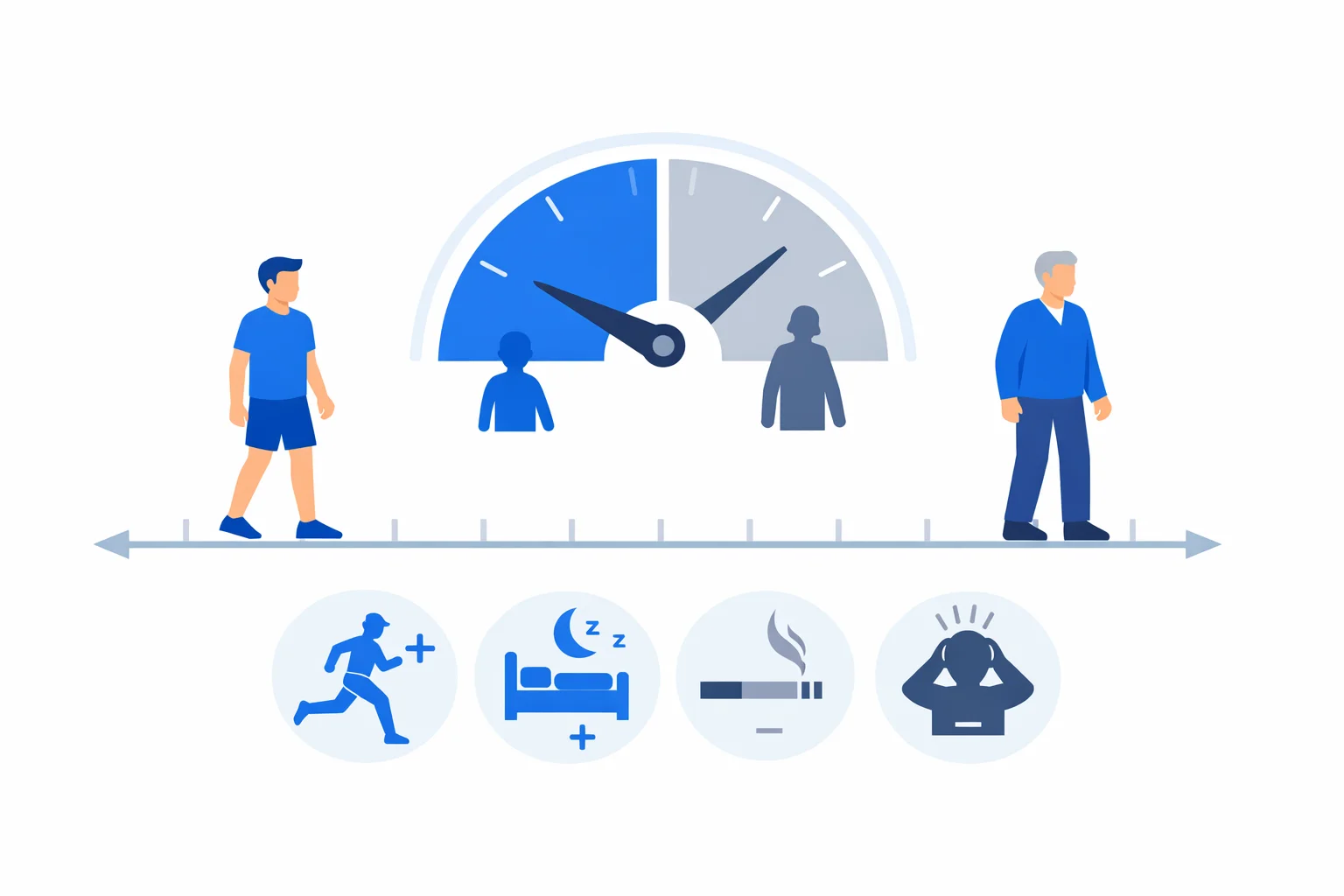
Two People, Same Birthday, Different Bodies
Here's the confusion the calculator is built to clear up: chronological age and biological ageare not the same measurement, and most people treat them as if they were. Chronological age is trivially easy — it's today's date minus your birth date, ticking up by exactly one year every year for everyone, no exceptions. Biological age is the harder, more honest question: given the wear and tear on your body, how old do you actually function? Two 52-year-olds can be a decade apart on that second scale, and that's not a metaphor — it's measurable in their resting heart rates, their VO₂ max, their blood markers, and their mortality risk.
The reason this matters more than a fun number: biological age tracks risk. Someone whose body is aging fast faces the disease profile of an older person even while their ID still reads 52. That's why researchers care about it and why a lifestyle-based estimate — the kind this tool runs — is genuinely useful. You can't change your birthday, but nearly every input that moves your biological age is something you have a hand on.
What Biological Age Actually Measures
Scientists have several ways to pin down biological age, and it helps to know where a free calculator sits among them. The gold-standard lab methods read your biomarkers directly — most famously the epigenetic "clocks" that measure DNA methylation patterns (the Horvath clock and newer pace-of-aging clocks like DunedinPACE), plus blood-based panels tracking inflammation, kidney function, and glucose control. Those tests are accurate but cost money and need a sample.
A physical age calculator takes the practical shortcut: instead of reading your cells, it reads your habits. Every input on this page — activity, sleep, smoking, weight, resting heart rate, and the rest — has a documented relationship with all-cause mortality from large population studies. Stack those known effects together and you get a defensible estimate of whether your body is running ahead of or behind the calendar. It won't match a lab clock to the decimal, but for spotting which habit is quietly aging you, it does the job for free.
Chronological vs Biological Age, Side by Side
The two ages answer different questions, and lining them up makes the distinction obvious:
| Chronological Age | Biological Age | |
|---|---|---|
| What it counts | Time since birth | Physiological wear and function |
| How it's found | Subtraction from a birth date | Biomarkers, or a lifestyle estimate like this one |
| Can it change direction? | Never — one year up, every year | Yes — it can rise or fall with your habits |
| Same for everyone born the same day? | Always identical | Can differ by 10–20 years |
| What it predicts | Eligibility, milestones, paperwork | Disease risk and how you'll feel |
Read the third row again, because it's the whole point. Chronological age is a one-way ratchet. Biological age has a reverse gear. That's the entire reason to measure it — not to feel good or bad about a number, but because the number responds to what you do next.
How This Calculator Adds or Subtracts Years
The model is deliberately transparent so you can see exactly why your number landed where it did. It starts at your chronological age, then adds or subtracts years for each factor based on its documented effect on mortality risk. Here are the adjustments this tool applies:
| Factor | Best case (subtracts) | Worst case (adds) |
|---|---|---|
| Physical activity | −2.8 yrs (300+ min/week) | +3.0 yrs (sedentary) |
| Smoking | 0 (never smoked) | +8.5 yrs (heavy current) |
| Body weight (BMI) | 0 (BMI 18.5–24.9) | +5.5 yrs (BMI 40+) |
| Alcohol | 0 (0–7 drinks/week) | +4.0 yrs (22+ drinks/week) |
| Resting heart rate | −1.0 yr (under 60 bpm) | +3.0 yrs (over 90 bpm) |
| Stress load | −0.8 yr (very low) | +2.8 yrs (severe/chronic) |
| Sleep | −1.0 yr (7–8 hrs) | +2.2 yrs (under 5 hrs) |
| Social connection | −1.2 yrs (strong ties) | +2.0 yrs (isolated) |
| Fruit & veg intake | −1.5 yrs (6+ servings/day) | +2.0 yrs (0–1 servings) |
Notice the asymmetry: the penalties are bigger than the rewards. A heavy smoker can add 8.5 years, but the best a non-smoker gets is zero, not a bonus — because not poisoning yourself is the baseline, not an achievement. The math is capped so the estimate stays within roughly 15 years below and 25 above your real age, which keeps a stack of bad habits from producing an absurd result like a biological age of 90 for a 40-year-old.
Two 52-Year-Olds, Twelve Years Apart
Back to our two colleagues. Let's run both through the model. Marcus is the stair-climber: 220 minutes of exercise a week (−1.8), 7.5 hours of sleep (−1.0), never smoked (0), a resting heart rate of 56 (−1.0), BMI of 23 (0), five servings of vegetables a day (−0.5), three drinks a week (0), low stress (−0.3), and a tight circle of friends (−1.2). Add it up: −6.8 years. His estimated biological age is about 45.
Dave sits at the next desk: no structured exercise (+3.0), 5.5 hours of sleep (+1.2), a pack-a-day habit (+6.5), resting heart rate of 84 (+1.8), BMI of 31 (+2.5), one vegetable serving a day (+2.0), fifteen drinks a week (+2.5), high stress (+1.5), and few close relationships (+2.0). His total is +23 years, but the model caps it, so his estimated biological age lands near 77. Same birthday, and the calculator puts their bodies more than three decades apart on paper.
The lesson isn't "Dave is doomed." It's that his single biggest lever — smoking, at +6.5 years — is also the most reversible. Knock out that one habit and his estimate drops toward the high 60s overnight in the model, and in real life the recovery follows within a few years. Seeing the factors ranked is what turns a vague "I should be healthier" into "quitting cigarettes is worth more than everything else combined."
Which Habits Move Your Number the Most
Not all inputs carry equal weight, and it's worth knowing where the leverage is. Three factors dominate:
- Smoking. The heaviest single penalty, and for good reason. A 2013 New England Journal of Medicine study found smokers lose roughly a decade of life expectancy — and that quitting before 40 avoids about 90% of the excess risk. No other everyday habit moves the needle this hard.
- Physical activity.The swing from sedentary (+3.0) to active (−2.8) is nearly six years, and it front-loads: the jump from zero to 150 minutes a week matters far more than going from 300 to 450. If you want to know exactly how much movement you're banking, our physical activity level calculator translates your week into a standard PAL score, and the calories burned calculator shows the energy each session adds up to.
- Social connection. The dark horse. A 2010 meta-analysis of 148 studies found weak social ties raise mortality risk about as much as smoking 15 cigarettes a day — more than obesity or inactivity. Most physical age calculators ignore it entirely, which is a mistake, so this one counts it explicitly.
Can You Actually Make Your Body Younger?
To a real degree, yes — and this is where biological age stops being a gimmick. Because the score responds to current behavior, changing the behavior changes the score. Blood pressure and resting heart rate respond to a few months of consistent cardio. Lung function partially recovers after quitting smoking. The DunedinPACE clock, which measures the speedof aging rather than a fixed age, has shown measurable slowing in people who improve diet and activity. You're not literally rewinding time, but you can slow the rate at which your body accumulates damage, and sometimes claw back a few years of function.
The practical move is to treat the calculator as a diagnostic for effort allocation. Run your real numbers, find the single factor adding the most years, and put your energy there first. For most sedentary non-smokers, that's activity. For smokers, it's always the cigarettes. Fixing your worst factor buys more biological youth than optimizing three factors that were already fine.
Where a Lifestyle Estimate Stops and a Lab Test Begins
Honesty matters here, so let's be clear about what this tool can and can't do. It's a heuristic built on population averages, which means it's good at ranking habits and rough at predicting individuals. It can't see your genetics — some people smoke into their 90s and some marathoners drop dead at 45, and no lifestyle questionnaire catches those tails. It doesn't know about a family history of heart disease, a thyroid condition, or a cancer screening you're overdue for. And it relies on your self-reported numbers, so a generous estimate of your weekly exercise flatters the result.
Use it for what it's built for: a fast, free reality check that shows which levers you control and roughly what each one is worth. If you want a true biological age measured from your cells, that's an epigenetic clock or a clinical blood panel ordered through a doctor — not a web form. But for the everyday question of "is how I'm living aging me faster than the calendar?", running your habits through this biological age calculator gives you a straight, numbers-backed answer and a clear place to start.