Your Tires, Your Blood, the Ocean Floor: One Equation Connects Them All
From a Tire Gauge to an Ocean Trench
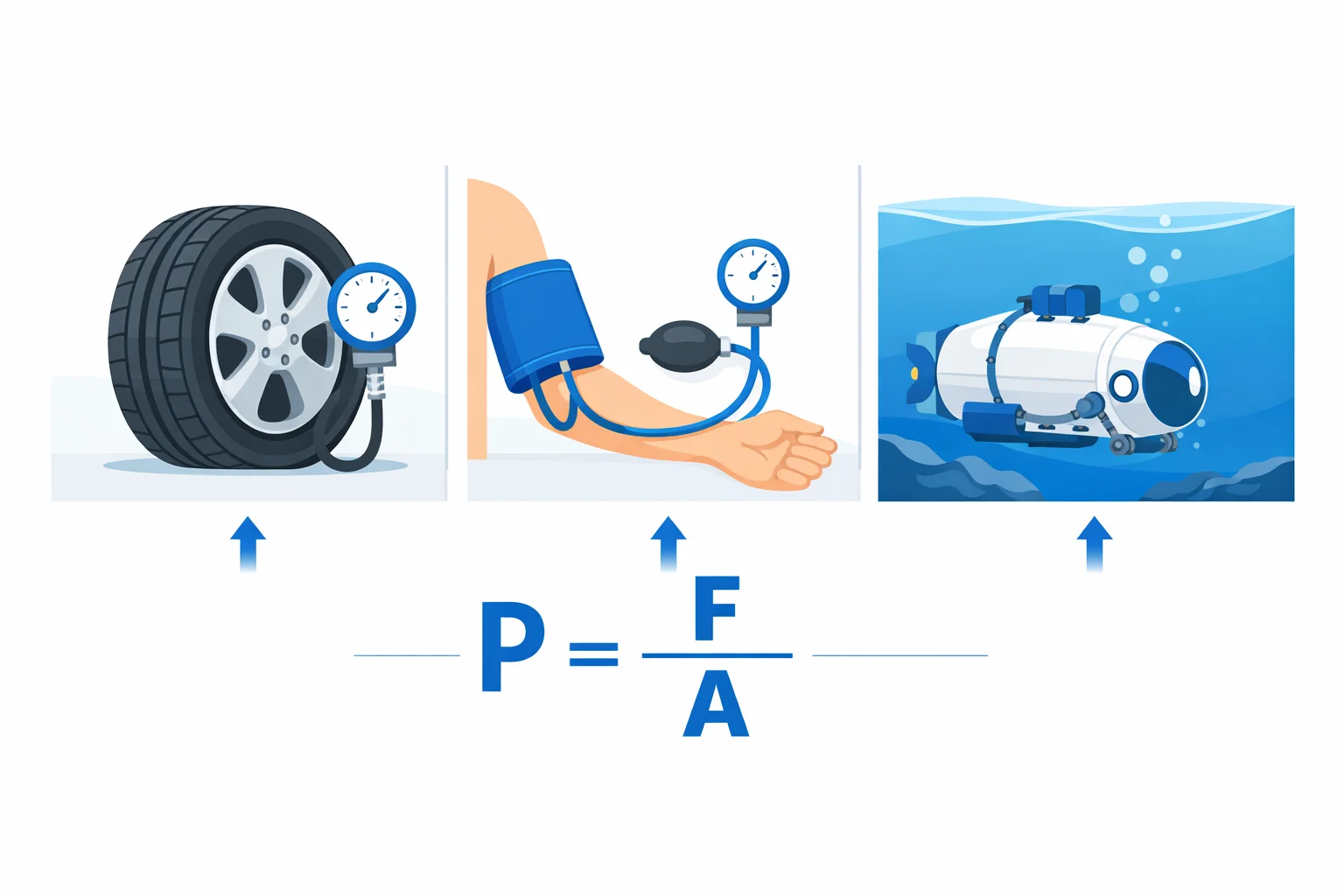
Your car's tire pressure sits around 32 psi — about 220,000 Pa pushing outward on every square centimeter of rubber. A pressure calculatorturns that single number into something you can reason about: 32 psi means roughly 2.2 atmospheres of absolute pressure, which is the same gauge pressure you'd feel at 11 meters underwater. That's not a coincidence. Pressure is pressure, whether it comes from compressed air inside a tire or a column of seawater pressing down on a diver's chest.
The equation that ties all of this together is deceptively compact: P = F / A. Pressure equals force divided by area. Three variables, one division, and it explains everything from why a nail punctures wood (small area, enormous pressure) to why atmospheric pressure doesn't crush you (your body pushes back with equal internal pressure). Let's reverse-engineer some real-world pressures to see how this formula actually works outside a textbook.
P = F/A: The Three-Variable Relationship
The SI unit of pressure is the pascal(Pa), defined as one newton per square meter. That's tiny — atmospheric pressure at sea level is 101,325 Pa, which is why kilopascals (kPa) and atmospheres (atm) exist as more practical units. The formula rearranges three ways:
- P = F / A — find pressure when you know force and area
- F = P × A — find force when you know pressure and area
- A = F / P — find the contact area when you know force and pressure
Each rearrangement solves a different class of real problems. An engineer designing a gasket needs P = F/A to ensure the seal doesn't blow. A structural engineer calculating wind load on a building facade uses F = P × A. A materials scientist testing hardness pushes a known force through an indenter and measures the imprint area — that's A = F/P in reverse.
The Stiletto vs. the Snowshoe: Why Area Matters More Than Force
Here's a number that shocks most students: a 60 kg person standing on one stiletto heel (area ≈ 1 cm² = 0.0001 m²) exerts about 5.89 MPa on the floor — nearly 60 atmospheres. That same person in snowshoes (area ≈ 0.4 m² per shoe, both feet = 0.8 m²) exerts only 736 Pa, or 0.007 atm. The force didn't change. The person weighs the same 588.6 N either way. What changed was area, and it shifted the pressure by a factor of 8,000.
This is exactly why the P in P = F/A carries so much engineering significance. You can't always control force — gravity is what it is, loads are what they are. But you can almost always control area. Every foundation, every bearing surface, every seal and gasket is an exercise in choosing the right area to produce the right pressure. Foundation footings for a house spread the building's weight over enough soil area to keep ground pressure below the soil's bearing capacity (typically 100–300 kPa for residential clay soils).
Hydrostatic Pressure: Stacking Fluid Weight
When the "force" comes from gravity pulling on a column of fluid, the basic equation specializes into the hydrostatic pressure formula: P = P₀ + ρgh. Here, P₀ is the pressure at the surface (usually atmospheric), ρ is the fluid density in kg/m³, g is gravitational acceleration (9.81 m/s²), and h is the depth in meters. Each meter of freshwater adds 9,810 Pa — about 0.097 atm — to the pressure.
Scuba divers know this instinctively. At 10 meters, gauge pressure hits 1 atm, so absolute pressure is 2 atm. At 30 meters — the recreational diving limit — it's 4 atm. The air in your lungs compresses to one-quarter its surface volume, which is why ascending too fast without exhaling causes lung overexpansion injuries. The buoyancy calculator on this site handles the related question of whether objects float or sink at a given depth, but the driving mechanism is the same: pressure increasing with depth pushes harder on the bottom of a submerged object than on the top.
Mercury's density (13,546 kg/m³) is why barometers use such short tubes. Standard atmospheric pressure supports a mercury column of only 760 mm (29.92 inches). If you tried the same barometer with water, you'd need a tube 10.3 meters tall — impractical, which is exactly why Torricelli chose mercury in 1643. Torricelli's insight also led to a famous result: the exit speed of fluid draining from a tank depends only on √(2gh), a direct consequence of Bernoulli's equation applied between the surface and the drain.
Pressure Units: A Field Guide to Pa, atm, psi, and bar
Every industry picked its own pressure unit, and none of them agreed. Here's the conversion landscape:
| Unit | Equivalent in Pa | Where You'll See It |
|---|---|---|
| 1 Pa | 1 | SI standard, scientific papers |
| 1 kPa | 1,000 | Weather reports (some countries), HVAC specs |
| 1 atm | 101,325 | Chemistry, diving tables, physics textbooks |
| 1 bar | 100,000 | European weather, industrial gauges, scuba tanks |
| 1 psi | 6,894.76 | US tire gauges, plumbing, HVAC in North America |
| 1 mmHg | 133.32 | Blood pressure, laboratory vacuum systems |
| 1 inHg | 3,386.39 | US aviation altimeters, weather barometers |
The lack of a universal pressure unit is a genuine source of engineering errors. The Mars Climate Orbiter was destroyed in 1999 partly because one team used pound-force-seconds while another expected newton-seconds — a unit mismatch in impulse (force × time), which is tightly coupled to pressure calculations in thruster design. Always double-check which pressure unit a specification demands before plugging numbers in.
Worked Example: Force on a Dam Floodgate
A rectangular floodgate on a dam is 4 m wide and 3 m tall. The water level reaches the top of the gate. What total hydrostatic force pushes against it?
This isn't a simple P × A problem because pressure varies with depth. At the top of the gate (depth = 0), gauge pressure is zero. At the bottom (depth = 3 m), it's ρgh = 1000 × 9.81 × 3 = 29,430 Pa. The average pressure on the gate is half the maximum: Pavg= 29,430 / 2 = 14,715 Pa. Now you can use F = P × A:
F = 14,715 Pa × (4 m × 3 m) = 14,715 × 12 = 176,580 N≈ 176.6 kN
That's about 18 tonnes of force on a gate the size of a large garage door. And this is only 3 meters of water — major dam gates face 50+ meters of head, producing forces in the meganewton range. The work calculator can then tell you how much energy it takes to open that gate against this force over its travel distance.
When P = F/A Stops Working
P = F/A assumes pressure is uniformly distributed across the area, and that the force acts perpendicular to the surface. Both assumptions break in several real scenarios:
- Non-uniform loading: A column on soft soil doesn't distribute force evenly — edges bear more load than the center (this is why foundation engineering uses bearing capacity formulas, not just P = F/A).
- Moving fluids: Once fluid flows, pressure becomes direction-dependent. Static pressure, dynamic pressure (½ρv²), and total pressure are all different quantities. Bernoulli's equation handles this — P = F/A doesn't.
- Compressible gases at high speed: Above about Mach 0.3, gas density changes significantly with pressure, and the simple ρgh formula underestimates pressures. Compressible flow equations (isentropic relations) take over.
- Molecular scale: At very low pressures (below ~1 Pa), gas behavior shifts from continuum to molecular flow. The concept of "pressure" as a smooth field breaks down because individual molecule impacts become statistically sparse.
None of this means P = F/A is wrong — it's an exact definition. But the assumptions you bring to a problem (uniform distribution, perpendicular force, static fluid, incompressible flow) determine whether the formula gives you a useful answer or a misleading one. The power calculator is useful when you need to go beyond static pressure and calculate the rate of energy transfer in pressurized systems doing work over time.
Pressure at Extreme Scales: Diamonds and Neutron Stars
At the mild end, a party balloon holds about 1.01 atm inside — barely above atmospheric. A car tire sits at roughly 2.2 atm. A scuba tank stores air at 200 atm. Industrial hydraulics run at 200–700 atm. Waterjet cutters hit 6,000 atm, generating enough pressure to slice through armor plate.
Then things get extreme. Diamond anvil cells in materials science labs squeeze samples between two gem-quality diamonds to pressures exceeding 3,700,000 atm (375 GPa). At these pressures, hydrogen becomes a metal. At the center of Earth, pressure reaches about 3,600,000 atm. At the core of a neutron star? Roughly 1028atm — a number so large that the "atoms" themselves collapse into a soup of neutrons packed together at nuclear density. Pressure is, quite literally, the force that shapes the structure of matter across the entire universe.